

When nearby text starts to look blurry, one thought often comes first: “Is this presbyopia?” And the next word typed into the search box is often “lutein.”
To start with the conclusion, it is difficult to say that lutein reverses presbyopia. That does not mean lutein is meaningless. Lutein is discussed more often in relation to macular health, especially in the area of age-related macular degeneration, than presbyopia.
If you choose a supplement without understanding this difference, your expectations may not match reality. Trouble seeing nearby text and health issues in the central retina may both sound like “eye” problems, but their actual causes are different.
Why Does Presbyopia Happen?
Presbyopia is usually noticed from the 40s onward. Smartphone text seems farther away, and books feel more comfortable when held a little farther from the eyes.
The American Academy of Ophthalmology explains presbyopia as a process in which the lens inside the eye becomes harder with age. When we are young, the lens changes shape smoothly. That is how the eye can focus on both near and distant objects.
As we age, however, the lens loses elasticity. Its ability to focus on nearby objects also weakens. This change is presbyopia.
Here is the important point. Presbyopia is mainly a problem of the lens’s focusing ability. Lutein, on the other hand, is usually discussed in connection with the macular area of the retina.
What Is Lutein More Closely Related To?
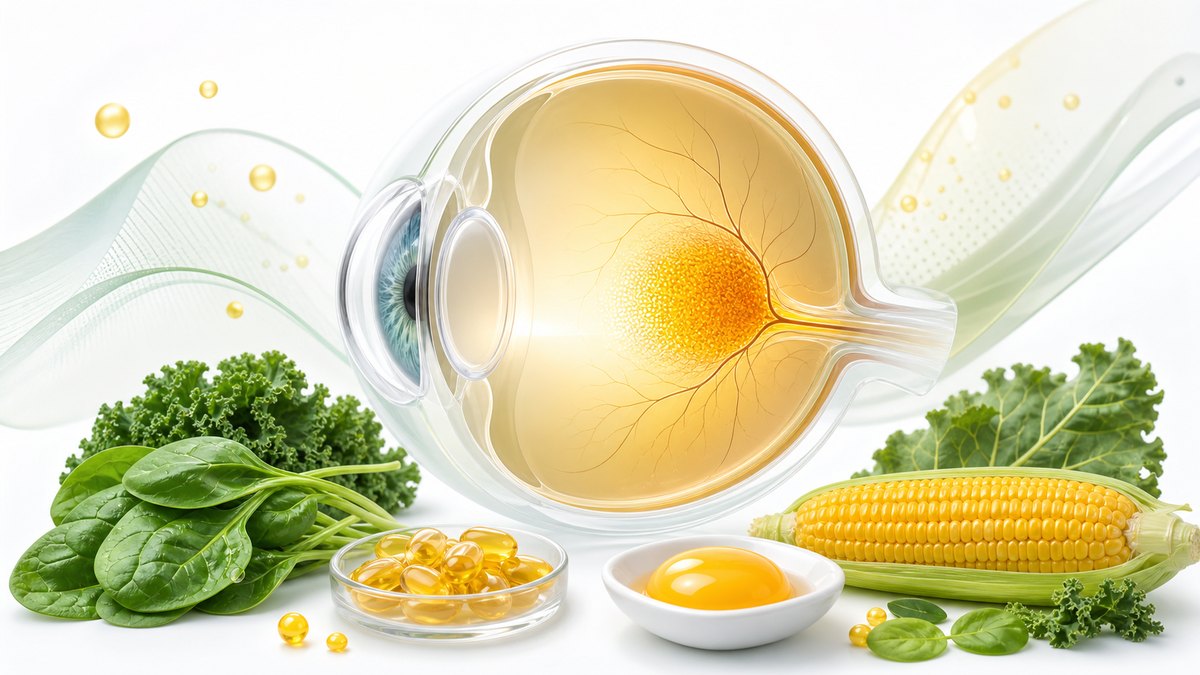
Lutein and zeaxanthin are carotenoids found in the macula of the eye. The macula is important for reading letters, recognizing faces and seeing fine details straight ahead.
That is why lutein research is usually closer to the question “Does it support macular health?” than “Does it make nearby text easier to see?”
The evidence cited especially often comes from the AREDS and AREDS2 studies by the U.S. National Eye Institute. These studies looked at whether specific combinations of vitamins and minerals could slow the progression of age-related macular degeneration.
The AREDS study showed that a specific supplement combination could slow progression in moderate or more advanced macular degeneration. AREDS2 also studied a formula that used lutein and zeaxanthin instead of beta-carotene.
However, this should not be interpreted as “lutein treats presbyopia.” The focus of the research is macular degeneration, not presbyopia.
5 Criteria for Judging the “Effect of Lutein on Presbyopia”

1. If the Problem Is Nearby Text, Vision Correction Comes First
If the main issue is blurry nearby text, an eye exam should come before lutein. Reading glasses, progressive multifocal lenses, contact lenses and some medication or surgical options are discussed as presbyopia correction choices.
Supplements are not a way to directly restore focusing ability. So if presbyopia is causing discomfort, it is more realistic to check your current refractive status and whether any eye disease is present through an ophthalmology visit or an optometry exam.
2. If There Is a Risk of Macular Degeneration, the Conversation Changes
Age-related macular degeneration is a condition in which central vision becomes blurry or distorted. It is different from presbyopia, where small text is simply hard to see up close.
The U.S. National Eye Institute discusses dietary supplements in the area of AMD treatment and management. A Cochrane review also summarizes that AREDS-type antioxidant vitamin and mineral supplements may slow progression to late AMD.
People with intermediate AMD, in particular, may be more likely to expect benefit from supplements than people with early AMD. In other words, the point is not “anyone can take it for prevention,” but rather “decide after checking the condition of the macula with an eye doctor.”
3. Look at the Ingredient Combination, Not Just the Product Name
Rather than choosing based only on lutein as a single ingredient, you should look at the formula. AREDS2-type combinations include lutein, zeaxanthin, vitamin C, vitamin E, zinc and copper.
Amounts and combinations vary by product. Some products are closer to general eye-health supplements, while others emphasize an AREDS2-style formula. Even if they are all called “lutein,” their intended purpose may differ.
Smokers and former smokers should be especially cautious with products containing beta-carotene. The Cochrane review explains that beta-carotene has been associated with an increased risk of lung cancer, and that this risk was found mainly in former smokers.
4. Food Intake Should Be Considered Too
Lutein is found in green and yellow vegetables. Kale, spinach, broccoli, corn and egg yolk are often mentioned.
Taking an eye supplement cannot completely replace eating habits. Rather, vegetable intake, not smoking, UV protection, blood pressure and diabetes management, and regular eye exams should go together.
Supplements are closer to tools that fill gaps in lifestyle habits. If you expect them to work like a medicine that fixes presbyopia, you are likely to be disappointed.
5. If Symptoms Change Suddenly, Medical Care Comes Before Supplements
Presbyopia often progresses slowly. However, if the center of your vision looks distorted, straight lines appear bent, or vision in one eye suddenly drops, you should not dismiss it as simple presbyopia.
These symptoms may also be related to macular degeneration, retinal problems, cataracts, glaucoma, diabetic retinopathy and other conditions. You should see an eye doctor before choosing a supplement.
Who Might Consider Lutein, and Who Should Be Careful?
Lutein is widely used as a general eye-health supplement. Getting lutein through foods is a relatively natural choice.
Supplements, however, depend on the individual situation. If you have already been diagnosed with macular degeneration or have a family history, it is better to consult an eye doctor about whether an AREDS2-type combination is appropriate.
On the other hand, if the whole issue is “nearby text is blurry, so I think presbyopia has started,” expectations should be lowered. It is difficult to say that lutein alone will remove the need for reading glasses.
People who are pregnant or breastfeeding, taking medications such as anticoagulants, or using several supplements together should also check for overlapping ingredients. Eye supplements may contain zinc, vitamin E, copper and other ingredients in addition to lutein.
So What Is the Conclusion?
If the question is whether lutein is effective for presbyopia, the answer requires caution. The evidence that it improves presbyopia itself is weak. That is because presbyopia is a problem of lens elasticity and focusing ability.
However, lutein is meaningfully discussed in the areas of macular health and age-related macular degeneration. Especially in diagnosed cases such as intermediate AMD, an AREDS2 formula may be reviewed together with an eye doctor’s guidance.
So before buying, it is better to reframe the question this way.
If you are taking it “to fix presbyopia,” you should lower your expectations. If you are asking, “Is this a situation where macular health management is needed?” then the decision should be based on the results of an eye exam.
You can also continue reading health, policy and everyday decision-making articles in the Life Economy & Policy article collection.
FAQ
If I take lutein, can I avoid using reading glasses?
It is difficult to see it that way. The core issue in presbyopia is a decline in the lens’s focusing ability. For discomfort with nearby text, correction methods such as glasses or lenses should be considered first.
Does lutein help prevent macular degeneration?
It is difficult to say that the same preventive effect has been proven for everyone. However, the AREDS and AREDS2 studies and Cochrane reviews discuss supplement combinations that may slow the progression of intermediate or more advanced AMD. Checking your individual macular condition comes first.
When is it best to take lutein?
The basic rule is to follow the product instructions. Because it is a fat-soluble ingredient, many products are taken with meals. However, you should check for overlap with medications you are taking and ingredients in other supplements.
Is a higher lutein dose always better?
Higher is not automatically better. Rather than dose alone, you should consider the purpose, formula, your individual eye condition, smoking history and existing diseases together.
If my eyes feel dim or blurry, should I buy lutein right away?
It is safer to check the cause first. It may be simple presbyopia, but cataracts, macular degeneration, dry eye, diabetic retinopathy or other causes may also be involved.
References
- American Academy of Ophthalmology, What Is Presbyopia?
- National Eye Institute, Age-Related Eye Disease Studies AREDS/AREDS2
- National Eye Institute, Age-Related Macular Degeneration
- Cochrane, Do antioxidant vitamin and mineral supplements slow down the progression of AMD?