
# Why Even Cafes with 100 Million Won in Monthly Sales Fail: Small Business Is a Game of Structure, Not Revenue
100 million won in monthly sales.
For someone preparing to open a cafe or restaurant, it sounds like a fairly clear goal. It is easy to assume that at that level of sales, the owner should at least have a stable amount of money to take home.
But in the video Knowledge Inside, Knowledge Guest: Hap-seok EP.11, CEO Yoo Jung-soo and tax accountant Lee Jang-won tell a slightly different story. Sales may look large, but the amount that actually remains can be much smaller than expected.
The core point is simple. Self-employment is not a game of revenue. It is a game of cost structure, commercial district, branding, cash flow, and exit criteria.
Why 100 million won in monthly sales is not a number you can relax about
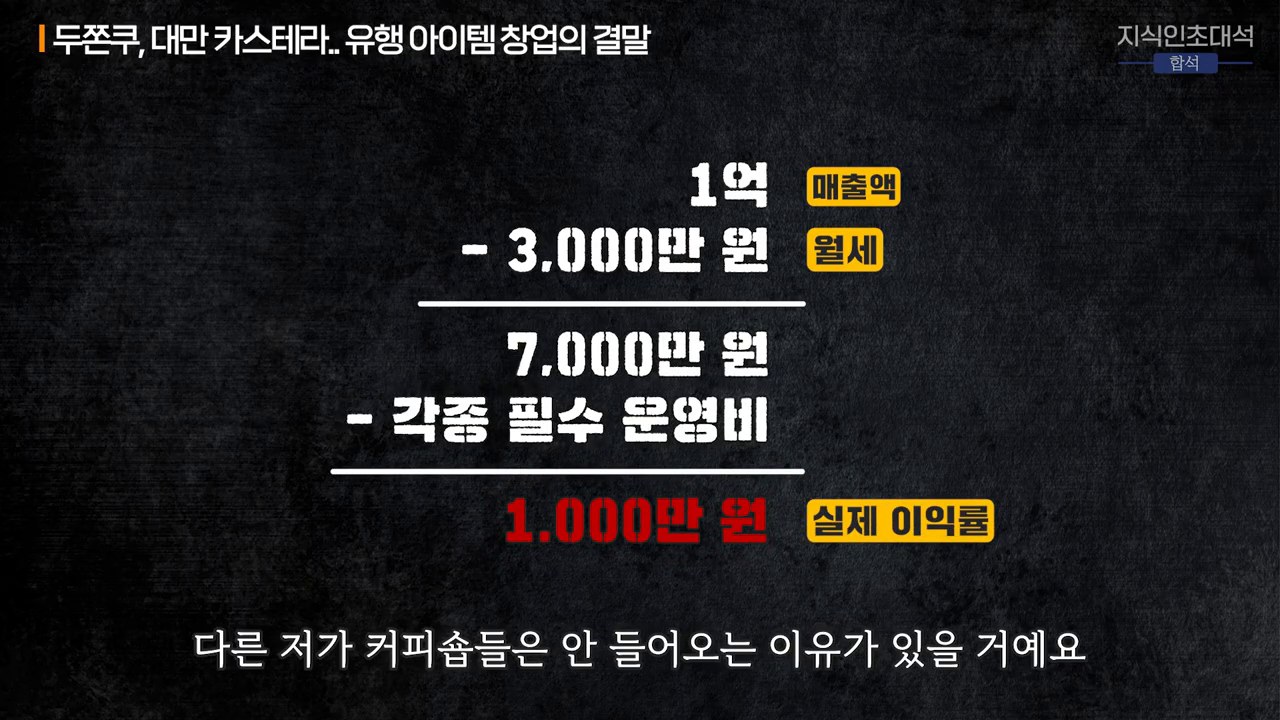
One of the most striking moments in the video is the explanation of the profit-and-loss structure of a cafe with 100 million won in monthly sales.
Even if there is 100 million won in revenue, it is not all the owner’s money. Rent goes out, and ingredient costs are deducted. Employee wages, Korea’s four major social insurances, and retirement allowance reserves also need to be considered. If delivery accounts for a meaningful share, platform fees are deducted as well. Value-added tax and comprehensive income tax remain after that.
So while the figure of 100 million won in sales looks big on the surface, actual profit can become much smaller. This is especially true in commercial districts with high rent.
The numbers a founder should look at first are not sales. They are the following.
- Gross margin
- Cost-of-goods ratio
- Labor-cost ratio
- Rent as a share of sales
- Delivery-fee share
- Value-added tax and income-tax burden
- The owner’s own working hours and true labor cost
If even one of these is missed, the store can look as if it is doing business while being structured so that no money remains.
The self-employment market is far more crowded than it looks
The video also points to structural problems in Korea’s self-employment market. Cafes and restaurants in particular have low barriers to entry. With training, equipment, and a lease, people can start relatively quickly.
The problem is precisely that low barrier to entry.
When stories spread that someone is making money, similar stores quickly multiply. Trend-driven items such as Dubai chocolate, a specific dessert, or low-cost coffee spread even faster. For consumers, this can be fun. For founders, it is a market where competitors appear almost instantly.
In this market, “I’ll be fine if I just work hard too” is not enough. There are already too many people working hard. That is why the more important question is this:
Why should customers come back to my store?
Trendy items create a first visit, but they do not guarantee a return visit
Menus that become hot on social media are powerful. They photograph well, spread easily as short videos, and can draw first-time visits.
But a first visit and a repeat visit are different.
The video explains the risk of items that are strong only in buzz. If consumers experience something once and have no reason to return, they quickly move somewhere else. Founders may see early opening sales and become certain of success, but a few months later sales can drop sharply.
When starting a business around a trend item, at least three questions must be examined.
- Is there a reason it will still sell after the trend ends?
- Will differentiation remain even if competitors copy it?
- Is there a reason a customer who came once will come again?
If you cannot answer these questions, social-media buzz is unlikely to become a lasting source of strength.
A memorable store lasts longer than a merely good store
The point CEO Yoo Jung-soo emphasizes is branding. Here, branding is not only a matter of logos or interiors. It is a question of what scene remains in the customer’s mind.
People do not remember every store in detail. Instead, they remember one scene: a cafe strongly associated with the feeling of rain, a shop with a distinctive installation at the center of the space, or a restaurant with one clearly defined signature menu.
There are many good stores. There are many delicious stores. But there are few memorable stores.
Before opening a business, you should not ask only “What will we sell?” You also need to ask, “In what one sentence will customers remember our store?”
Many stores are in the red once the owner’s labor cost is counted
There is one cost that is often left out in self-employment: the owner’s own labor cost.
The owner stays in the store all day, manages the kitchen, takes orders, handles inventory, and closes the shop. If that time is not counted as a cost, the business can look as if it is working.
The problem begins there. If the owner rests, the store becomes unstable. If the owner hires staff, costs rise. So the owner keeps enduring it personally. In the end, the structure can become one in which the owner puts in money and time while little cash remains.
The profit-and-loss statement of a self-employed business must include the owner’s labor cost. Only then can you see whether the business is truly making money.
Closing is also a strategy: the later you quit, the bigger the cost becomes
Another important piece of advice in the video concerns criteria for closing down.
Closing a business is not simply shutting the doors. The remaining lease term, demolition costs, loans, unpaid wages, inventory disposal, and tax issues all follow. That is why the thought “If I just hold on a little longer, it will improve” can increase losses.
When starting a business, it is easy to create only a success scenario. In reality, however, you also need a failure scenario.
- After how many consecutive months of losses will you change the structure?
- At what amount of accumulated loss will you stop?
- What numbers will you check before taking on additional loans?
- At what point before the lease ends will you make a decision?
Without these criteria, the store may look alive, but in reality it can keep eating away at the owner’s cash flow.
A checklist you must review before starting a business

The conclusion of the video is not “Do not start a business.” More precisely, it is “Do not start without understanding the numbers and the structure.”
If you are preparing to open a business, you should be able to answer at least the questions below.
1. Have you met people who have survived in the same industry for at least seven years?
The video advises meeting at least three people who have survived for a long time in the relevant industry. The words of actual survivors are often sharper than startup lectures.
2. Have you calculated the cost-of-goods ratio and labor-cost ratio yourself?
You need real numbers, not a rough feeling. Menu-by-menu costs, disposal rate, peak-time staffing, the four major social insurances, and retirement allowances must all be included.
3. Have you checked what percentage of sales goes to rent?
A good commercial district can generate sales. At the same time, it can take away profit through high rent.
4. Have you looked at delivery sales again on a net-sales basis?
Delivery orders make sales look larger. But once commissions, advertising costs, and packaging costs are deducted, the money left changes.
5. Is the business structured to run without the owner?
If the store stops the moment the owner steps away, it is closer to high-intensity self-employed labor than to a business. At least over the long term, you need to consider whether systematization is possible.
The real question this video asks
Saying that even a cafe with 100 million won in monthly sales can fail is not meant to scare people away from self-employment.
Rather, it raises more realistic questions.
Am I looking at revenue, or am I looking at profit? Am I looking at a trend, or at a repeat-visit structure? Am I only thinking about enduring, or do I also have criteria for stopping?
Self-employment has romance. The appeal of creating your own space, your own menu, and your own brand is real. But that romance must stand on numbers. When the numbers collapse, good taste and good ideas are hard to sustain for long.
If you are considering starting a business, it is better to create a cost-structure table before writing a sales target. It is also wise to meet people who have survived for a long time in the same industry. The more uncomfortable their stories sound, the more necessary they may be before you actually open.
Recommended reading
- Innovative Small-Business AI Adoption Support: Eligibility, Support Scale, and Pre-Application Checklist
- E-Commerce Industry Outlook 2024–2025: Market Changes and PEST Analysis
- Jeju Tourism Industry Outlook 2026: Crisis and Survival Strategy PEST Analysis
FAQ

If monthly sales are 100 million won, how much does a cafe owner actually take home?
There is no fixed answer. It depends on rent, cost-of-goods ratio, labor costs, delivery fees, and tax structure. The key point of the video is that you must calculate the actual profit left over, not focus on the 100 million won in sales itself.
What number should I look at first before opening a cafe?
Before sales targets, you should look at the cost-of-goods ratio, labor-cost ratio, rent share, value-added tax, delivery fees, and the owner’s own labor cost.
Should I avoid starting a business with a trendy dessert or social-media menu?
It does not mean you must never do it. But you need to confirm whether there will still be a reason for repeat visits after the trend ends, and whether differentiation will remain even if competitors copy it.
When should I decide to close if the business is losing money?
It depends on the industry and situation, but it is important to decide the loss limit and decision point before you start. If you decide only after the money runs out, your options shrink.
Do food-and-beverage founders have to understand the kitchen?
The video emphasizes that the owner needs to understand the core skills and kitchen structure. That is how the owner can control costs, quality, employee dependency, and supplier risk.
References
Image source: the captured images used in this article are used as quoted images from the original YouTube video for review, commentary, and educational purposes. Image copyrights belong to the original rights holders and the channel.