It is hard to describe the most popular dramas of the first half of 2026 with a single one-line ranking. The drama with the highest TV rating, the drama watched heavily on Netflix, and the title people say they are “enjoying most these days” are not always the same.
So this article separates the criteria. The main benchmark is Gallup Korea’s monthly preference survey for “favorite broadcast/video programs.” TV ratings reports and Netflix performance are added as supporting indicators. To give the conclusion first: the drama that felt like No. 1 in the first half of 2026 was the Netflix web drama Teach You a Lesson.
Start with the criteria: the ratings No. 1 and the felt-popularity No. 1 are different
The reason drama rankings differ from source to source is simple. TV ratings strongly reflect people who watched on television at a scheduled broadcast time. OTT rankings, by contrast, reflect binge-watching immediately after release and global viewing. Gallup Korea’s preference survey goes beyond platform and time slot, capturing the impression a program leaves in respondents’ minds.
For that reason, it is safer to read “the most popular dramas of the first half of 2026” through the following lenses.
National preference: titles that recorded high percentages in Gallup Korea’s monthly preference survey
TV ratings: titles that achieved high nationwide ratings on terrestrial, general-programming, or cable channels
OTT performance: titles with strong viewing numbers and weekly rankings on platforms such as Netflix
Online buzz: titles that drew large news, community, and search reactions immediately after broadcast or release
Combining these criteria into one score may look neat, but it can be misleading. The ranking below therefore centers on each drama’s peak in Gallup Korea preference and adds supporting evidence next to each title.
Top 7 most popular K-dramas in the first half of 2026
Rank
Title
Key evidence
How to read it
1
Teach You a Lesson
No. 1 in Gallup Korea’s June preference survey with 10.7%. Also strong in reports on Netflix’s first-half global viewing numbers.
The OTT hit that effectively dominated the latter part of the first half.
2
The Grand Prince’s Wife in the 21st Century
No. 1 in Gallup Korea’s May preference survey with 5.1%. Episode 9 was reported at 11.7% nationwide TV rating.
A terrestrial Friday-Saturday drama that was strong in both ratings and preference despite divided opinions.
3
Brilliant Days
No. 1 in Gallup Korea’s January preference survey with 4.5%.
A title that showed the steady audience power of weekend dramas.
4
Rookie Employee Chairman Kang
No. 2 in Gallup Korea’s June preference survey with 3.4%.
A title that lifted the felt popularity of TV dramas in late June.
5
We Prescribe Love
Joint No. 3 in Gallup Korea’s June preference survey with 3.0%.
A weekend-drama-style contender that stayed in the rankings throughout the first half.
5
Brave New World
Joint No. 3 in Gallup Korea’s June preference survey with 3.0%.
A Friday-Saturday drama whose attention rose around its finale period.
5
Scarecrow
Joint No. 2 in Gallup Korea’s May preference survey with 3.0%.
A title that showed presence among Monday-Tuesday dramas.
The reason the table has a joint fifth place is that several titles recorded the same 3.0% preference level. Rather than forcing an artificial order, it is more accurate to group titles that showed the same level of popularity.
No. 1 Teach You a Lesson: a drama where preference and OTT results exploded together
When discussing dramas from the first half of 2026, the first title to examine is Teach You a Lesson. It ranked No. 1 in Gallup Korea’s June survey with 10.7%. Considering that few dramas have exceeded 10% preference since 2013, that is a notably strong figure.
Its OTT performance was also large. According to a Media Today report, Teach You a Lesson recorded 48.2 million views within one month of release and was also mentioned around sixth place in Netflix’s first-half global viewing ranking. In other words, it captured both domestic preference and global OTT consumption.
Thinknote has also published an MBTI analysis of the characters in Teach You a Lesson. If this ranking article shows the drama’s overall popularity, the character article lets you continue into why Na Hwa-jin and Im Han-lim drew such strong reactions.
No. 2 The Grand Prince’s Wife in the 21st Century: a case where harsh criticism and high ratings coexisted
The Grand Prince’s Wife in the 21st Century is an interesting case. It received plenty of harsh comments online, but measured by indicators, it has to be included among the representative dramas of the first half. It ranked No. 1 in Gallup Korea’s May survey with 5.1%, and Sports Kyunghyang reported that episode 9 recorded 11.7% nationwide and 11.9% in the Seoul metropolitan area according to Nielsen Korea.
This drama shows that “a well-reviewed drama” and “a widely watched drama” are not always the same. In pop-culture rankings, artistic evaluation and viewing/preference indicators need to be read separately.
No. 3 Brilliant Days: the January standout that showed the power of weekend dramas
Brilliant Days ranked No. 1 in Gallup Korea’s January survey with 4.5%. Even if it did not create the explosive online reaction of an OTT hit, weekend dramas still have a strong fixed audience.
That is why a title like this can easily be left out if first-half popularity is viewed only through OTT buzz. Conversely, if you look only at TV ratings, the impact of new OTT releases can be underestimated. This is exactly why the criteria are separated in this article.
After the top four: June was competitive for TV dramas
In June, Teach You a Lesson took an overwhelming No. 1 spot, but TV dramas were not weak. In Gallup Korea’s June survey, Rookie Employee Chairman Kang ranked second with 3.4%, while We Prescribe Love and Brave New World were jointly third with 3.0%.
The titles in this range look less like a single long-running front-runner and more like weekend and Friday-Saturday dramas dividing their own audience groups. So if you choose “the best single title of the first half,” Teach You a Lesson leads. But if you include dramas people steadily watched on TV, the ranking becomes much more complicated.
What changes if we look only at OTT?
By OTT standards, Teach You a Lesson stands out the most. Immediately after its June release, it hit No. 1 in domestic preference and was strongly mentioned in reports on Netflix global viewing numbers. In April, Bloodhounds Season 2 entered Gallup Korea’s top 20, and in March, Lady Dua appeared in the top 10.
The important shift here is that the hit cycle for dramas has become shorter. In the past, success centered on accumulating ratings across the broadcast period. Now, buzz concentrates in the first one or two weeks after release, and the result appears immediately in preference surveys and global viewing numbers.
If we look only at TV ratings, The Grand Prince’s Wife in the 21st Century matters more
By TV ratings, The Grand Prince’s Wife in the 21st Century gains more weight. A nationwide rating in the 11% range is a notable figure for a 2026 first-half miniseries or Friday-Saturday drama. Its 2049 rating, a key indicator among younger viewers, was also reported at 5.1%.
However, TV ratings are strongly affected by time slot, channel, and whether the title is a weekend drama. So being No. 1 in TV ratings does not necessarily mean being No. 1 in OTT popularity or online buzz.
What was the most popular drama in the first half of 2026?
When Gallup Korea preference and OTT performance are considered together, it is most natural to view Teach You a Lesson as No. 1. It ranked first in Gallup Korea’s June survey with 10.7% and was also strongly mentioned in reports on Netflix global viewing numbers.
Why is this ranking different from a TV-ratings ranking?
TV ratings mainly count people who actually watched during a TV broadcast time. Gallup Korea preference and OTT performance reflect a broader mix of platform, viewing time, and buzz. The same drama can therefore rank differently depending on the criterion.
Why is The Grand Prince’s Wife in the 21st Century ranked high despite mixed reviews?
Evaluation and popularity indicators are different. The Grand Prince’s Wife in the 21st Century drew criticism, but its No. 1 Gallup Korea preference result in May and reported nationwide ratings in the 11% range provide enough basis to place it near the top for the first half.
Does the No. 1 title change if we look only at OTT dramas?
If the focus is OTT, the lead of Teach You a Lesson becomes even clearer because it received strong responses in both domestic preference and global viewing numbers immediately after release.
Is this an official integrated ranking?
No. This is not an official integrated ranking. It is a comparison of publicly available data by criterion, centered on Gallup Korea preference peaks and supplemented with TV ratings and OTT performance.
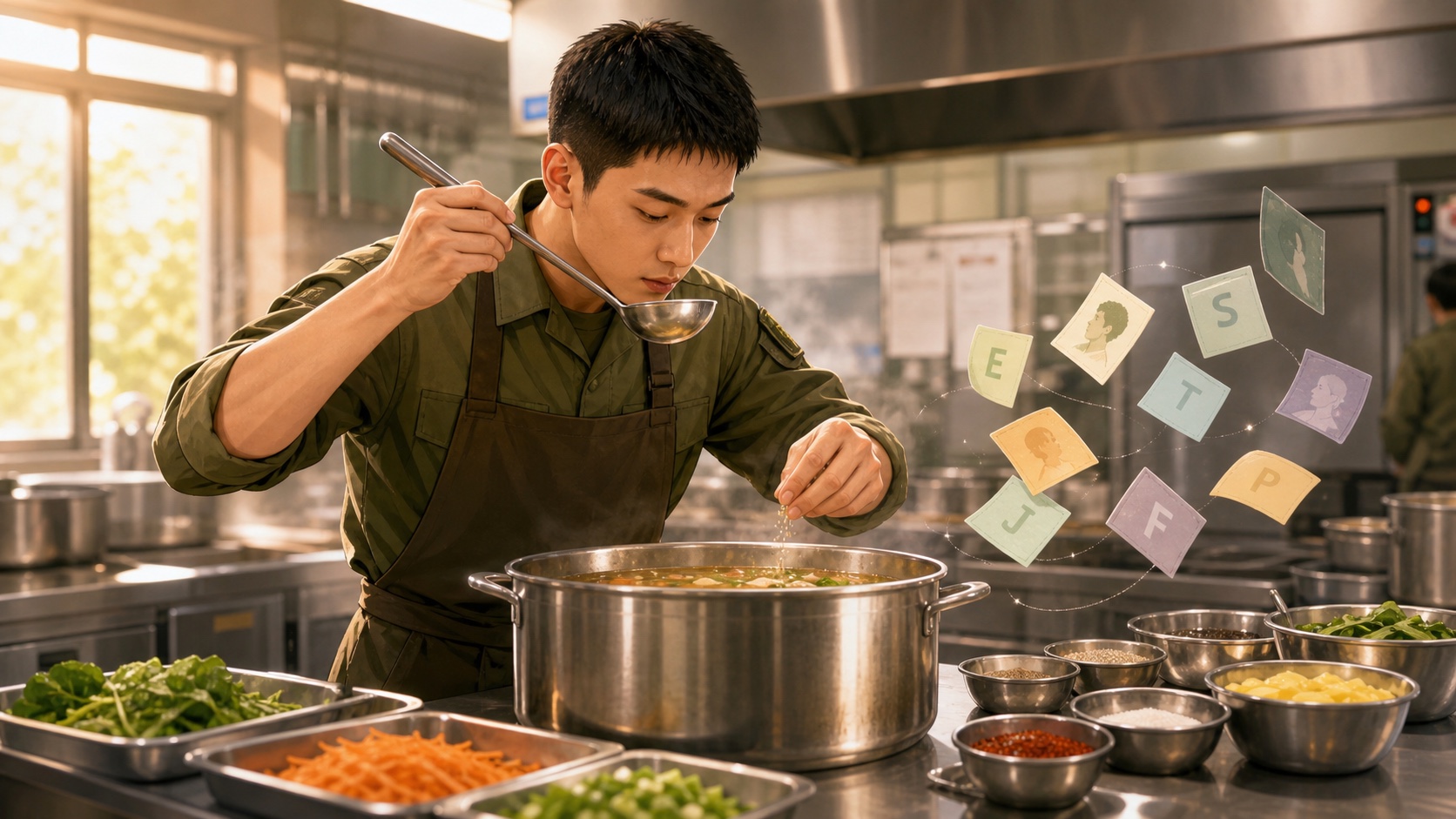
Kang Sung-jae’s growth is revealed less through grand declarations than through the feel in his fingertips and the rhythm of repeated days.
The Perspective of This Article
This article is a character reading of TVING’s original drama The Legend of the Kitchen Soldier through the lens of MBTI. Here, MBTI is not a tool for evaluating the actors or any real people. It is closer to a lens for examining what fictional characters notice first, how they endure, and how they form relationships in the unfamiliar space of the military.
The Legend of the Kitchen Soldier combines the military, cooking, and growth fantasy, just as its promotional phrase suggests: “a kitchen knife instead of a rifle, an apron instead of a cartridge belt.” Private Kang Sung-jae encounters a new role as a kitchen soldier inside the closed order of the military, and within that role he gradually creates his own ability and place. That is why the characters in this drama are difficult to explain with simple labels such as “kind,” “strong,” or “by the book.”
This article focuses on Kang Sung-jae, Jo Ye-rin, the senior kitchen soldier, and the ambitious officer. The goal, however, is not to force four letters onto each character. The more important question is why they move in such different ways when faced with the pressures of food, rules, recognition, and survival.
Quick Conclusion: MBTI Summary of the Main Characters
Character
This Article’s Reading
Alternative Possibility
Confidence
Core Reason
Kang Sung-jae
ISFP
INFP
67%
A growth-oriented survivor who endures a harsh reality while making a place for himself through sensation and hands-on skill.
Jo Ye-rin
ESTJ
ISTJ
64%
An “FM” platoon-leader type who values rules, responsibility, and order on the ground.
Senior kitchen soldier
ESFJ
ESTJ
58%
A practical helper who manages the unit’s meals, people, and daily rhythm.
Ambitious officer
ENTJ
ESTJ
57%
A command-organization figure who reads the internal board in terms of promotion and performance.
Kitchen team
Mixed-type team
—
55%
A structure in which sensation, rules, survival, and the desire for recognition collide and produce growth.
This table is a starting point for enjoying the drama. In The Legend of the Kitchen Soldier, the key question is not “who is more capable?” but “who creates a place for themselves, and by what method?” Kang Sung-jae quietly endures and then grows through the feel in his hands. Jo Ye-rin holds a disordered field together through rules and responsibility. The senior kitchen soldier understands the rhythm of daily life, while the ambitious officer calculates performance and position inside the organization.
Even within the same military kitchen, sensation, rules, care, and ambition move in different ways.
Before Reading It Through MBTI: The Characters in The Legend of the Kitchen Soldier Are “Everyday Survival” Characters
The characters in The Legend of the Kitchen Soldier are less like grand war-hero archetypes and more like everyday survival characters. The setting is the military, and the core space is the kitchen. The military is a place with clear rules and hierarchy, while the kitchen is the place within it that takes responsibility for the rhythm of each day. People become sensitive when they are hungry, and meals can change the atmosphere of an entire unit. In this drama, then, food is not just a prop. It becomes a language of relationships and recognition.
This is also why Kang Sung-jae is interesting. He does not appear from the beginning as an overwhelming leader or a fully formed genius. Based on the public introduction, he is a private who has just been transferred into the unit, a young man who has lived tenaciously through a tough reality. That kind of person encounters unexpected quests and opportunities through cooking in the military and begins to grow. This premise creates a tension that is well suited to an MBTI reading.
In a military space, personality often becomes sharper than usual. Some people cling to rules. Some read other people’s moods. Some calculate results. Some prove themselves by doing the work directly with their hands. The Legend of the Kitchen Soldier shows precisely these differences through the genre devices of cooking and fantasy.
For that reason, this article looks less at one specific scene and more at repeated choices. How Kang Sung-jae learns under pressure, how Jo Ye-rin protects order, how the senior kitchen soldier connects people with the rhythm of meals. What the ambitious officer calculates first inside the organization.
Kang Sung-jae’s MBTI: Close to ISFP, a “Survivor Who Grows Through His Fingertips”
Kang Sung-jae’s Repeated Actions and Judgment Criteria
At first glance, Kang Sung-jae may look like a growth-protagonist who simply receives a lucky opportunity. But if we see him only as “a soldier who becomes good at cooking,” we miss what matters. Kang Sung-jae’s core lies in his attitude. Rather than making grand plans, he learns the task in front of him with his body and creates a place for himself.
TVING’s official description presents Kang Sung-jae as a private who is reborn as a “legendary kitchen soldier.” The Naver Webtoon original introduction also refers to “an opportunity to become the legendary kitchen soldier, arriving like a ray of light in an anxious military life.” This setup shows. Kang Sung-jae is not a character who initially tries to change the world. He is someone who grasps a small possibility inside an anxious reality.
The first repeated trait Kang Sung-jae shows is learning through sensation. He reads as someone who grows through doing, tasting, failing. Adjusting again, rather than through abstract theory. The subject of cooking itself strengthens this tendency. Food cannot be understood only in the head. The strength of the flame, the rhythm of knife work, the subtle difference in seasoning. People’s reactions all have to be learned through the body.
His second trait is endurance: he does not easily show that he dislikes something. In articles from the production presentation, Kang Sung-jae is introduced as a diligent and sincere young man who lives tenaciously even amid a harsh reality. This prevents us from reading him as merely impulsive. Even if he wants to move freely, he is closer to someone who first shoulders today’s portion of work.
In relationships, Kang Sung-jae reads as a person who shows his heart through action rather than exaggerating it through big words. In the space of the kitchen, he persuades less by speech and more by putting food on the table and receiving reactions through results. Even when he wants recognition, he is likely to prove his existence by making one proper meal rather than directly demanding acknowledgment.
Under pressure, Kang Sung-jae does not command the whole board from the start. He moves his body and adapts. That is why he reads as ISFP-like. I is not passivity, but a direction of organizing emotion internally. S is the sensory attention to concrete realities such as the ingredients, the time, and people’s immediate reactions. F is not illogic, but a tendency to include personal values and human responses in judgment. P does not mean the absence of planning. It means adjusting with hands and senses to match a changing field.
There is still room to see Kang Sung-jae as INFP. If we look only at the structure of a young man from a poor background discovering his own possibility and moving toward the narrative of the legendary kitchen soldier, an INFP-style growth arc also feels natural. But this article gives slightly more weight to ISFP. Kang Sung-jae’s change is proven less by expanding ideals or concepts in words and more through the sensory act of cooking inside the real constraints of the military.
Ultimately, Kang Sung-jae is closer to “a person who changes his life through small changes at his fingertips” than to “a person who talks about a great dream.” His ISFP-like side is not looseness, but survival instinct. Through making one proper meal, rather than through grand slogans, Kang Sung-jae learns. He, too, can become necessary to someone.
A character like Jo Ye-rin tries to rebuild a chaotic field through rules and responsibility.
Jo Ye-rin’s MBTI: Close to ESTJ, an “FM-Type Character Who Sets the Field Straight”
Jo Ye-rin’s Sense of Rules and Way of Taking Responsibility
Public articles refer to Jo Ye-rin as an “FM platoon leader.”. Phrase alone already reveals something of her basic texture. An FM-type character is not simply a rigid person. It is someone who believes that when rules collapse, the field collapses. In a military setting, that tendency inevitably becomes even more visible.
Jo Ye-rin’s first trait is that she sees order first. If Kang Sung-jae is a person who adapts through sensation in unfamiliar situations, Jo Ye-rin reads as a person who first establishes standards and tries to protect them. She quickly checks who should do what. Procedures must be followed, and which lines must not be crossed.
Her second trait is placing responsibility ahead of personal emotion. A character like Jo Ye-rin does not easily set aside rules just because she feels sorry for someone. On the surface, she may look cold or stiff. But seen more deeply, that strictness is not meant to harass people. It is closer to the responsibility of holding the field together so accidents do not happen.
In relationships, Jo Ye-rin is likely to deal with people through standards rather than praise. Even if she likes someone, she will not simply protect that person unconditionally. She will look at whether they properly perform the role they have been assigned. As Kang Sung-jae grows, Jo Ye-rin may come to acknowledge him not merely as a new private but as a functioning member of the field. That recognition will probably be closer to a judgment. “he did it” than to warm words.
In conflict, Jo Ye-rin prioritizes procedure and responsibility rather than impulsive emotional reactions. This is where she reads as ESTJ-like. E does not simply mean talkativeness; it indicates a direction of directly intervening in external situations to establish order. S is attention to current rules, reports, and actual conditions on the ground. T is not coldness but a tendency to ground judgment in role and responsibility. J is a way of organizing and fixing an unstable situation.
There is also room to see Jo Ye-rin as ISTJ. If the drama emphasizes her quietly maintaining regulations and duties more than leading people from the front, an ISTJ reading would be persuasive. Considering the publicly presented image of an FM platoon leader and the role of managing a military field, however, this article gives slightly more weight to ESTJ.
It is not enough to see Jo Ye-rin’s ESTJ-like side merely as strictness. She is less a character who uses rules to control people and more a character who believes people will not collapse if rules are in place. In her relationship with Kang Sung-jae, then, the key is not emotional opposition but the standard of growth. Jo Ye-rin observes how well Kang Sung-jae performs while also checking whether his ability is connected to responsibility within the field.
The Relationship Between Kang Sung-jae and Jo Ye-rin: When ISFP Meets ESTJ
Relationship Point
Kang Sung-jae’s Tendency
Jo Ye-rin’s Tendency
Possible Conflict or Complement
Way of growing
Learns by doing and by sensation
Sets standards and procedures first
One side may feel frustrated, the other uneasy.
Expression of responsibility
Results and actions more than words
Rules, roles, and standards
They may recognize each other’s sincerity late.
Crisis response
Adjusts flexibly to the field
Restores disordered structure
When sensation and discipline meet, they become a strong team.
Way of seeking recognition
Proves that he is needed
Evaluates role performance
Trust accumulates before praise.
The relationship between Kang Sung-jae and Jo Ye-rin is interesting because the two see the same field from completely different directions. Kang Sung-jae learns with his hands; Jo Ye-rin judges by standards. What matters to Kang Sung-jae is how to save this one meal right now. What matters to Jo Ye-rin is whether. One meal functions properly inside the order of the unit.
At first, this difference can look like conflict. Kang Sung-jae may feel Jo Ye-rin’s standards are rigid. Jo Ye-rin may view Kang Sung-jae’s flexibility as unstable. When Kang Sung-jae achieves a result by sensory improvisation and. Result collides with procedure, their standards of judgment can easily clash.
Yet that very difference becomes a complement. Kang Sung-jae’s ISFP-like sensation gives life to Jo Ye-rin’s ESTJ-like order. Jo Ye-rin’s standards keep Kang Sung-jae’s talent from scattering as mere luck or impulse. With sensation alone, the field becomes unstable; with rules alone, food loses its vitality. When the two are together, the drama’s two axes—cooking and the military—come alive at the same time.
Relationally, Jo Ye-rin can become both a wall and a standard for Kang Sung-jae’s growth. Kang Sung-jae can show Jo Ye-rin that even within rules, a sense that saves people is necessary. Their relationship is less a simple opposition or attraction than a process in which each person’s method is tested in the field.
So the core of these two is not that they “fit well.” They need each other precisely because they are different. If Kang Sung-jae shows Jo Ye-rin a flexible instinct for survival, Jo Ye-rin shows Kang Sung-jae the moment when ability turns into responsibility. The growth narrative of The Legend of the Kitchen Soldier gains its strength from this difference.
Senior Kitchen Soldier MBTI: Close to ESFJ, a “Practical Helper Who Knows the Rhythm of Rice and People”
The senior kitchen soldier is likely to be one of the roles most closely connected to Kang Sung-jae’s growth. Although official materials have not disclosed enough detailed character names, the nature of the kitchen as a space makes this role more than just “a senior soldier.” He is closer to an everyday manager who knows the unit’s meals, schedule, people’s moods. The nagging realities of the field.
The reason this character reads close to ESFJ is. He sees people and daily rhythms together. A military kitchen is not a place where good taste alone solves everything. Meals must come out on time, fill many people’s stomachs. Account for hygiene, portions, and atmosphere. A person who handles all of this is likely to be someone who does not miss people’s reactions.
The senior kitchen soldier’s first trait is reading the field through experience. Rather than moving only by a rulebook, he knows when actual unit members become sensitive. Foods they respond to, and which mistakes lead to big problems. This reads as S-like: he sees the meal. Has to function today and the physical condition of people now, rather than grand possibilities.
His second trait is managing relationships through daily life. An ESFJ-like person does not necessarily express emotion only through soft words. Sometimes care appears as nagging, checking in repeatedly, or everyday phrases like “Did you eat?” The way a senior kitchen soldier treats Kang Sung-jae is likely to be less about grand theory and more about teaching him how to endure on the ground.
In conflict, he may also look like an ESTJ. If he emphasizes kitchen order, hygiene, and punctuality, he can read as a strict manager. But this article gives slightly more weight to ESFJ. The heart of a kitchen is feeding people. That work cannot be completed by rules alone. People’s tastes, atmosphere, stamina, and morale all matter together.
The senior kitchen soldier is not simply a person who teaches Kang Sung-jae technique. He is the person who shows him what rice—or a meal—means inside a unit. Therefore, his ESFJ-like side is not merely “being kind.” It is more naturally read as the ability to care for people and maintain an organization’s emotional temperature through the repetition of daily life.
Ambitious Officer MBTI: Close to ENTJ, an “Organization-Type Character Who Calculates Performance and Promotion”
Public articles from the production presentation mention an officer role who charges forward for success. This type of character is likely to create a contrasting axis to Kang Sung-jae’s growth within The Legend of the Kitchen Soldier. If Kang Sung-jae develops his ability in order to survive, the ambitious officer moves toward higher status and results inside the organization.
The reason this character reads close to ENTJ is strong goal orientation. A character who reads as ENTJ-like is not simply ambitious. He reads the board of the organization, calculates where results must be produced. Tries to move people and situations toward a target. In the hierarchical space of the military, this tendency becomes even more visible.
The first trait is seeing results first. Good intentions may matter less than visible performance. The kitchen, the atmosphere of the unit. Kang Sung-jae’s ability may not be seen only as they are. Interpreted in terms of “how does this affect my position and the organization’s evaluation?”
The second trait is reading relationships as resources. An ENTJ-type character is not necessarily cold toward people. However, such a character often sees role, ability, and usefulness before emotion. As Kang Sung-jae’s talent becomes visible, this officer may see. Possibility less as something to cheer for purely and more as a card inside the organization.
In conflict, this character tries to organize the board rather than soothe emotions. He first calculates who will take responsibility, what report will go up, and what result will remain. This is where he reads as ENTJ-like. E is the energy of directly intervening in external situations. N is the sense of seeing opportunities and the larger board beyond the current event. T is not cold-bloodedness, but a judgment standard that prioritizes performance and structure. J is the method of organizing situations toward a goal.
ESTJ is also possible. If the emphasis is on promotion, regulations, hierarchy. Practical evaluation within the organization, ESTJ also fits. But this article gives slightly more weight to ENTJ. This character appears not merely to preserve existing rules. To move the board for his own rise and performance.
The ambitious officer can create an uncomfortable tension in the drama. But a character like this is necessary if Kang Sung-jae’s growth is not to remain merely an improvement in cooking skill. His ability can be hope to some people and a tool of performance to others. This tension becomes visible through such a character.
Kitchen Team Analysis: A Space Where Sensation, Rules, Daily Life, and Ambition Meet
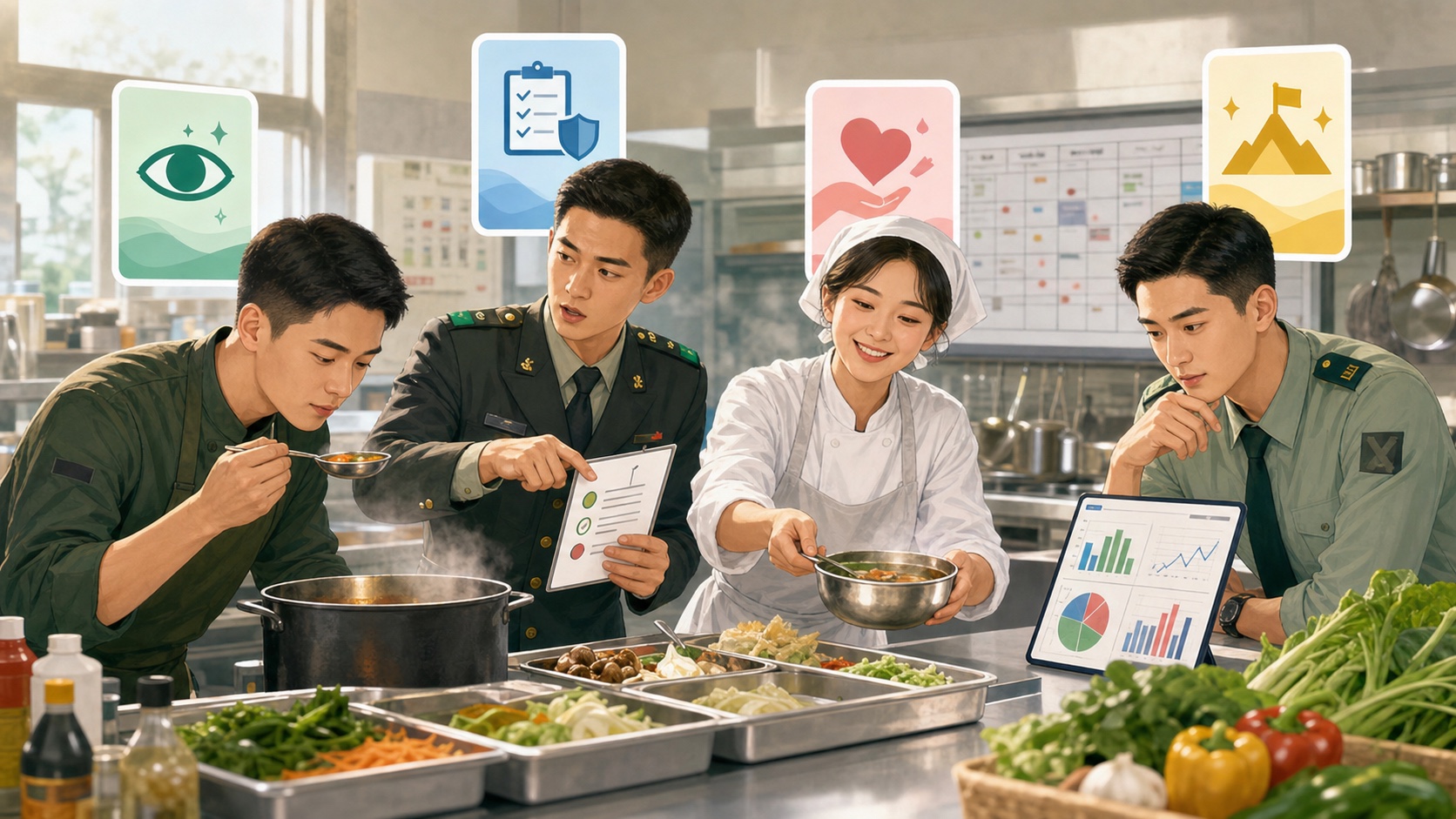
Seen through MBTI, the kitchen team is not an organization of people who all share one type. It is a team in which different survival methods collide in a single space. Kang Sung-jae grows through the sensation in his fingertips and the ability to adapt. Jo Ye-rin holds the field through rules and responsibility. The senior kitchen soldier knows the rhythm of rice and people. The ambitious officer calculates results and position inside the organization.
This combination is interesting because everyone sees “rice” or “a meal” differently. For Kang Sung-jae, a meal is a chance to prove his own possibility. For Jo Ye-rin, a meal is one of the standards by which the unit runs properly. For the senior kitchen soldier, a meal is the everyday language of looking after people. For the ambitious officer, a meal can sometimes become material for performance and evaluation.
Each person’s strength also becomes a seed of conflict. Kang Sung-jae’s flexibility can look unstable to those who value rules. Jo Ye-rin’s strictness can feel like a wall to Kang Sung-jae while he is still growing. The senior kitchen soldier’s practical sense of daily life can collide with performance logic from above. The ambitious officer’s drive can make people on the ground feel like tools.
But the fun of this drama comes from exactly that difference. The kitchen is not just a background; it is a place where people eat, endure, and receive recognition. Food is the most realistic thing and, at the same time, one of the most emotional. That is why the teamwork in The Legend of the Kitchen Soldier is closer to daily life than to combat, and closer to a growth story than to a hero’s tale.
The best way to read this team through MBTI is not to look at a compatibility chart. It is to look at what function each character performs in the space of the kitchen. When ISFP-like sensation, ESTJ-like order, ESFJ-like care. ENTJ-like desire for results collide in the same place, the drama becomes not only a military story but also a story about people finding their place.
What to Be Careful About in This Analysis
First, the MBTI types in this article are not official settings. What can be confirmed from TVING, CJ ENM, Naver Webtoon. Production-presentation articles are the drama’s basic premise, the characters’ roles, and casting information. The MBTI types are not official materials. They are a blog-style interpretation based on behavior and relationship patterns in the work.
Second, I and E should not be judged only by how much someone talks. Reading Kang Sung-jae as ISFP does not mean he is passive. He is closer to someone who proves himself through action and sensation rather than words. Likewise, reading Jo Ye-rin or the ambitious officer as E-like does not simply mean they are lively. It refers to the direction of directly intervening in external situations to create standards or results.
Third, T and F should not be divided into cold people and warm people. Jo Ye-rin’s T-like judgment does not mean she lacks emotion. It means she first looks at roles and responsibilities in order to protect the field. Kang Sung-jae’s F-like side is also not irrationality. It is a way of including the values he wants to protect and people’s reactions in his judgment.
Fourth, it would be difficult to treat genre fantasy as the correct answer for real military life. The Legend of the Kitchen Soldier deals with the military and cooking, but it also uses status-window and growth-fantasy devices. The purpose of this article is not to evaluate real military service, but to read genre characters through the language of personality types.
Finally, this reading may differ from fandom interpretations. Some readers may see Kang Sung-jae as INFP, Jo Ye-rin as ISTJ, or the ambitious officer as ESTJ. Those differences are not necessarily right or wrong; they are differences in emphasis. A character’s MBTI can change depending on which behaviors are placed at the center.
In this drama, rice is not just food; it is a language that changes the atmosphere and relationships of the unit.
Conclusion: The Legend of the Kitchen Soldier Shows “How to Make a Place for Yourself” Before It Shows MBTI
The appeal of The Legend of the Kitchen Soldier does not lie only in guessing whether Kang Sung-jae is ISFP or Jo Ye-rin is ESTJ. The more important question is how a person thrown into an unfamiliar order creates a place for themselves. Someone learns through sensation, someone protects through rules, someone knows the rhythm of daily life, and someone reads the board in pursuit of results.
MBTI helps us see these differences a little more easily. Even within the same kitchen, people do not take responsibility in the same way. Kang Sung-jae proves himself through a meal, Jo Ye-rin protects the field through standards. The senior kitchen soldier cares for people through the rhythm of repeated meals.
That is why this drama is both a food drama and a growth drama. Cooking rice does not simply mean making food. It means helping someone get through their day and becoming a necessary person within that process. The MBTI reading of The Legend of the Kitchen Soldier ultimately returns to a question beyond four letters: how does a person become legendary in the place they have been given?
Is Kang Sung-jae’s MBTI in The Legend of the Kitchen Soldier ISFP?
This article sees Kang Sung-jae as close to ISFP. Cooking as a sensory act, his way of physically adapting inside the unfamiliar military. His tendency to prove himself through results rather than words all read as ISFP-like. However, if the growth narrative and inner possibility are emphasized, an INFP reading is also possible.
Is Jo Ye-rin’s MBTI in The Legend of the Kitchen Soldier ESTJ?
This article interprets Jo Ye-rin as close to ESTJ. Since public articles introduce her as an FM platoon leader, she reads as a character who values rules, responsibility, and order on the ground. If quiet duty performance and adherence to procedure are emphasized more, ISTJ is also possible.
What type can the senior kitchen soldier be seen as?
This article reads the senior kitchen soldier role as close to ESFJ. A military kitchen is not simply a place that makes food. It is a place that manages people’s meals, moods, and daily rhythms together. That is why this article interprets him as a helper who reads people and the flow of daily life, rather than as someone who only looks at rules.
Is this analysis official MBTI?
No. This article is not official MBTI material, but a blog-style interpretation for reading fictional characters. Official sources were used to confirm the premise and basic settings. MBTI types were inferred from behavior, relationships, roles, and repeated choices.
Is it okay to analyze drama characters through MBTI?
Yes, but MBTI should not be used like an answer sheet. Character MBTI works best not as a tool for defining a person once and for all. As a language for discussing why a character repeats certain choices.