
# What Is Korea’s Five Poles and Three Special Regions Strategy? A Balanced-Growth Plan Beyond Seoul
Concentration in the Seoul metropolitan area is an old story in Korea. Recently, however, one phrase has appeared repeatedly in government policy: “Five Poles and Three Special Regions”.
The phrase is short, but the agenda is large. It is a national balanced-growth strategy that aims to reduce a structure in which growth and population are concentrated in Seoul and its surrounding region, and to redesign the country around multiple growth regions.
This article explains the strategy not as a political slogan, but from the viewpoint of how jobs, transport, universities, industries, and administration may change in local regions.
## Meaning: five mega-regional growth axes and three special self-governing provinces
“Five Poles and Three Special Regions” literally means five growth axes and three special self-governing regions.
- Five poles: mega-regional growth axes such as the Seoul metropolitan area, the southeast/Busan-Ulsan-Gyeongnam area, the Daegu-Gyeongbuk area, the central/Chungcheong area, and the Honam area.
- Three special regions: Gangwon State, Jeonbuk State, and Jeju Special Self-Governing Province, which pursue specialized growth based on special autonomy systems.
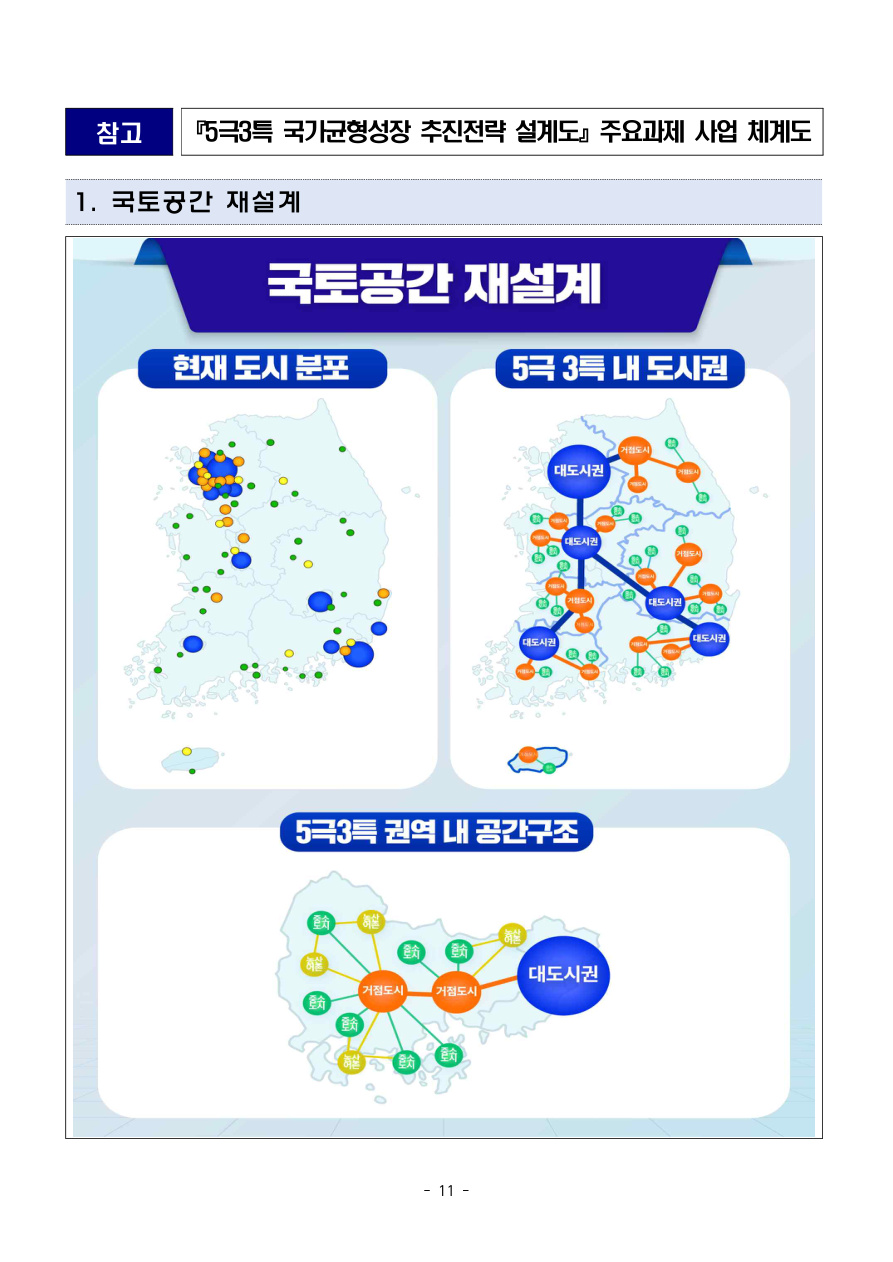
The key is to move away from seeing each administrative district separately. The point is not to grow only Busan, only Daegu, or only Gwangju. It is to connect nearby cities, industries, universities, and transport networks into one living and economic sphere.
Government materials describe the strategy through three pillars: economic regions, living regions, and administrative-fiscal systems. Economic regions create regional growth engines; living regions improve access to transport, medical care, education, and culture within roughly 60 minutes; and the administrative-fiscal pillar builds regional cooperation and funding mechanisms.
## Why now: the limit of Seoul-centered concentration
The background is simple. The capital region already functions like a mega-regional economy. Non-capital regions, by contrast, are often fragmented by administrative boundaries, making it harder to connect industry, universities, transport, and medical resources.
Official materials explain capital-region concentration as a matter of income, population, companies, R&D, assets, and transport infrastructure. Seoul has a powerful pull for people and firms, while many local regions face a vicious cycle of youth outflow and economic contraction.
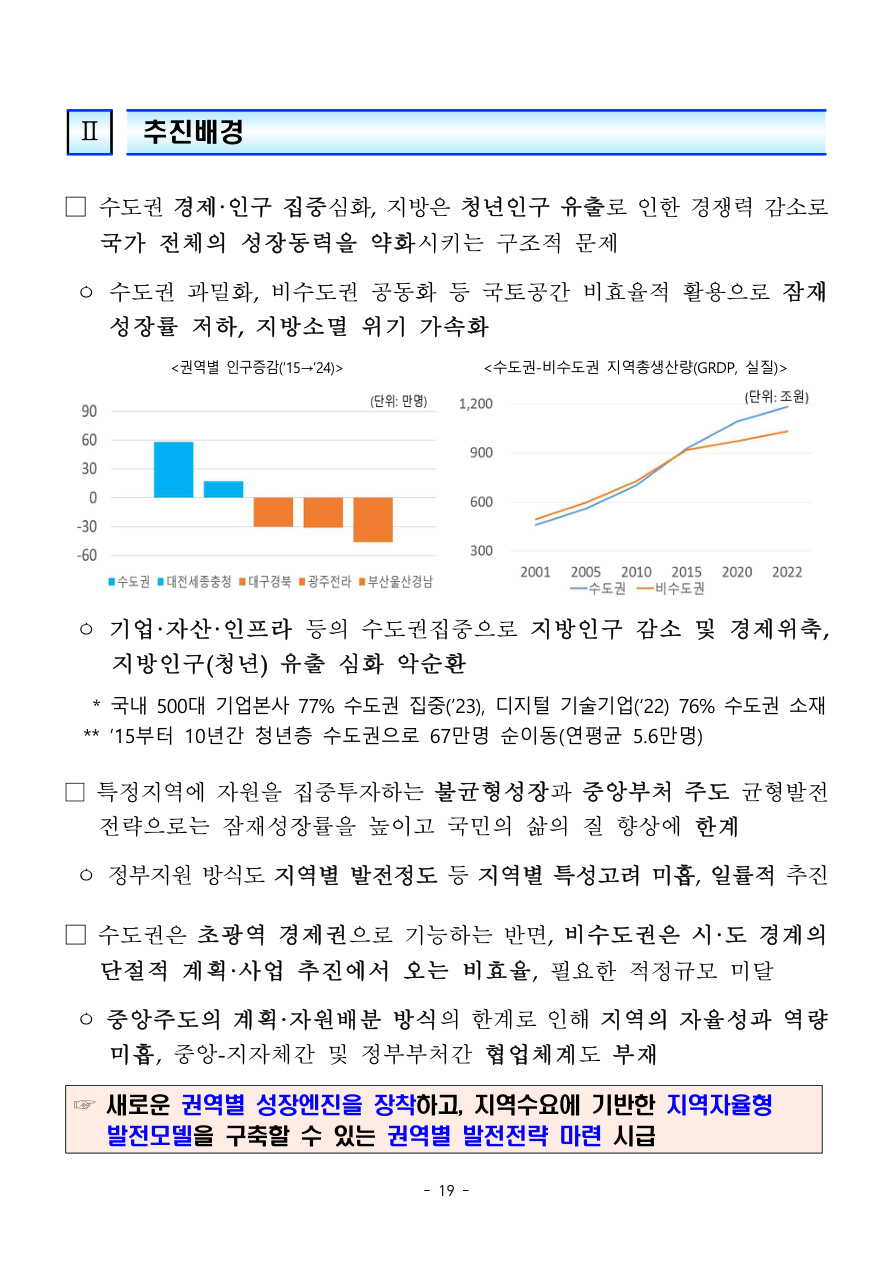
The important question is not simply whether local regions should receive more money. The deeper question is whether they can create the critical scale needed for self-sustaining growth. Industry alone is not enough. Universities, research, transport, housing, healthcare, and culture must move together if people are to stay.
## The five poles are regional growth engines, not five individual cities
The “five poles” do not mean selecting five specific cities. They mean expanding the frame to the regional level and developing growth engines, talent pipelines, and industry-university-research innovation hubs together.
For example, the southeast is not viewed as Busan’s port, Ulsan’s manufacturing base, and Gyeongnam’s industrial foundation separately. The strategy draws them together around AI transformation, advanced manufacturing, logistics, universities, and research institutes.
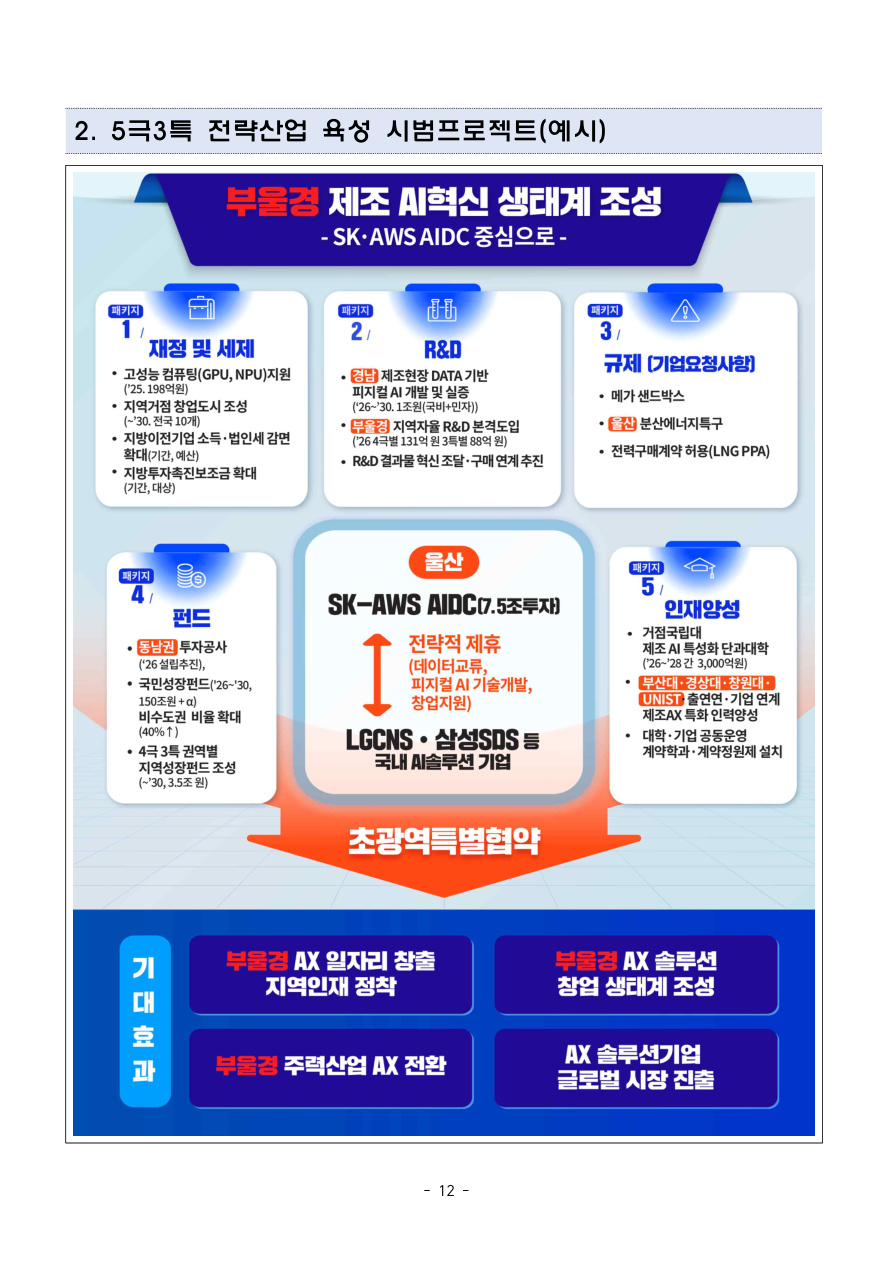
This differs somewhat from earlier balanced-development policies. In the past, the central government often chose projects and local regions executed them. This approach emphasizes identifying strategic industries that match regional demand and bundling projects across ministries.
## The core of living regions is 60-minute connectivity
Balanced growth is not only about jobs. For people to live in a region, mobility, healthcare, education, care services, and culture must be connected.
A notable phrase in the living-region strategy is a 60-minute transport system by region. The idea is to connect hub cities through metropolitan rail, buses, BRT, transfer centers, and integrated mobility services, while expanding demand-responsive transport in underserved areas.
This is the part residents may feel most directly. If commuting and school travel become easier within a region, job options widen. Access to healthcare and culture also changes. If transport connections remain weak, even excellent industrial complexes will struggle to retain people.
## The three special regions connect autonomy experiments to growth strategy
The three special regions are Gangwon, Jeonbuk, and Jeju. They are not merely places with special administrative names. Based on special laws and autonomy, they can design strategies suited to local strengths in tourism, agri-bio, energy, marine industries, forests, data, and AI.
Still, the label “special self-governing province” does not guarantee growth. Regulatory exceptions, fiscal support, transport networks, talent development, and business attraction must move together. That is why the national strategy says the three special regions should be developed to a level comparable with the five poles.
## Administrative and fiscal foundation: cooperation must be institutional
Mega-regional strategy cannot rely on verbal cooperation alone. Different administrative districts divide budgets, authority, responsibility, and performance evaluation. That is why the strategy treats administrative and fiscal foundations as a separate pillar.
Government materials propose tools such as special local governments, mega-regional special agreements, special accounts, broader block grants, and preferential support for local regions. In plain terms, the aim is to create a structure in which regions plan together, invest together, and share responsibility together.
This may determine success or failure. Industrial projects are visible. But if the rules of administration and finance do not change, regional cooperation can easily end as a one-off project.
## Five things to check when evaluating the strategy
- Are regional strategic industries connected to actual investment and hiring?
- Does the 60-minute living-zone plan change daily mobility, not only maps?
- Can universities, companies, and research institutes operate as one ecosystem?
- Are central ministries and local governments sharing budgets and authority?
- Can the special self-governing regions turn autonomy into measurable growth?
## Balanced development is not “redistribution”; it is a redesign of the growth map
If this strategy is seen only as support for local regions, its core is missed. It is not a proposal to shrink the capital region. It is closer to a judgment that one capital region alone cannot carry the nation’s growth and quality of life.
For local regions to grow, jobs, education, healthcare, transport, and culture must circulate within the region. That is why the strategy emphasizes living regions over administrative borders, packages over isolated projects, and regional growth engines over short-term support.
## Related reading
- Korea’s Potential That Koreans Often Overlook
- The Anthropic Mythos Shock
- Korea’s 4.5-Day Workweek Support System
- 2026 Apartment Holding Tax Guide
## FAQ
### What exactly does Five Poles and Three Special Regions mean?
It is a policy framework for balanced national growth centered on five mega-regions and three special self-governing provinces. It prioritizes regional economic and living zones over individual administrative districts.
### Is it a policy to suppress the capital region?
Not simply. Official materials describe it as a strategy to ease the one-pole structure centered on Seoul and to connect regional industry, transport, education, and administration so local regions can also become growth engines.
### Which regions are the three special regions?
They are Gangwon State, Jeonbuk State, and Jeju Special Self-Governing Province.
### What change would ordinary citizens feel most?
Transport and daily living zones: 60-minute regional mobility, better healthcare, education and cultural access, and stronger links between local jobs and universities.
### What will determine success?
Whether strategic industries lead to investment and jobs, whether transport links real living zones, and whether central and local governments coordinate budgets and authority.
## References
- Presidential Committee for Local Era, Five Poles and Three Special Regions National Balanced-Growth Strategy
- Ministry of the Interior and Safety, Five Poles and Three Special Regions and Balanced Growth of Small and Medium-Sized Cities
- Policy Briefing press release
- Office of the President national task: Balanced Growth for All