
Bukhansan Mountain is close to Seoul, but once you get up on the road, the noise of the city fades away quicker than you might think. On this day, we started from the meditation path in section 5 of Bukhansan Mountain Dullegil. As I walked, I naturally climbed towards the Hyeongjebong ridge, and after seeing the view, I came down towards Jeongneung Valley.
Original Korean article: Bukhansan Mountain Dullegil Section 5 Hyeongjebong hiking route: A path of rocks and forests read through the Five Elements of Myeongnihak
The interesting thing is that this path is not just a “pretty trail.” The National Park Service introduces the Meditation Trail as a 2.4km section that runs from Jeongneung parking lot to the entrance of Hyeongjebong Peak. This section passes between the trail and Hyeongjebong ridge. So, it feels like a flat walking trail and a breath-taking mountain trail at the same time.
Even if you read it in terms of the five elements, the road was quite clear that day. The forest path is the growth of wood, and the granite rock is the crystal of gold. The sweat coming up the hill is fire, and the dirt road and ridge are the center of earth. Jeongneung Valley on the way down the mountain is a water system. After walking, I realized that Bukhansan Mountain was a mountain of the five elements that I understood first through my body rather than through books.
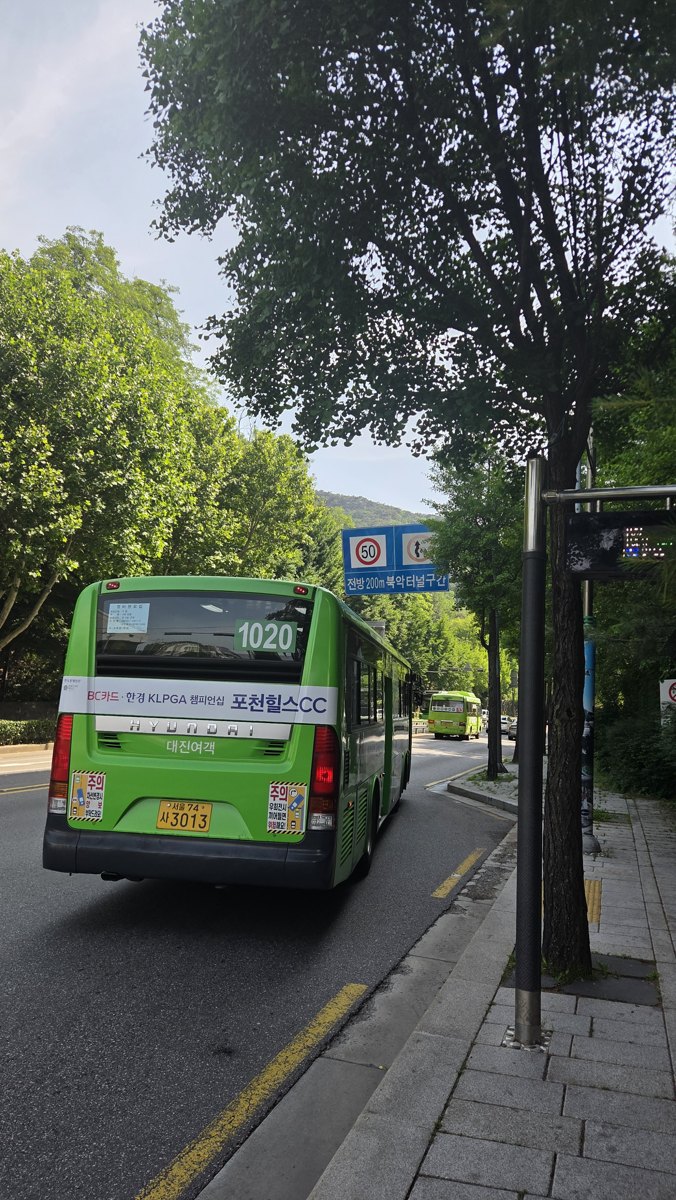
The first scene crossing from the city to the mountains
The hike started around 10 a.m. at a point where you can see the road and bus toward Jeongneung. Hiking days are usually remembered through summit photos, but in fact, the beginning of the hike is better revealed in these scenes. My body is still in the rhythm of the city, but my feet are already heading towards the mountains.
When read in terms of the five elements, this point feels like the boundary of earth. Sat is central and transitional. It is the threshold to break away from the structure of daily life such as work, home, road, and bus and move on to a different rhythm called the mountain road.
At this time, the feeling the mountain gave me was simple. “Let’s change the pace today.” Bukhansan Mountain takes people to another time.
Deciding the route in front of the Bukhansan Dullegil sign
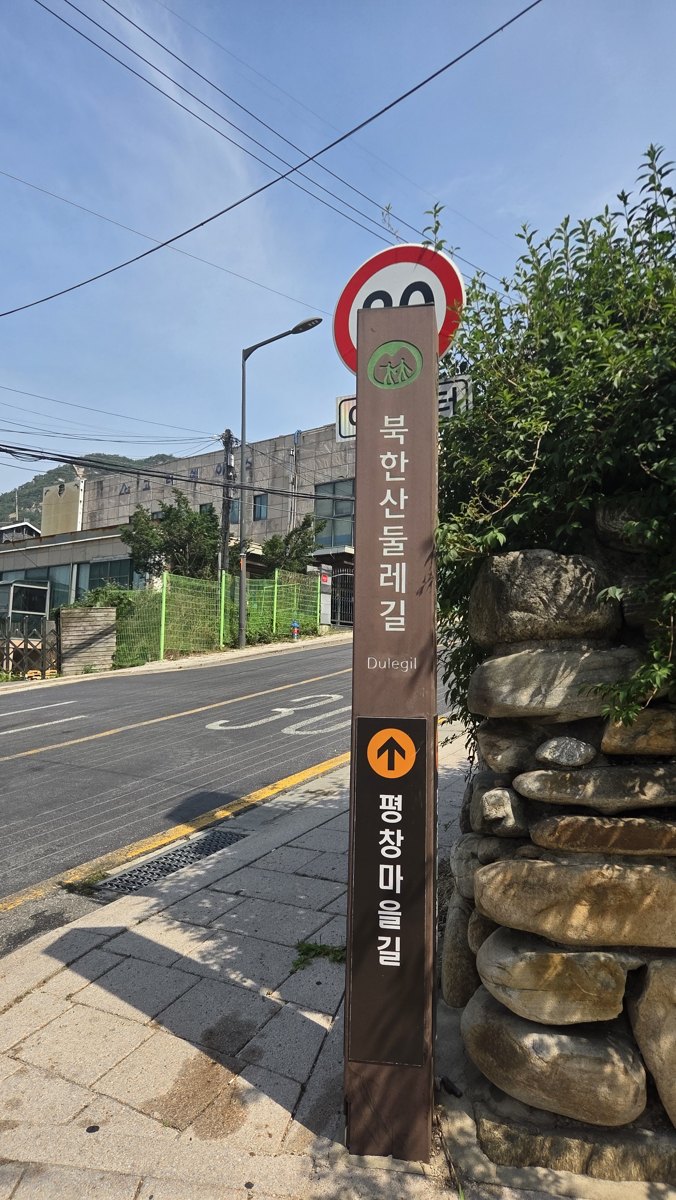
After walking a bit, I came across a sign for the Bukhansan Trail. In the photo, you can see the ‘Bukhansan Dulle-gil’ vertically, and an arrow in the direction of Pyeongchang Village Road can be seen below. From here on, I really feel like I’m choosing a path.
The Dulle-gil is not a straight path to the summit. This is a path where you walk along the edge of the mountain and at some point take in the energy of the ridge. This is also the charm of the meditation path in section 5 of Bukhansan Mountain Dullegil.
The National Park Service introduces the meditation path as “Contemplation from the city, asking my way in the forest.” This expression is quite true when you actually walk it. When you stand in front of the sign, hiking becomes not just an exercise, but a small question.
Your body switches on on the stairs
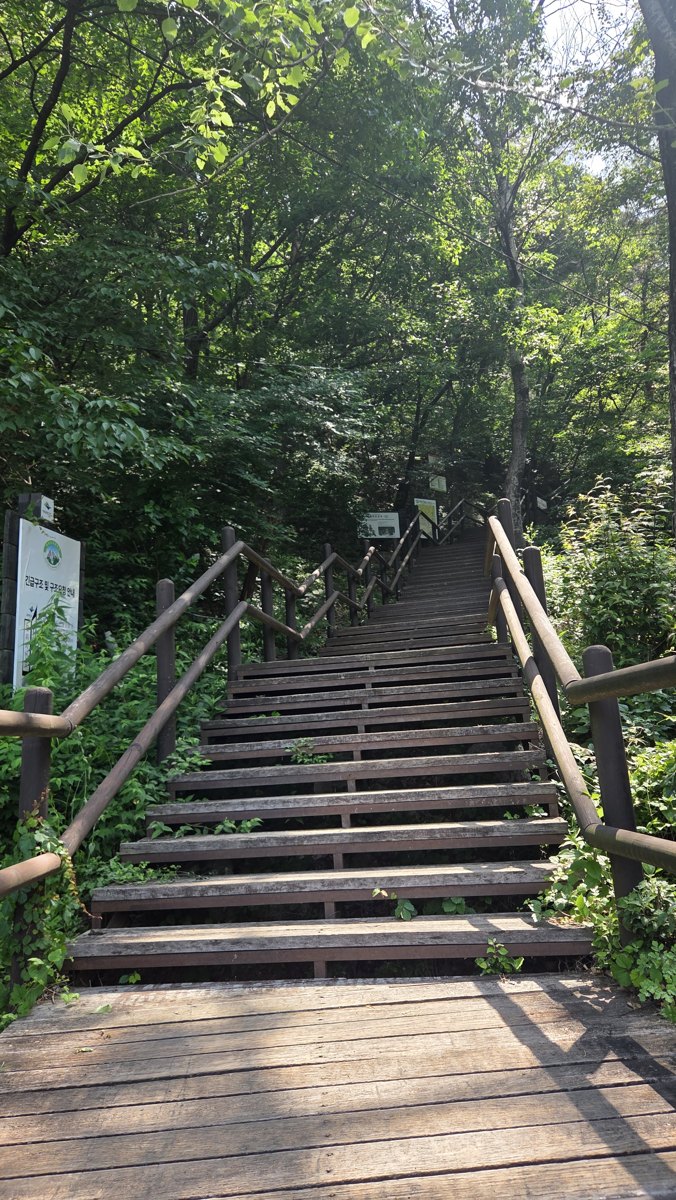
Soon we came to a wooden staircase. This is the section where the flat road ends and your body becomes fully aware of the mountain. Your breathing changes little by little, and the rhythm of your legs also changes.
If you read it in terms of the five elements, this section is close to fire. Anger is rising and heat. The initial uphill climb awakens the fire that was dormant in your body. One thing to note is that this fire is not a hasty fire.
Fire in the city is more of a reminder, a deadline, a speed. The fire of the mountains is similar to heartbeat, sweat, and breathing. Even if it is the same fire, the texture is different.
The path in the forest indicated by a signpost
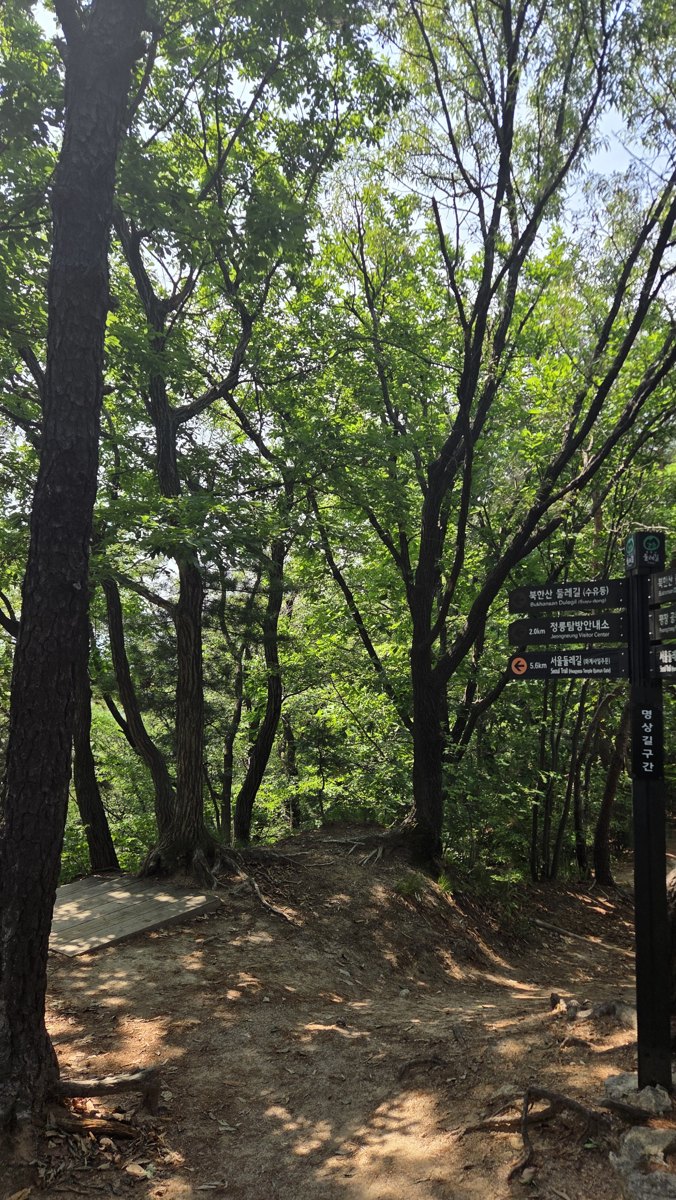
You will see a signpost at the point where the forest becomes darker. On the right side of the photo, you can see signs such as ‘Bukhansan Dullegil (Suyu-dong)’, ‘Jeongneung Visitor Information Center 2.0km’, and ‘Seoul Dullegil 5.6km’. Below the sign, you can also see the meditation path section markings.
Personally, I felt like this scene was the center of this hike. Because it shows that the road does not extend in only one direction. The Dulle-gil, Visitor Information Center, Seoul Dulle-gil, and Meditation Trail overlap in one place.
In Myungri, this scene can be read as a scene of relationship. Wood stretches out, and gold cuts the path. The forest continues to grow, but signposts provide direction. A good hike requires the flow of the forest and signposts to show direction.
The rocks of Bukhansan Mountain reveal their faces.
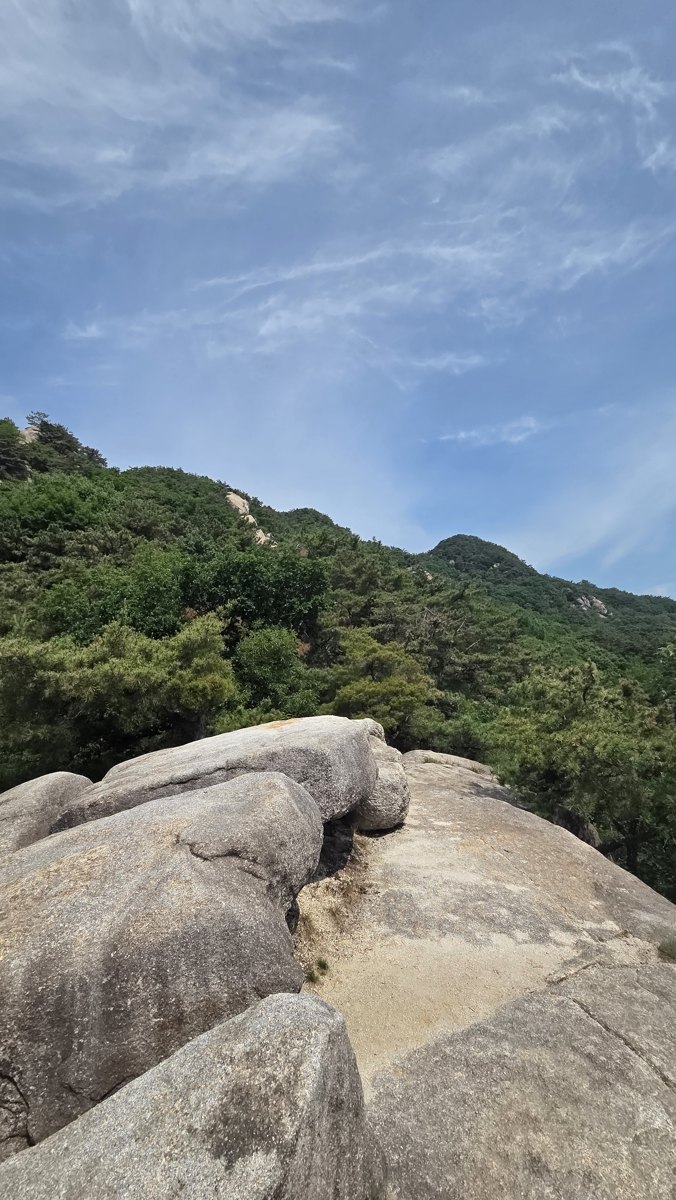
As we climb a little further, the scene changes dramatically. A large rock appears between the greenery of the forest path, and the ridge and sky open up. From this point on, Bukhansan Mountain is no longer a smooth trail. It clearly shows the face of the rocky mountain.
The National Park Service describes Bukhansan National Park as a place where granite ground has eroded and weathered over a long period of time, forming steep rocky peaks and beautiful valleys. If you look at the rock in the photo, you will immediately understand the explanation.
If you look at the five elements, this scene is gold. Gold is read as an energy of hardness, discipline, and determination. The rocks of Bukhansan Mountain are not gentle persuasions. Instead, it seems to be saying, “I need to keep my posture straight from here on out.”
Seoul unfolds above the forest
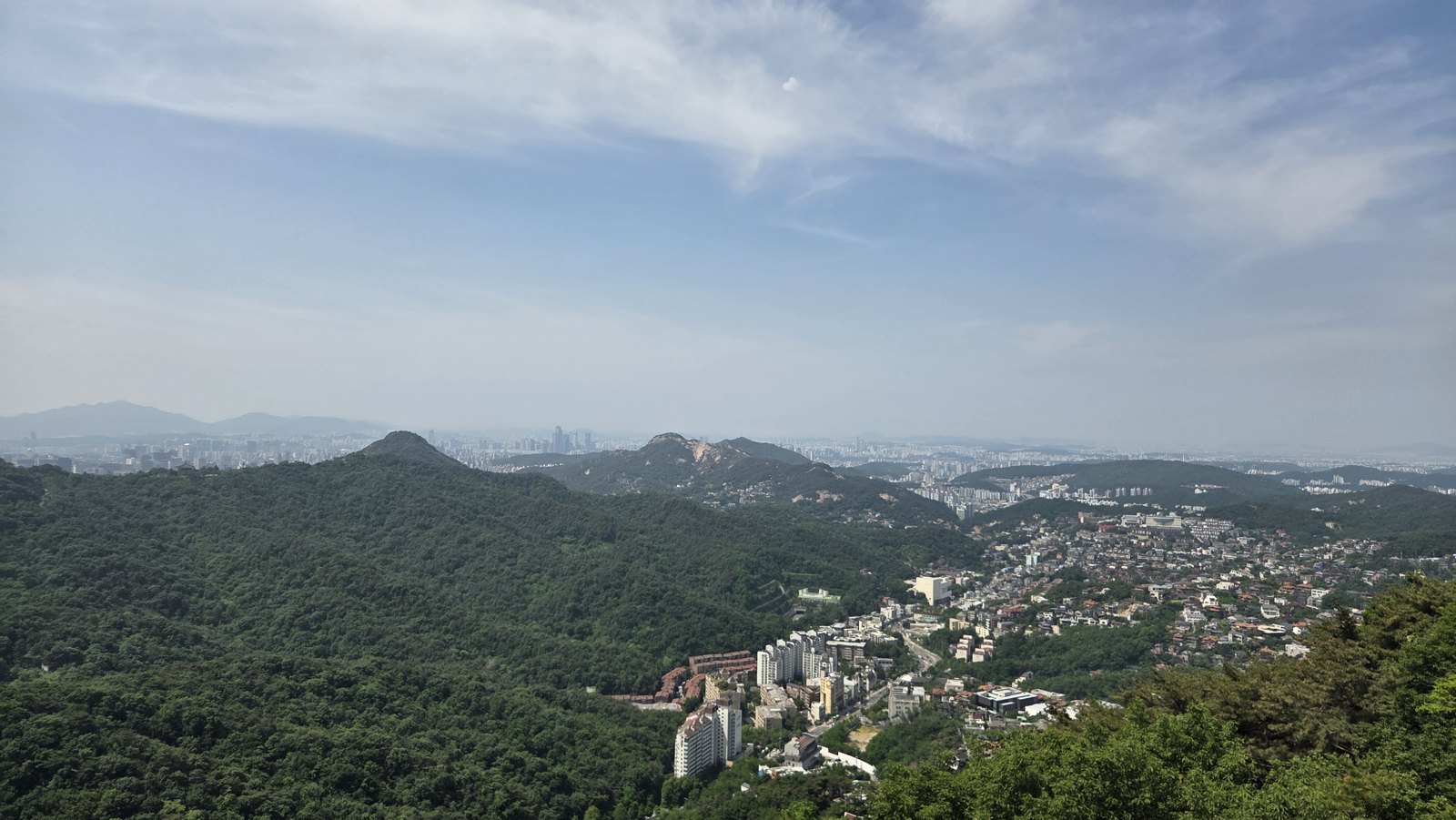
The view opens wide. The forest continues below, and beyond that, you can see Seoul’s apartments and roads, and even low mountain ranges in the distance. When you stand on the mountain, the city becomes smaller.
What I liked about this scene was the feeling that the mountains and the city were not pushing each other away. Bukhansan Mountain is not a mountain that pushes out the city. It is a mountain that embraces the city, creates shade over it, and gives city dwellers a moment to catch their breath.
In myeongri-logical terms, it is a scene of earth. To accepts and mediates everything. The complex energy of Seoul and the quiet energy of the mountains are seen as one landscape here.
The line of the peak rises like gold
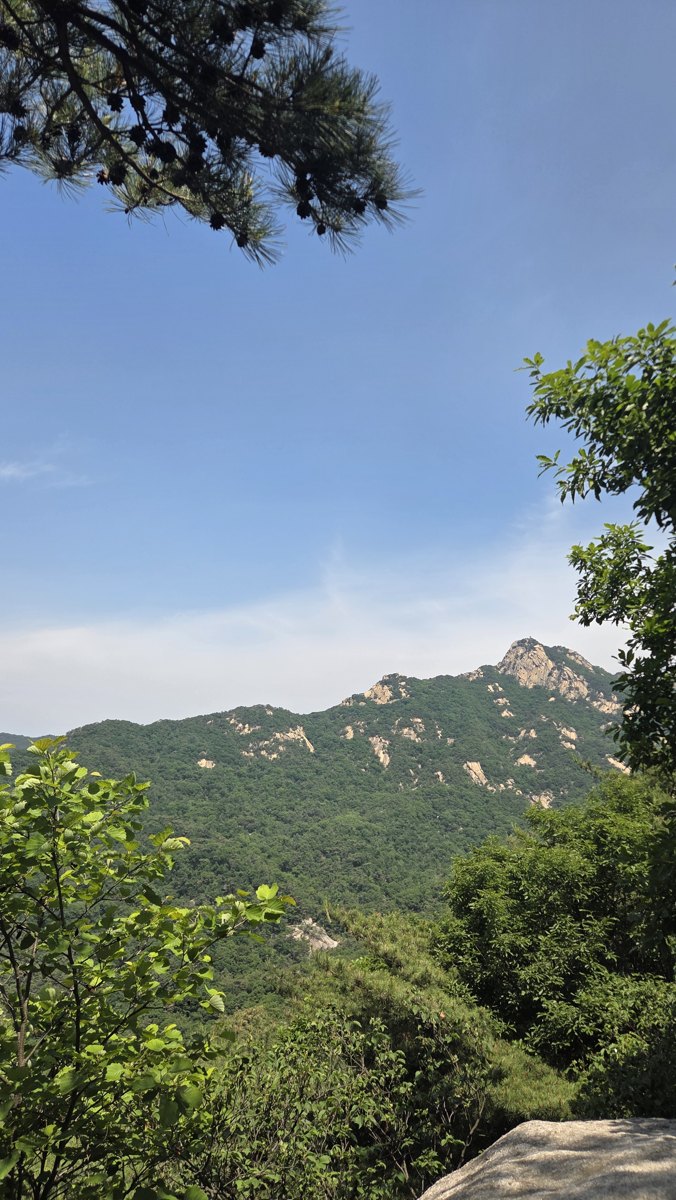
As you climb up the ridge, you can see the peak and rocky ridge of Bukhansan Mountain more clearly. A gray rock ridge rises above the green forest. This is a scene that shows Bukhansan Mountain as Bukhansan Mountain.
Here, gold is not just a cold and hard energy. The gold you encounter in the mountains actually makes your mind clearer. You will have fewer unnecessary thoughts and will focus on the rock you are stepping on and the sky in front of you.
At this point, hiking naturally becomes immersive. Thoughts decrease and sensations increase. You focus on where to put your feet, where the wind is coming from, and what the texture of the next rock is. Walking literally becomes meditation.
Reading the energy of relationships near Hyeongjebong Peak
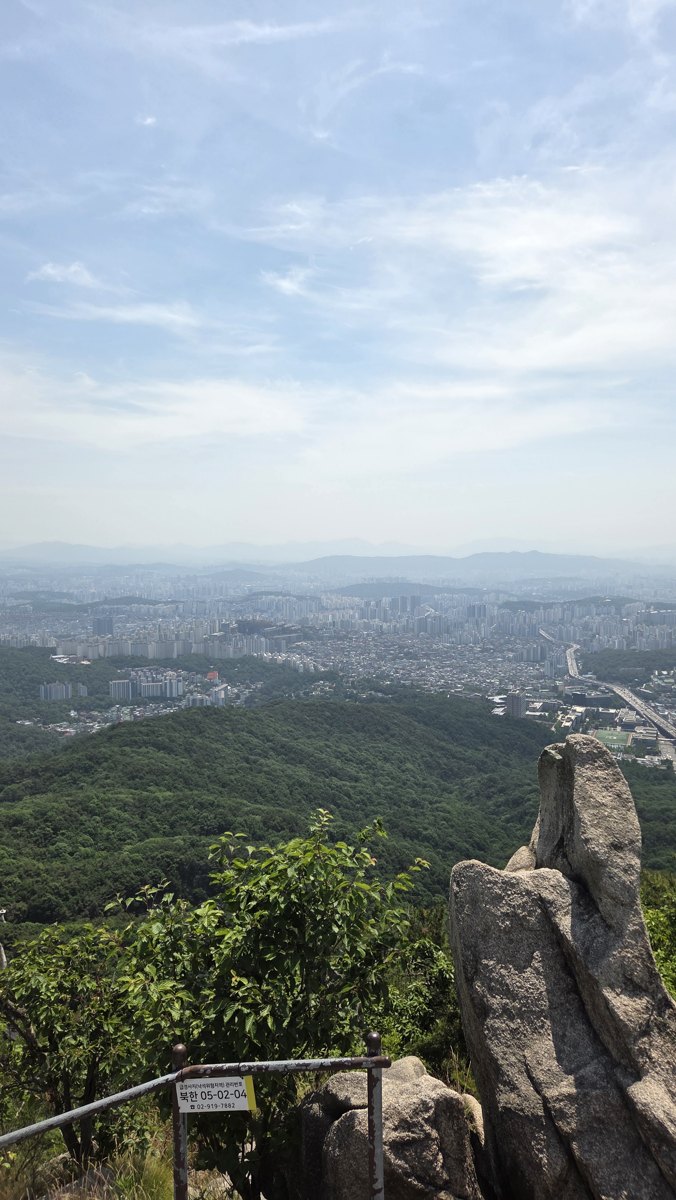
Near Hyeongjebong Peak, both rock and city views open up. This scene was close to the peak of the hike as the flow descended around Hyeongjebong Peak.
The name Hyeongjebong Peak also catches my eye for no reason. The image of two peaks standing side by side brings to mind the Bigyeon and Gyeopjae of Myeongnihak. Bigyeon and Gyeopjae are read as symbols of strength similar to mine, colleagues, competitors, and people who go together.
Of course, the name of a mountain cannot be interpreted neatly like Saju. Still, when looking at the fun of hiking, Hyeongjebong Peak is a pretty good metaphor. Even if I am walking alone, I often meet people with hearts similar to mine in the mountains. I who wants to go up and I who want to rest, me who wants to go forward and I who want to go back walk together.
So Hyeongjebong Peak sounded like a name closer to companionship than competition. It looked like a scene of two hearts standing toward the same height, pushing each other up.
Cool off from the heat of hiking in Jeongneung Valley
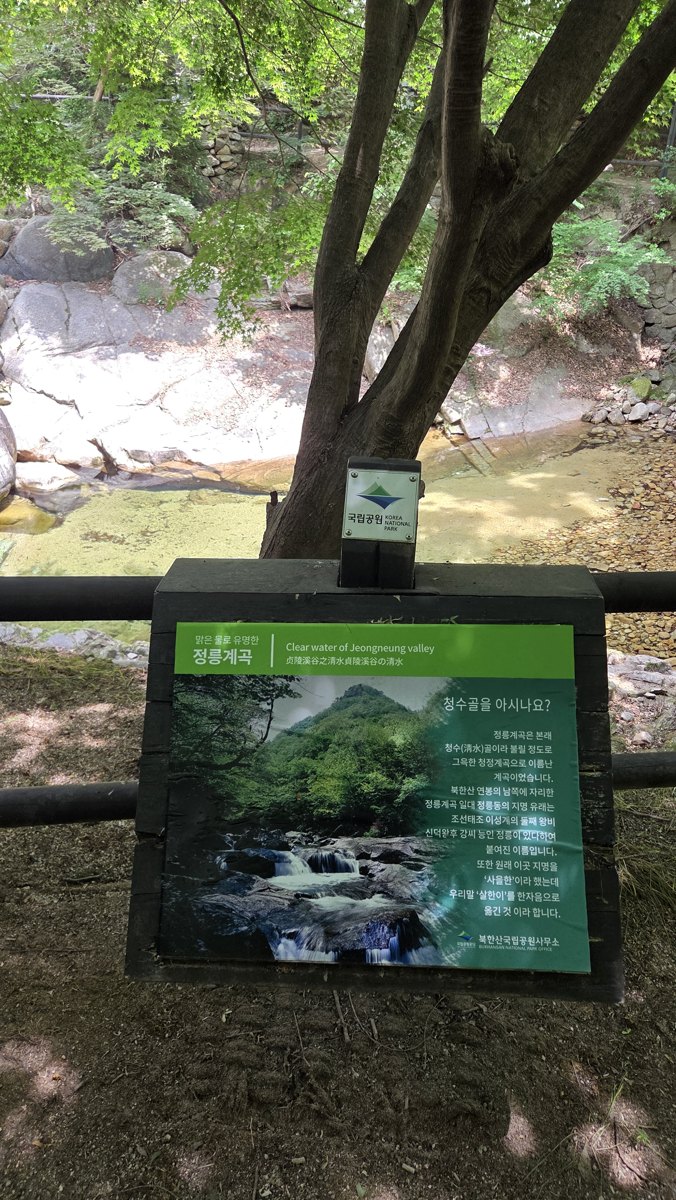
On the way down, you will see an information board for Jeongneung Valley. The signboard says ‘Jeongneung Valley, famous for its clear water’ and ‘Clear water of Jeongneung valley.’ In the explanation below, you can see that Jeongneung Valley was originally a valley so clean that it was called Cheongsugol.
This scene was the ending of Water. Numbers are read with the energy of closure, organization, and reflection. If the fire of the uphill awakens the body, the water of the valley cools the mind.
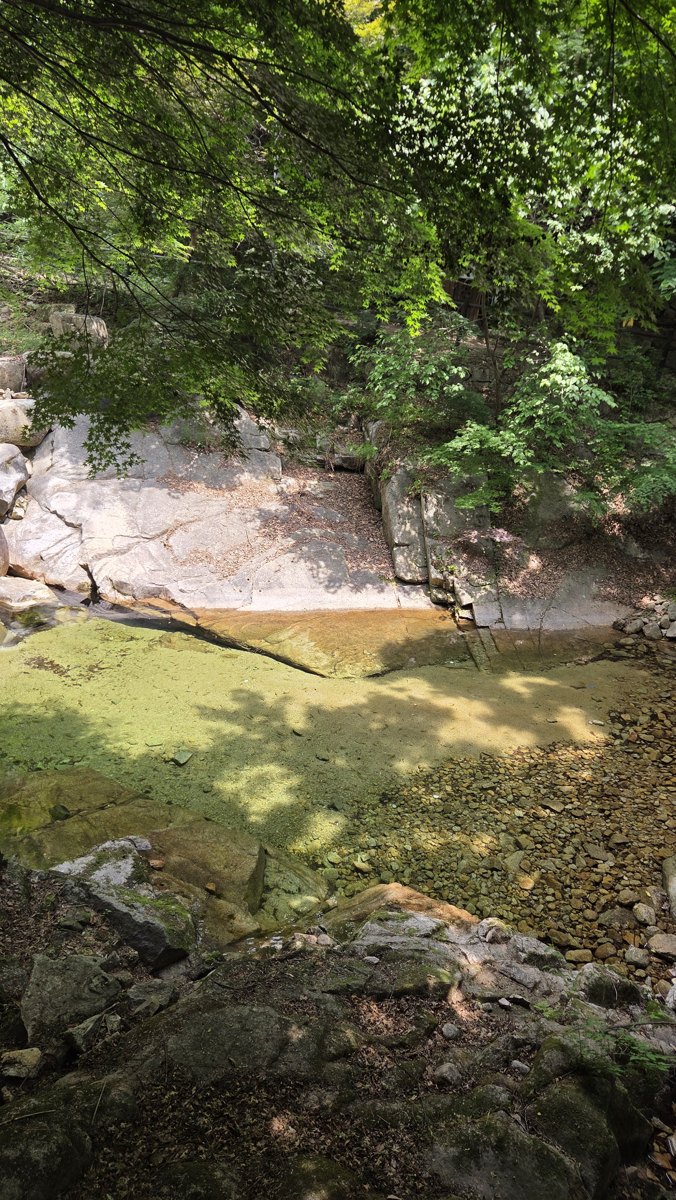
Although the valley water was not large, it was sufficient. The shallow water flowing over the rocks, the shade of the trees, and the green reflected in the water quietly close the end of the hike. The beauty of Bukhansan Mountain does not end at the summit. The day is finally over when you hear the sound of water on the way down the mountain.
It is more interesting to read Bukhansan Mountain in terms of the five elements.
Bukhansan Mountain is a mountain that is good to read in terms of the five elements. The interpretation of Myeongnihak mentioned here is not fortune telling. It is a way of reading nature through the language of symbols. If you read it that way, the hiking scene becomes a little clearer.
Tree: The trail and the sense of growth in the forest
The forest at the beginning of the meditation path is close to trees. The neck grows, stretches and recovers. The fact that the body that was stiff in the city is relaxed on a forest path fits well with this energy.
Fire: Ascent and the heat of breathing.
Stairs and uphill climbs are fire. I’m out of breath and sweaty. However, the mountain’s anger is closer to awakening people rather than consuming them. It gives the body back the sense of being alive.
To (土): Center of ridge and view
Seoul and the mountain range seen from the observation point give a feeling of earth. To holds the center and connects various energies. Bukhansan Mountain is a mountain that serves as the center between the city and nature.
Gold: Determination of granite rocks and peaks
The strongest remaining energy in Bukhansan Mountain is, of course, gold. The lines of granite rocks, rock ridges, and peaks all resemble the symbol of gold. Gold is clarity. On the mountain, even complex thoughts are cut off at some point.
Water: The end of Jeongneung Valley
The last one was water. The water of Jeongneung Valley cools down the heat of the hike and sends away the emotions of the day. So the water on the way down the mountain is not just a scenery. It’s close to the conclusion of the hike.
The message this course gives
The charm of Section 5 of Bukhansan Dullegil and Hyeongjebong Peak lies in the constantly changing scenes. At first it is a village road. It soon becomes a forest road. Stairs appear again, rocks appear, a view opens, and finally a valley appears.
The route keeps changing so you never get bored. That change is the fun of this course. Hiking is not just about seeing the scenery. It’s also about seeing what kind of rhythm I change into.
So the name Meditation Path is a good fit. Meditation is not just about sitting still. Sometimes meditation with the soles of your feet is deeper. At the rock, I gather my wits, in the forest I catch my breath, and at the water’s edge, I let go. The meditation that Bukhansan taught me that day was close to that.
Good information to refer to before hiking
- The official name of section 5 of Bukhansan Dullegil is Meditation Trail.
- The official section is from Jeongneung parking lot to the entrance of Hyeongjebong Peak.
- The distance based on the National Park Service is 2.4km, and the estimated travel time is approximately 1 hour and 10 minutes.
- Difficulty levels are indicated by awards.
- In fact, when you climb up to the Hyeongjebong ridge, there are sections that are closer to hiking than walking along the trail.
If you are choosing your next travel destination, it is also worth reading the article recommending Korea travel destinations for June. If you want to combine seasonal flowers and travel destinations, you can also refer to the summary of domestic hydrangea attractions. If you are curious about the basic language of Myeongnihak, this introductory article on how to read the Korean manse calendar is a good read. If you want to read about the immersion of hiking psychologically, you can also read Csikszentmihalyi’s article on immersion theory.
Frequently Asked Questions
What kind of road is section 5 of Bukhansan Dullegil?
Section 5 of Bukhansan Mountain Trail is a meditation trail. The National Park Service guides you through a 2.4km section that runs from Jeongneung parking lot to the entrance of Hyeongjebong Peak. Because it passes between a forest path, a trail, and the Hyeongjebong ridge, it has the feel of a horizontal walk and a mountain path.
Does the difficulty level increase when you reach Hyeongjebong Peak?
yes. Rather than just walking along the trail, going up the Hyeongjebong ridge adds more rocks and uphill climbs. The photo flow continues with forest steps, dirt roads, and rock views. Rather than going for a light walk, it is better to prepare hiking shoes and water.
What does it mean to interpret Bukhansan Mountain through Myeongnihak?
The interpretation of Myungri in this article is not intended to predict the future. This storytelling is intended to make hiking more enjoyable by reading the topography and scenery of the mountain as symbols of wood, fire, soil, gold, and water. The forest was read as wood, the uphill was read as fire, the ridge was read as sat, the granite rock was read as gold, and the Jeongneung Valley was read as water.
References
- Information on the 5-section meditation trail of the National Park Service’s Bukhansan Mountain Trail
- National Park Service Bukhansan National Park tour guide
Related Reading
Continue with these related Thinknote English articles in the Korea Travel & Festivals cluster.
- Namhansanseong hiking story from Macheon-dong and down to Seongnam: The forest and fortress path read through the Five Elements of Myeongnihak
- Nha Trang 2-day, 1-night local tour: Beach, restaurant, and spa course visited by early morning flight
- Summary of festivals in Korea for July 2026: Schedule by region and theme
- A one-day trip to Boseong Green Tea Fields and Yulpo Beach, a healing drive to Jeollanam-do
- June flower trip to Gangwon-do, how to enjoy lavender at Goseong Hanui Lavender Farm
- Top 10 Hydrangea Spots in Korea, from flowering time to parking check
FAQ
What is this article about?
This article introduces a Korea travel, festival, hiking, or regional itinerary topic for international readers who want context beyond a simple destination list.
How should I use this guide?
Use it for trip planning, seasonal timing, route ideas, and local context. Always confirm opening dates, transport, weather, and official schedules before traveling.
Where can I read the original Korean article?
The original Korean article is available here: Original Korean article.