[카테고리:] Korea Policy & Economy

  • 2026 Fall National Scholarship: What to Check After the First-Round Application

    Original Korean article

    If you are searching for the 2026 fall semester National Scholarship, first check the dates. According to the Korea Student Aid Foundation (KOSAF) official notice, the first-round application period for the 2026 fall semester was from 9:00 on May 22, 2026 to 18:00 on June 22, 2026, and the deadline for document submission and household-member consent was 18:00 on June 29. This guide was checked on 2026-07-17 KST and summarizes what students who already completed the first-round application should check now, as well as what to prepare before any second-round notice.

    The three essentials are: confirm whether your application was received, check for missing documents or household-member consent, and remember that enrolled students are, in principle, expected to apply in the first round.

    2026 Fall National Scholarship First-Round Schedule

    CategoryOfficial scheduleWhat to check
    Application period2026. 5. 22. (Fri.) 9:00 ~ 6. 22. (Mon.) 18:00The deadline day closes at 18:00. During the rest of the application period, applications are available 24 hours a day, including weekends and public holidays, but the deadline day is an exception.
    Document submission2026. 5. 22. (Fri.) 9:00 ~ 6. 29. (Mon.) 18:00Submitting the application alone is not the end. Applicants selected for document submission must check their submission status.
    Household-member consent2026. 5. 22. (Fri.) 9:00 ~ 6. 29. (Mon.) 18:00Consent to provide household-member information must be completed before the student-aid income bracket can be calculated.

    KOSAF’s notice lists all academic-status categories as first-round applicants, including new students, transfer students, readmitted students, returning students, and currently enrolled students. In particular, enrolled students are, in principle, required to apply during the first-round application period. KOSAF also states that for enrolled students applying in the second round, a relief application may be automatically applied up to two times during enrollment and support may be possible after review. Students should also note that this relief-application application is not a structure in which the student chooses whether to apply it.

    Who Is Covered: Type I, Type II, Multiple-Child, and Regional Talent Scholarships Are Applied for Together

    The National Scholarship uses an integrated application method. KOSAF explains that National Scholarship Type I, Type II, Multiple-Child National Scholarship, and Regional Talent Scholarship are applied for in one batch; if a student satisfies the benefit requirements for a given scholarship, that scholarship may be awarded.

    • National Scholarship Type I: The basic target group is students with Korean nationality enrolled at domestic universities who are in student-aid income bracket 9 or below and meet the academic-performance criteria.
    • National Scholarship Type II: This is for students at universities participating in Type II who meet each university’s selection criteria. In principle, it targets students in student-aid income brackets 1 through 9, but the notice states that students in bracket 10 may also receive support if the university recognizes urgent financial circumstances or similar needs.
    • Multiple-Child National Scholarship: This is for unmarried university students with Korean nationality enrolled at domestic universities, in student-aid income bracket 9 or below, and from a multiple-child household. A multiple-child household means a household with three or more children of Korean nationality.
    • Regional Talent Scholarship: The main targets are new students who graduated from a non-capital-region high school and entered a non-capital-region university in 2026, or existing students already confirmed for continued support.

    Type I Support Amounts: Differentiated by Student-Aid Income Bracket

    Type I support is provided by student-aid income bracket within the limit of mandatory tuition-related expenses for the semester. The official amount table is as follows.

    Student-aid income bracketMaximum support per semesterMaximum annual support
    Basic livelihood recipient / near-poverty classFull amount*Full amount*
    Brackets 1~3KRW 3,000,000KRW 6,000,000
    Brackets 4~6KRW 2,200,000KRW 4,400,000
    Brackets 7~8KRW 1,800,000KRW 3,600,000
    Bracket 9KRW 500,000KRW 1,000,000
    * Based on mandatory expenses within the tuition amount.

    Multiple-Child National Scholarship Support Amounts

    If the Multiple-Child National Scholarship overlaps with Type I, the Multiple-Child National Scholarship is supported first, and duplicate receipt is not allowed. When applying, entering sibling information, including information about the applicant, is required.

    Student-aid income bracketMaximum support for first and second childMaximum support for third child and beyond
    Basic livelihood recipient / near-poverty classFull amount*Full amount*
    Brackets 1~3KRW 3,050,000 per semester / KRW 6,100,000 per yearFull amount*
    Brackets 4~6KRW 2,525,000 per semester / KRW 5,050,000 per yearFull amount*
    Brackets 7~8KRW 2,325,000 per semester / KRW 4,650,000 per yearFull amount*
    Bracket 9KRW 675,000 per semester / KRW 1,350,000 per yearKRW 1,000,000 per semester / KRW 2,000,000 per year
    * Based on mandatory expenses within the tuition amount.

    Academic Criteria: Not Applied to New Students in the First Semester; Previous Semester Applies to Enrolled Students

    According to the official Type I review criteria, academic-performance criteria are not applied to new students, transfer students, and readmitted students for their first semester only. Enrolled students are generally required to have completed at least 12 credits in the previous semester and achieved at least 80 points on a 100-point scale.

    • For basic livelihood recipient and near-poverty students, the standard is completion of 12 credits in the previous semester and at least 70 points.
    • For students with disabilities, the completed-credit and percentile-score academic criteria are not applied.
    • For youth preparing for independent living, the percentile-score criterion is not applied, but the completed-credit criterion does apply.
    • For brackets 1~3, KOSAF states that students with at least 70 but less than 80 points in the previous semester may receive support after the C-grade warning system is applied, up to two times.
    • For students graduating or in extra semesters, the completed-credit criterion is not applied.

    Checklist to Review Now

    1. Application status: Log in to KOSAF and confirm in the National Scholarship application status menu that your application was properly received.
    2. Document-submission status: Check whether you are required to submit additional documents, such as family relationship, marriage, or basic/near-poverty documents.
    3. Household-member consent: If consent from a parent or spouse is required, confirm whether it has been completed.
    4. Student-aid income bracket calculation: Wait for the result of the recognized-income calculation, which reflects income, property, financial assets, liabilities, and other factors.
    5. Duplicate support: If there was duplicate support in a past semester, support may be restricted, so check whether it has been resolved.
    6. Number of benefit receipts: Support may be restricted if the maximum number of benefit receipts by academic program or by student has been exceeded.

    How Should You View a Second-Round Application?

    As checked on 2026-07-17, this article is organized based on the first-round schedule confirmed on KOSAF’s official 2026 fall semester notice page. The second-round application schedule must be confirmed through a separate notice, and you should not plan your application based on estimated dates. In particular, because enrolled students are, in principle, expected to apply in the first round, anyone waiting for a second round should also check their remaining relief-application opportunities and their university’s registration and scholarship schedule.

    Official Application Channel

    Applications and status checks are handled through the Korea Student Aid Foundation website or mobile app. Treat summaries on blogs, online communities, or social media as references only, and always confirm actual application availability and schedules on KOSAF’s official pages.

    Frequently Asked Questions

    When was the first-round application for the 2026 fall National Scholarship?

    According to KOSAF’s official notice, it was from 9:00 on May 22, 2026 to 18:00 on June 22, 2026.

    When were document submission and household-member consent due?

    They were due from 9:00 on May 22, 2026 to 18:00 on June 29, 2026. If an application was completed but documents or household-member consent were missing, the review process may be affected.

    Can enrolled students also apply in the second round?

    KOSAF states that enrolled students are, in principle, required to apply during the first-round application period. For enrolled students who apply in the second round, a relief application may be automatically applied up to two times during enrollment, and support may be possible after review.

    Up to which income bracket does National Scholarship Type I provide support?

    Based on KOSAF’s 2026 fall semester notice, Type I targets university students in student-aid income bracket 9 or below, while also reviewing academic criteria and completion of application procedures.

    Related Reading

    Official Sources

    This article was prepared after checking KOSAF’s official pages as of 2026-07-17 KST. Scholarship schedules and detailed criteria may change, so actual application, review, and payment decisions should always be confirmed through KOSAF’s official notices and your university’s scholarship office announcements.

  • Five Korean Government Support Programs to Apply for or Check in July 2026

    Original Korean article

    Reference time: July 17, 2026, 16:00 KST. Policy schedules may change due to budget exhaustion, system maintenance, or additional notices. The items below focus only on programs whose official websites show July application, use, intake, or confirmation needs.

    The key is to distinguish between “programs you can apply for right now” and “programs for which you need to check an official July notice.” Application funds, subsidies, and loan-type funds are often targeted by fake text messages and proxy sites, so the final application should always be confirmed through an official website, community service center, or bank app.

    Summary of Government Support Programs to Check First in July

    ProgramSchedule as of JulyTarget groupWhere to apply or checkCaution
    Energy VoucherApplication period: 2026.6.15.~12.31.; summer use: 7.1.~9.30.Households receiving Basic Livelihood Security benefits and meeting household-member characteristic criteriaEup/myeon/dong administrative welfare center; BokjiroIn July, check both application status and whether summer bill deduction applies.
    Culture Nuri CardIssuance: 2026.2.2.~11.30.; use: 2026.2.2.~12.31.Basic livelihood recipients and near-poverty class members aged 6 or olderCommunity service centers, official website, mobile app, ARS rechargeReissuance may close early if regional budgets are exhausted.
    Earned Income Tax Credit / Child Tax CreditIf you missed the regular application, check whether late application is available.Households meeting earned, business, religious-income, and other requirementsNTS routes such as Hometax, Sontax, and ARSLate applications may have different reduction and review schedules.
    Small Business Policy FundsQ3 agency loans: 2026.7.6.~until funds are exhausted; some direct loans open in JulySmall businesses meeting requirements for each fundSmall Business Policy Fund websiteBefore funds are exhausted, check application documents, credit, and guarantee conditions.
    Youth Future SavingsIn July, manage it as an item for checking official launch and bank notices.Eligible youth asset-building applicants meeting detailed requirementsFinancial Services Commission, Korea Inclusive Finance Agency, and participating-bank noticesBefore official application dates and banks are confirmed, beware of signup reservation or proxy links.

    1. Energy Voucher: In July, Check Both Application and Summer Bill Deduction

    The Energy Voucher is a program that helps energy-vulnerable households use electricity, city gas, district heating, kerosene, LPG, and coal briquettes. According to the official notice, the application period is June 15 to December 31, 2026, and the summer usage period is July 1 to September 30, 2026.

    Item to checkOfficial guidance standard
    Eligible applicantsHouseholds that receive livelihood, medical, housing, or education benefits under the National Basic Livelihood Security Act and meet household-member characteristic criteria, such as elderly persons, infants and young children, persons with disabilities, pregnant women, persons with severe, rare, or severe intractable diseases, single-parent families, child-headed households, or multiple-child households.
    Support amountOne-person household: KRW 295,200; two-person household: KRW 407,500; three-person household: KRW 532,700; four-or-more-person household: KRW 701,300. These are total support amounts for 2026, not monthly amounts.
    How to applyVisit the eup/myeon/dong administrative welfare center for your registered residence, apply through an authorized application by the responsible public official, or apply online through Bokjiro.
    July checkIn summer, support is mainly through electricity bill deduction. Check your recent electricity bill and whether there have been any household-member changes.

    2. Culture Nuri Card: Issuance Is Still Possible in July, but Watch Budget Exhaustion

    The Culture Nuri Card supports cultural arts, travel, and sports activities for basic livelihood recipients and near-poverty class members aged 6 or older. The official 2026 issuance period is from February 2 to November 30, and the use period runs until December 31.

    ItemDetails
    Eligible recipientsBasic livelihood recipients and near-poverty class members aged 6 or older, born on or before December 31, 2020.
    Support amountThe official issuance notice shows a 2026 support amount of KRW 150,000 and a life-cycle additional support amount of KRW 10,000.
    Where to applyCommunity service centers nationwide, the Culture Nuri Card website, mobile app, and telephone ARS recharge.
    CautionBecause budgets are allocated by region, issuance may close early when the current-year budget is exhausted.

    3. Earned Income and Child Tax Credits: If You Missed Regular Filing, Check Late-Application Availability

    The Earned Income Tax Credit and Child Tax Credit are National Tax Service programs paid after review of household, income, and asset requirements. In July, people who already missed the regular application should check on Hometax whether late application is available. However, receiving an individual notice or seeing an estimated amount does not by itself confirm payment.

    • After identity verification on Hometax or Sontax, check whether you can apply.
    • Even if you did not receive a notice, if you believe you meet the requirements, you can check whether direct application is possible.
    • Late applications may differ from regular applications in payment timing and reduction standards, so follow the wording on the official National Tax Service screen first.
    • Avoid text-message links, fee-charging proxies, or requests for account numbers and passwords disguised as tax-credit applications.

    4. Small Business Policy Funds: Check Q3 Agency Loans and July Direct-Loan Intake

    The Korea Small Business Market Promotion Corporation’s policy-fund website shows funds currently open for intake as of July 2026. In particular, Q3 policy funds through agency loans are listed as open from July 6, 2026 until funds are exhausted, and some direct loans, including temporary management-difficulty funds, are also shown as July intake items.

    CategoryOfficial display as of JulyWhat to check before applying
    Q3 policy funds through agency loans2026-07-06 ~ until funds are exhaustedEligible industries, guarantee or collateral conditions, required documents, and whether a financial institution handles the product
    Temporary management-difficulty fundsSome items shown as 2026-07-15 ~ until funds are exhausted, etc.Detailed requirements such as damage type, region, and supporting documents
    Repayment extension, etc.Some items are continuously openRequirements for existing loan users and whether additional application is possible

    5. Youth Future Savings: In July, Check Official Launch and Participating-Bank Notices

    Youth Future Savings is a youth asset-building policy that attracts heavy search demand. However, as of July, readers should be more cautious about first confirming whether the official launch schedule, participating banks, eligibility requirements, and conversion procedure from the Youth Leap Account have been finalized, rather than simply asking whether an application link is open.

    • Prioritize official notices from the Financial Services Commission, Korea Inclusive Finance Agency, and participating banks’ apps.
    • The Youth Leap Account and Youth Future Savings are not the same program, so do not make your own assumptions about duplicate participation or conversion conditions.
    • Before an official application date is confirmed, avoid links advertising “advance reservation by proxy,” “paid signup,” or “advance payment of government support funds.”

    Five-Minute Checklist Before Applying

    • Check whether the page you are viewing is a government, public-agency, or official operating-organization domain.
    • Recheck the application period, usage period, and whether funds have been exhausted on the same page.
    • For income, assets, household members, and business-owner requirements, rely on official system checks or confirmation from the responsible agency, not estimates.
    • The maximum support amount is not the amount everyone receives. Check household size, income bracket, and fund-specific limits.
    • Instead of entering through text-message links, type in and access the official Hometax, Bokjiro, Culture Nuri Card, Energy Voucher, and Small Business Policy Fund websites directly.

    Related Reading

    FAQ

    Are these government subsidies that everyone can apply for in July?

    No. The Energy Voucher and Culture Nuri Card have eligibility requirements such as recipient or near-poverty status, and the tax credits are reviewed based on household, income, and asset requirements. Small Business Policy Funds also differ by fund requirements and budget exhaustion status.

    Can I apply for the Energy Voucher in July?

    The official application period is from June 15 to December 31, 2026. July is the month when summer use begins, so it is advisable to check the application, bill-deduction method, and whether you need to prepare an electricity bill.

    Can the Culture Nuri Card still be issued in July?

    The official issuance period is from February 2 to November 30, 2026. However, issuance may close early if regional budgets are exhausted, so if you are eligible in July, it is safer not to delay checking.

    Are Small Business Policy Funds first-come, first-served?

    Application periods, budgets, reviews, guarantees, and financial-institution procedures differ by fund. Items shown on the official site as “until funds are exhausted” can change quickly in terms of whether applications are still available, so recheck notices and the fund list before applying.

    Should I click a Youth Future Savings signup link right now?

    First check official notices confirming the launch date, participating banks, and detailed eligibility requirements. Avoid advance-reservation, proxy, or fee-request links that impersonate government-supported financial products, and rely on notices from the Financial Services Commission, Korea Inclusive Finance Agency, and bank apps.

    Official References

    This article was prepared based on public guidance checked on official websites as of the reference time. Additional regional support, local-government notices, and budget exhaustion status should be confirmed separately with the agency responsible for your residence or business location.

  • 2026년 7월에 신청·확인해야 하는 정부지원제도 5가지

    기준일: 2026년 7월 17일 16:00 KST. 정책 일정은 예산 소진, 시스템 점검, 추가 공고에 따라 바뀔 수 있습니다. 아래 내용은 공식 누리집에서 7월 신청·사용·접수 또는 확인 필요성이 드러난 항목만 중심으로 정리했습니다.

    핵심은 “지금 바로 신청 가능한 제도”와 “7월에 공식 공고를 확인해야 하는 제도”를 구분하는 것입니다. 신청금, 지원금, 대출성 자금은 가짜 문자와 대행 사이트가 자주 붙기 때문에 마지막 신청은 반드시 공식 사이트나 주민센터·은행 앱에서 확인해야 합니다.

    7월에 먼저 볼 정부지원제도 요약

    제도7월 기준 일정대상신청·확인처주의할 점
    에너지바우처신청기간 2026.6.15.~12.31., 하절기 사용 7.1.~9.30.기초생활수급 + 세대원 특성 기준 충족 세대읍·면·동 행정복지센터, 복지로7월에는 신청과 하절기 요금차감 여부를 함께 확인
    문화누리카드발급 2026.2.2.~11.30., 사용 2026.2.2.~12.31.6세 이상 기초생활수급자·차상위계층주민센터, 누리집, 모바일앱, ARS 재충전지역별 예산 소진 시 조기 마감 가능
    근로·자녀장려금정기신청을 놓친 경우 기한 후 신청 여부 확인근로·사업·종교인 소득 등 요건 충족 가구홈택스·손택스·ARS 등 국세청 안내 경로기한 후 신청은 감액·심사 일정이 달라질 수 있음
    소상공인 정책자금3분기 대리대출 2026.7.6.~자금 소진 시, 일부 직접대출 7월 접수자금별 요건을 충족한 소상공인소상공인정책자금 사이트자금 소진 전 신청서류와 신용·보증 조건 확인
    청년미래적금7월에는 공식 출시·은행 공고 확인 항목으로 관리청년 자산형성 대상자 중 세부 요건 충족자금융위·서민금융진흥원·취급은행 공지공식 신청일·은행 확정 전에는 가입 예약/대행 링크 주의

    1. 에너지바우처: 7월에는 신청과 하절기 요금차감 확인

    에너지바우처는 에너지 취약계층이 전기, 도시가스, 지역난방, 등유, LPG, 연탄을 사용할 수 있도록 지원하는 제도입니다. 공식 안내 기준 신청기간은 2026년 6월 15일부터 12월 31일까지이고, 하절기 사용기간은 2026년 7월 1일부터 9월 30일까지입니다.

    확인 항목공식 안내 기준
    신청대상국민기초생활보장법상 생계·의료·주거·교육급여 수급자이면서 노인, 영유아, 장애인, 임산부, 중증·희귀·중증난치질환자, 한부모가족, 소년소녀가정, 다자녀세대 등 세대원 특성기준을 충족하는 세대
    지원금액1인 세대 295,200원, 2인 세대 407,500원, 3인 세대 532,700원, 4인 이상 세대 701,300원. 월별 금액이 아니라 2026년도 총 지원금액입니다.
    신청방법주민등록상 거주지 읍·면·동 행정복지센터 방문, 담당 공무원 직권신청, 복지로 온라인 신청
    7월 체크하절기에는 전기 요금차감 방식 중심입니다. 최근 전기요금 고지서와 세대원 변동 여부를 확인하세요.

    2. 문화누리카드: 7월에도 발급 가능하지만 예산 소진을 봐야 함

    문화누리카드는 6세 이상 기초생활수급자와 차상위계층의 문화예술·관광·체육 활동을 지원하는 카드입니다. 2026년 공식 발급기간은 2월 2일부터 11월 30일까지, 사용기간은 12월 31일까지입니다.

    항목내용
    지원대상6세 이상, 2020년 12월 31일 이전 출생한 기초생활수급자·차상위계층
    지원금액2026년 지원금 15만 원 및 생애주기별 추가지원금 1만 원 안내가 공식 발급 안내에 표시되어 있습니다.
    신청처전국 주민센터, 문화누리카드 누리집, 모바일앱, 전화 ARS 재충전
    주의사항지역별 예산이 있어 당해 연도 예산 소진 시 발급이 조기 마감될 수 있습니다.

    3. 근로·자녀장려금: 정기신청을 놓쳤다면 기한 후 신청 가능 여부 확인

    근로장려금과 자녀장려금은 가구·소득·재산 요건을 심사해 지급되는 국세청 제도입니다. 7월에는 정기신청을 이미 놓친 사람이 홈택스에서 기한 후 신청 가능 여부를 확인해야 하는 시기입니다. 다만 개인별 안내문 수신 여부나 예상금액만으로 지급이 확정되는 것은 아닙니다.

    • 홈택스 또는 손택스에서 본인 인증 후 신청 가능 여부를 확인합니다.
    • 안내문을 받지 않았더라도 요건을 충족한다고 판단되면 직접 신청 가능 여부를 확인할 수 있습니다.
    • 기한 후 신청은 정기신청과 지급 시기·감액 기준이 달라질 수 있으므로 국세청 공식 화면의 안내 문구를 우선합니다.
    • 장려금 신청을 빙자한 문자 링크, 수수료 대행, 계좌·비밀번호 요구는 피하세요.

    4. 소상공인 정책자금: 3분기 대리대출과 7월 직접대출 접수 확인

    소상공인시장진흥공단 정책자금 사이트에는 2026년 7월 기준 접수 중인 자금이 표시되어 있습니다. 특히 대리대출 3분기 정책자금은 2026년 7월 6일부터 자금 소진 시까지 접수로 안내되어 있고, 일시적경영애로자금 등 일부 직접대출도 7월 접수 항목으로 표시됩니다.

    구분7월 기준 공식 표시신청 전 확인할 것
    대리대출 3분기 정책자금2026-07-06 ~ 자금 소진 시까지지원대상 업종, 보증·담보 조건, 필요서류, 금융기관 취급 여부
    일시적경영애로자금일부 항목 2026-07-15 ~ 자금 소진 시까지 등피해 유형·지역·증빙자료 등 세부 요건
    상환연장 등상시접수 항목 존재기존 대출 활용자 요건과 추가신청 가능 여부

    5. 청년미래적금: 7월에는 공식 출시·취급은행 공고 확인

    청년미래적금은 청년 자산형성 정책으로 검색 수요가 큰 제도입니다. 다만 7월 현재 독자가 조심해야 할 점은 “신청 링크가 열렸는지”보다 공식 출시 일정, 취급은행, 가입요건, 청년도약계좌와의 전환 절차가 확정됐는지를 먼저 확인하는 것입니다.

    • 금융위원회, 서민금융진흥원, 취급은행 앱의 공식 공지를 우선 확인합니다.
    • 청년도약계좌와 청년미래적금은 같은 제도가 아니므로 중복·전환 조건을 임의로 판단하지 않습니다.
    • 공식 신청일이 확정되기 전 “사전예약 대행”, “수수료 가입”, “정부지원금 선지급”을 내세운 링크는 피합니다.

    신청 전 5분 체크리스트

    • 내가 보는 페이지가 정부·공공기관·공식 운영기관 도메인인지 확인합니다.
    • 신청기간, 사용기간, 자금 소진 여부를 같은 페이지에서 다시 확인합니다.
    • 소득·재산·가구원·사업자 요건은 예상이 아니라 공식 시스템 조회 또는 담당기관 확인을 기준으로 봅니다.
    • 최대 지원금은 모두가 받는 금액이 아닙니다. 세대원 수, 소득구간, 자금 종류별 한도를 확인합니다.
    • 문자 링크로 들어가기보다 홈택스, 복지로, 문화누리카드, 에너지바우처, 소상공인정책자금 사이트를 직접 입력해 접속합니다.

    함께 보면 좋은 글

    FAQ

    7월에 모든 사람이 신청할 수 있는 정부지원금인가요?

    아닙니다. 에너지바우처와 문화누리카드는 수급자·차상위 등 자격 요건이 있고, 장려금은 가구·소득·재산 요건 심사를 거칩니다. 소상공인 정책자금도 자금별 요건과 예산 소진 여부가 다릅니다.

    에너지바우처는 7월에 신청해도 되나요?

    공식 신청기간은 2026년 6월 15일부터 12월 31일까지입니다. 7월은 하절기 사용이 시작되는 달이므로 신청과 요금차감 방식, 전기요금 고지서 준비 여부를 함께 확인하는 것이 좋습니다.

    문화누리카드는 7월에도 발급 가능한가요?

    공식 발급기간은 2026년 2월 2일부터 11월 30일까지입니다. 다만 지역별 예산 소진 시 조기 마감될 수 있으므로 7월에 대상자라면 늦추지 않고 확인하는 편이 안전합니다.

    소상공인 정책자금은 선착순인가요?

    자금별로 접수기간과 예산, 심사·보증·금융기관 절차가 다릅니다. 공식 사이트에 “자금 소진 시까지”로 표시되는 항목은 접수 가능 여부가 빠르게 바뀔 수 있으므로 신청 전 공지와 자금 목록을 다시 확인해야 합니다.

    청년미래적금은 지금 바로 가입 링크를 눌러도 되나요?

    공식 출시일, 취급은행, 세부 가입요건이 확정된 공식 공지를 먼저 확인해야 합니다. 정부지원 금융상품을 빙자한 사전예약·대행·수수료 요구 링크는 피하고 금융위원회·서민금융진흥원·은행 앱 공지를 기준으로 판단하세요.

    공식 참고자료

    이 글은 기준일 현재 공식 사이트에서 확인한 공개 안내를 바탕으로 작성했습니다. 지역별 추가 지원, 지자체 공고, 예산 소진 여부는 거주지·사업장 관할 기관에서 별도로 확인해야 합니다.

  • 2026년 2학기 국가장학금, 1차 신청 후 지금 확인할 것

    2026년 2학기 국가장학금을 검색하는 분이라면 먼저 날짜부터 확인해야 합니다. 한국장학재단 공식 안내 기준으로 2026년 2학기 1차 신청기간은 2026년 5월 22일 9시부터 6월 22일 18시까지였고, 서류제출과 가구원동의는 6월 29일 18시까지였습니다. 이 글은 2026-07-17 KST 확인 기준으로, 이미 1차 신청을 마친 학생이 지금 확인해야 할 항목과 2차 공지 전 준비할 내용을 정리한 안내입니다.

    핵심은 세 가지입니다. 신청 여부를 확인하고, 서류·가구원동의 누락을 점검하고, 재학생은 원칙적으로 1차 신청 대상이라는 점을 반드시 기억해야 합니다.

    2026년 2학기 국가장학금 1차 일정

    구분공식 일정확인할 점
    신청기간2026. 5. 22.(금) 9시 ~ 6. 22.(월) 18시마감일은 18시까지입니다. 나머지 신청기간에는 주말·공휴일 포함 24시간 신청 가능하되 마감일은 예외입니다.
    서류제출2026. 5. 22.(금) 9시 ~ 6. 29.(월) 18시신청만 해도 끝이 아닙니다. 서류제출 대상자는 제출 상태를 확인해야 합니다.
    가구원동의2026. 5. 22.(금) 9시 ~ 6. 29.(월) 18시가구원 정보제공 동의가 완료되어야 학자금 지원구간 산정이 진행됩니다.

    한국장학재단 안내에는 1차 대상자로 신입생, 편입생, 재입학생, 복학생, 재학생 등 모든 학적이 제시되어 있습니다. 특히 재학생은 원칙적으로 1차 신청 기간에 신청해야 하며, 2차 신청자는 재학 중 2회에 한해 구제신청이 자동 적용되고 심사 후 지원 가능하다는 점이 안내되어 있습니다. 구제신청 적용 여부를 학생이 선택하는 구조가 아니라는 점도 함께 확인해야 합니다.

    지원대상: I유형, II유형, 다자녀, 지역인재가 함께 신청됩니다

    국가장학금 신청은 통합 신청 방식입니다. 한국장학재단은 국가장학금 I유형, II유형, 다자녀 국가장학금, 지역인재장학금이 일괄 신청되며, 각 장학금의 수혜 요건을 충족하면 해당 장학금을 지급받을 수 있다고 안내합니다.

    • 국가장학금 I유형: 대한민국 국적으로 국내 대학에 재학 중이며, 학자금 지원 9구간 이하이고 성적기준을 충족한 학생이 기본 대상입니다.
    • 국가장학금 II유형: II유형 참여대학 재학생 중 대학별 선발기준을 충족한 학생이 대상입니다. 원칙적으로 학자금 지원구간 1~9구간 학생을 대상으로 하되, 대학이 긴급한 경제사정 등을 인정하면 10구간 학생도 지원 가능하다고 안내되어 있습니다.
    • 다자녀 국가장학금: 대한민국 국적의 국내대학 재학생 중 학자금 지원 9구간 이하이며, 다자녀 가정의 미혼 대학생이 대상입니다. 다자녀 가구는 대한민국 국적 자녀 3명 이상을 의미합니다.
    • 지역인재장학금: 비수도권 고교 졸업 후 2026년 비수도권 대학에 입학한 신입생, 또는 기존 계속지원 확정자가 주요 대상입니다.

    I유형 지원금액: 학자금 지원구간별 차등 지원

    I유형은 해당 학기 등록금 필수경비를 초과하지 않는 범위에서 학자금 지원구간별로 차등 지원됩니다. 공식 금액표 기준은 다음과 같습니다.

    학자금 지원구간학기별 최대지원금액연간 최대지원금액
    기초/차상위전액*전액*
    1~3구간300만원600만원
    4~6구간220만원440만원
    7~8구간180만원360만원
    9구간50만원100만원
    * 등록금 범위 내 필수경비 기준입니다.

    다자녀 국가장학금 지원금액

    다자녀 국가장학금은 I유형과 중복될 경우 다자녀 국가장학금이 우선 지원되며, 중복수혜는 불가합니다. 신청 시 본인을 포함한 형제정보 입력이 필수입니다.

    학자금 지원구간첫째·둘째 최대지원셋째 이상 최대지원
    기초/차상위전액*전액*
    1~3구간학기 305만원 / 연 610만원전액*
    4~6구간학기 252.5만원 / 연 505만원전액*
    7~8구간학기 232.5만원 / 연 465만원전액*
    9구간학기 67.5만원 / 연 135만원학기 100만원 / 연 200만원
    * 등록금 범위 내 필수경비 기준입니다.

    성적기준: 신입생은 첫 학기 미적용, 재학생은 직전학기 기준

    I유형 공식 심사기준에 따르면 신입생·편입생·재입학생은 첫 학기에 한해 성적기준이 적용되지 않습니다. 재학생은 원칙적으로 직전학기 12학점 이상 이수, 100점 만점 기준 80점 이상이 필요합니다.

    • 기초·차상위 학생은 직전학기 12학점 이수, 70점 이상 기준이 적용됩니다.
    • 장애인은 이수학점과 백분위점수 성적기준이 미적용됩니다.
    • 자립준비청년은 백분위점수 기준이 미적용되지만, 이수학점 기준은 적용됩니다.
    • 1~3구간은 직전학기 70점 이상~80점 미만이어도 2회에 한해 C학점 경고제 적용 후 수혜 가능하다고 안내되어 있습니다.
    • 졸업 또는 초과학기 학생은 이수학점 기준이 적용되지 않습니다.

    지금 확인해야 할 체크리스트

    1. 신청현황: 한국장학재단 로그인 후 국가장학금 신청현황에서 신청이 정상 접수됐는지 확인합니다.
    2. 서류제출현황: 가족관계·혼인·기초/차상위 등 추가서류 제출 대상인지 확인합니다.
    3. 가구원동의: 부모 또는 배우자 동의가 필요한 경우 완료 여부를 확인합니다.
    4. 학자금 지원구간 산정: 소득·재산·금융자산·부채 등을 반영한 소득인정액 산정 결과를 기다립니다.
    5. 중복지원 여부: 과거학기 중복지원이 있으면 지원이 제한될 수 있으므로 해소 여부를 확인합니다.
    6. 수혜횟수: 학제별·학생별 최대 수혜횟수를 초과하면 지원이 제한될 수 있습니다.

    2차 신청은 어떻게 봐야 할까?

    2026-07-17 확인 기준으로 이 글에서는 한국장학재단 2026년 2학기 공식 안내 페이지에서 확인한 1차 일정을 기준으로 정리했습니다. 2차 신청일정은 별도 공지로 확인해야 하며, 추정 날짜를 기준으로 신청 계획을 세우면 안 됩니다. 특히 재학생은 원칙적으로 1차 신청이 기본이므로, 2차 신청을 기다리는 경우 자신의 구제신청 가능 횟수와 학교별 등록·장학 일정을 함께 확인해야 합니다.

    공식 신청 경로

    신청과 확인은 한국장학재단 홈페이지 또는 모바일 앱에서 진행합니다. 블로그·카페·SNS의 요약 정보는 참고만 하고, 실제 신청 가능 여부와 일정은 반드시 한국장학재단 공식 페이지에서 확인하세요.

    자주 묻는 질문

    2026년 2학기 국가장학금 1차 신청은 언제였나요?

    한국장학재단 공식 안내 기준으로 2026년 5월 22일 9시부터 6월 22일 18시까지였습니다.

    서류제출과 가구원동의는 언제까지였나요?

    2026년 5월 22일 9시부터 6월 29일 18시까지였습니다. 신청만 완료하고 서류나 가구원동의가 누락되면 심사 진행에 문제가 생길 수 있습니다.

    재학생도 2차 신청이 가능한가요?

    한국장학재단은 재학생은 원칙적으로 1차 신청 기간에 신청해야 한다고 안내합니다. 2차 신청 재학생은 재학 중 2회에 한해 구제신청이 자동 적용되고, 심사 후 지원 가능할 수 있습니다.

    국가장학금 I유형은 몇 구간까지 지원되나요?

    2026년 2학기 한국장학재단 안내 기준으로 I유형은 학자금 지원 9구간 이하 대학생을 대상으로 하며, 성적기준과 신청절차 완료 여부 등을 함께 심사합니다.

    함께 읽으면 좋은 글

    공식 출처

    이 글은 2026-07-17 KST 기준으로 한국장학재단 공식 페이지를 확인해 작성했습니다. 장학금 일정과 세부 기준은 변경될 수 있으므로 실제 신청·심사·지급 판단은 반드시 한국장학재단 공식 안내와 소속 대학 장학 담당 부서 공지를 함께 확인하세요.

  • 2026 Apartment Holding Tax Guide: 5 Things to Check Before Property Tax and Comprehensive Real Estate Tax Bills Arrive

    2026 Apartment Holding Tax Guide: 5 Things to Check Before Property Tax and Comprehensive Real Estate Tax Bills Arrive

    ![Illustration of tax bills and a calculator on a desk inside a home overlooking apartments, used to review apartment holding taxes](https://www.thinknote.co.kr/wp-content/uploads/2026/06/01-apartment-tax-planning-desk.jpg)

    *Taxes change first according to calculation conditions, not just the amount itself.*

    Apartment holding tax is easy to misjudge if you look only at home prices. Your bill can change even when the market price of your home has not risen much. Conversely, even if the news is noisy, the effect on your own home may be small.

    The reason is simple. Holding tax is not a single tax. It is a common term that groups together property tax and comprehensive real estate holding tax. On top of that, official assessed value, tax base, fair market value ratio, deductions, and the tax burden cap overlap.

    So when looking at 2026 apartment holding tax, there is a question to ask before deciding whether it will “rise” or “fall.” Which calculation formula does my home enter? And which number changes enough to move the bill?

    This article is organized based on information checked on June 10, 2026 from the National Tax Service, Wetax, and the Real Estate Price Disclosure System. Tax laws and enforcement decrees can change. Before actual payment, you should confirm again through Hometax, Wetax, and your local government bill.

    ## Why Holding Tax Has Become Worrying Again in 2026

    Holding tax feels uncertain because the bill is confirmed late. Homeowners already feel price changes from last year and this year. But the actual tax appears later, after passing through official assessed values and tax-law standards.

    Apartments are especially sensitive to changes in official assessed value. That is because official assessed value is the starting point for the tax base. The fair market value ratio set by the government is then applied. People subject to comprehensive real estate tax must also review deductions and tax rates.

    There is an important point here. Even when the media says “holding tax burden is increasing,” it does not apply to every home by the same amount. The result changes depending on whether you own one home or multiple homes, the official assessed value, and how household-based criteria are applied.

    ## Property Tax and Comprehensive Real Estate Tax Are Not the Same Holding Tax

    ![Illustration of two document bundles symbolizing property tax and comprehensive real estate tax, connected to a household budget sheet](https://www.thinknote.co.kr/wp-content/uploads/2026/06/02-property-tax-two-folders.jpg)

    *Even within holding tax, property tax and comprehensive real estate tax start from different places.*

    To understand holding tax, you first need to separate property tax from comprehensive real estate tax.

    Property tax is a local tax. It is relevant to most people who own a home. Local governments issue the bill, and it is usually paid in two installments in July and September. Property tax on housing calculates the tax base using official assessed value.

    Comprehensive real estate tax is a national tax. It mainly applies to owners of high-value real estate above certain thresholds. The National Tax Service issues the bill, and it is usually paid in December. The tax base and tax rates are applied after subtracting deductions from the combined official assessed value of homes.

    | Category | Property Tax | Comprehensive Real Estate Tax |
    |—|—|—|
    | Nature of tax | Local tax | National tax |
    | Main taxpayers | Owners of homes and other property | Owners of real estate exceeding certain thresholds |
    | Issuing authority | Local government | National Tax Service |
    | Usual payment period | July and September | December |
    | Where to check | Wetax, local government | Hometax, National Tax Service |

    Therefore, you should not think “holding tax is over because I paid property tax.” If you are subject to comprehensive real estate tax, you need to check once more at the end of the year.

    ## Five Numbers That Change the Bill

    ![Illustration of five checkpoints symbolizing apartment official assessed value, ratios, tax base, deductions, and caps](https://www.thinknote.co.kr/wp-content/uploads/2026/06/03-five-tax-checkpoints.jpg)

    *Differences in the bill begin with a few key numbers.*

    When reviewing 2026 holding tax, the first numbers to check are these five.

    First, the official assessed value of jointly owned housing or apartment housing. It is not the same as the actual transaction price. It is the value the government calculates and discloses every year. It is the starting point for calculating property tax and comprehensive real estate tax.

    Second, the fair market value ratio. This ratio determines how much of the official assessed value is reflected in the tax base. According to National Tax Service guidance, the tax base for housing under comprehensive real estate tax applies 60% to the amount remaining after deductions. For property tax, the basic ratio for housing is 60%, while some one-household, one-home brackets are guided at 43% to 45%.

    Third, the tax base. This is the reference amount before the tax rate is multiplied. Tax is not imposed directly on the entire official assessed value. The tax base is created after deductions and ratios are applied.

    Fourth, deductions. According to National Tax Service guidance, the basic deduction for housing under comprehensive real estate tax is 900 million won. For one-household, one-home owners, the 1.2 billion won standard applies. Senior and long-term holding deductions should also be reviewed. However, the application requirements must be checked against National Tax Service standards.

    Fifth, the tax burden cap. This mechanism limits the increase in tax compared with the previous year. However, it does not mean “there is a cap, so it will not rise.” You must review both the calculated tax amount and the previous year’s tax amount.

    | Number to Check | Why It Matters | Where to Check |
    |—|—|—|
    | Official assessed value of apartment housing | Starting point for tax calculation | Real Estate Price Disclosure System |
    | Fair market value ratio | Check the 60% standard for comprehensive real estate tax on housing and the 60% property-tax housing standard | National Tax Service, Wetax, tax-law enforcement decrees |
    | Tax base | Basis for applying tax rates | Bill, Hometax, Wetax |
    | Deductions | Check the 900 million won basic deduction for comprehensive real estate tax and the 1.2 billion won standard for one-household, one-home owners | National Tax Service guidance |
    | Tax burden cap | Check the increase compared with the previous year | Bill, tax calculation details |

    ## Why Results Differ When Seen Through Examples

    The examples below are not actual billed tax amounts. They are simple examples meant to show how the comprehensive real estate tax base is formed. They do not reflect property tax deductions, senior or long-term holding tax credits, the tax burden cap, special tax for rural communities, or other items.

    ### Example 1. One-Home Owner With Official Assessed Value of 1.1 Billion Won

    If you are treated as a one-household, one-home owner and the official assessed value is 1.1 billion won, it is below the 1.2 billion won basic threshold for comprehensive real estate tax. In this case, the tax base for housing under comprehensive real estate tax can be seen as 0 won. However, property tax is imposed separately.

    ### Example 2. One-Home Owner With Official Assessed Value of 1.5 Billion Won

    First subtract the one-household, one-home deduction of 1.2 billion won. The remaining amount is 300 million won. Applying the 60% fair market value ratio for housing under comprehensive real estate tax makes the tax base about 180 million won.

    After that, the tax rate is applied to this tax base, and amounts equivalent to property tax and various deductions are reflected. That is why it is difficult to say simply, “It is a 1.5 billion won apartment, so the comprehensive real estate tax is this much.”

    ### Example 3. Two-Home Owner With Combined Official Assessed Value of 1.3 Billion Won

    For a two-home owner, you should first look at the general basic deduction of 900 million won, not the 1.2 billion won standard for one-household, one-home owners. Subtracting 900 million won from the combined official assessed value of 1.3 billion won leaves 400 million won. Applying 60% makes the tax base about 240 million won.

    Even for the same 1.3 billion won, the starting point differs depending on whether it is one home or two homes. This is why it is risky to judge your own tax only by the headline of a holding-tax article.

    ## Also Check Property Tax Examples for One-Home Owners

    Comprehensive real estate tax becomes an issue only for people above certain standards. But property tax is something most homeowners need to check. For one-household, one-home owners, the fair market value ratio for property tax is guided at 43% to 45% depending on the official assessed value bracket.

    The examples below are not billed property tax amounts. They are simple examples showing how official assessed value turns into the property tax base. Actual billed tax amounts also reflect tax rates, the tax burden cap, urban-area portions, local education tax, and local government billing standards.

    ### Property Tax Example 1. One Home With Official Assessed Value of 250 Million Won

    If the official assessed value is 250 million won, it can be viewed as a bracket where 43% applies. In this case, the property tax base is about 107.5 million won.

    ### Property Tax Example 2. One Home With Official Assessed Value of 500 Million Won

    If the official assessed value is 500 million won, it can be viewed as a bracket where 44% applies. In this case, the property tax base is about 220 million won.

    ### Property Tax Example 3. One Home With Official Assessed Value of 800 Million Won

    If the official assessed value is 800 million won, it can be viewed as a bracket where 45% applies. In this case, the property tax base is about 360 million won.

    The important point in these examples is one thing. Property tax also does not multiply the tax rate directly by the entire actual transaction price. The tax base is created through official assessed value and the fair market value ratio, and only then is the tax rate applied.

    ## One-Home Owners Should Start Here

    One-home owners should first confirm the requirements for “one household, one home.” It does not end with the fact that you own one house. The judgment can change depending on household standards, title ownership, and the form of holding.

    Next is the official assessed value. For comprehensive real estate tax on housing, you should first look at the 900 million won basic deduction and the 1.2 billion won standard for one-household, one-home owners. Exceeding the standard does not immediately mean a large tax. Deductions, tax rates, holding period, and age requirements work together.

    Retirees and long-term holders should also review senior and long-term holding deductions. However, the requirements in this area are detailed. It is safer to make a final confirmation through Hometax guidance and tax consultation.

    ## Multiple-Home Owners and High-Value Apartment Owners Are More Sensitive

    Multiple-home owners and high-value apartment owners must look at the combined official assessed value. The burden may look small when only one home is considered, but when several homes are combined, the comprehensive real estate tax judgment can change.

    Joint ownership is also hard to describe as automatically advantageous. Results change depending on the deduction method and household situation. It is also risky to decide the timing of a gift or sale based only on this tax. Acquisition tax, capital gains tax, and transaction costs must be reviewed together.

    High-value apartment owners are sensitive to changes in the fair market value ratio as well. As the tax base grows, even a small change in the ratio can feel larger in the actual tax amount. That is why you should check your own home’s official assessed value and tax base before reacting to news headlines.

    ## Checklist Before the Bill Arrives

    ![Illustration of a family at home in the evening comparing and reviewing documents related to apartment holding tax](https://www.thinknote.co.kr/wp-content/uploads/2026/06/04-household-notice-comparison.jpg)

    *Before the bill arrives, first re-check the conditions for your household.*

    If you are worried about this year’s holding tax, check in the following order.

    1. Check your home’s official assessed apartment value on the Real Estate Price Disclosure System.
    2. Check the property tax payment schedule through Wetax or local government guidance.
    3. Check the possibility that you may be subject to comprehensive real estate tax through Hometax or National Tax Service guidance.
    4. Organize whether you are a one-household, one-home owner, joint owner, or multiple-home owner.
    5. Place last year’s bill and this year’s official assessed value side by side.
    6. If the amount is large or the judgment is unclear, confirm with a tax professional.

    The behavior to avoid most in this process is trusting only one private calculator result. Calculators are useful for getting a quick sense. But the final standard is the official bill and guidance from the National Tax Service and local governments.

    ## Recommended Related Reading

    Holding tax matters not only as a tax itself but also because it affects household asset allocation and cash flow. The articles below are also worth reading.

    – [If Interest Rate Cuts Arrive: Deposit, Bond, and Dividend Stock Investment Strategies](https://www.thinknote.co.kr/interest-rate-cut-asset-allocation-2026/): This can be connected to how to view cash flow and asset weighting when the holding tax burden grows.
    – [The ETF Investment Boom: What Individual Investors Must Check Now](https://www.thinknote.co.kr/etf-mainstream-personal-investing-2026/): A follow-up read for readers thinking about the share of financial assets beyond real estate.

    Dedicated follow-up articles on holding tax are also needed. In particular, separating `how to look up official assessed value`, `how to read a property tax bill`, and `how to check whether you are subject to comprehensive real estate tax` into separate articles would improve search efficiency.

    ## Frequently Asked Questions

    ### Can holding tax rise even if home prices do not rise?

    Yes. Holding tax is not calculated from actual transaction price alone. Official assessed value, fair market value ratio, deductions, tax rates, and the tax burden cap all have an effect.

    ### If I paid property tax, does comprehensive real estate tax not matter?

    No. Property tax and comprehensive real estate tax are separate taxes. If you meet the criteria for comprehensive real estate tax, an additional bill may be issued in December.

    ### Are official assessed value and actual transaction price the same?

    No. The actual transaction price is the price at which a property was actually traded. Official assessed value is the tax-basis value calculated and disclosed by the government.

    ### Is joint ownership always advantageous?

    Not always. You must review the deduction method, household standards, and other taxes together. Changing title ownership can also create acquisition tax and gift tax issues.

    ### If there is a tax burden cap, does that mean tax cannot rise much?

    It is a mechanism that limits the increase, but it does not mean the tax will not rise. You need to compare the previous year’s tax amount with this year’s calculated tax amount.

    ## Conclusion: Calculation Conditions Come Before Home Prices

    When looking at 2026 apartment holding tax, there is no need to be scared by headlines alone. But it is also risky to brush it off by thinking, “My home should be fine.”

    What you need to check this year is not just the home price. You need to review official assessed value, tax base, fair market value ratio, deductions, and the tax burden cap together. In particular, the checking order differs for one-home owners and multiple-home owners.

    It is better to check the numbers first than to be surprised after the bill arrives. Check your home’s standards through the Real Estate Price Disclosure System, Wetax, and Hometax. The larger the tax, the safer it is to rely on official guidance and professional review for the final judgment.

    ## References

    – [National Tax Service, Comprehensive Real Estate Tax Guide](https://www.nts.go.kr/nts/cm/cntnts/cntntsView.do?mi=2353&cntntsId=7735)
    – [National Tax Service, Comprehensive Real Estate Tax FAQ](https://www.nts.go.kr/nts/cm/cntnts/cntntsView.do?cntntsId=7739&mi=2357)
    – [Real Estate Price Disclosure System](https://www.realtyprice.kr/notice/main/main.do)
    – [Wetax](https://www.wetax.go.kr/)
    – [Ministry of Economy and Finance, explanatory materials related to the comprehensive real estate tax fair market value ratio](https://www.moef.go.kr/)

    [Original Korean article](https://www.thinknote.co.kr/2026-apartment-holding-tax/)

  • Work-Life Balance 4.5-Day Week Government Support: Benefits and Implementation Direction for Companies

    If your company is considering a 4.5-day week, shorter Fridays, focused work hours, or reducing overtime, there is a government support program to check first. It is usually introduced as the **Work-Life Balance Job Incentive**.

    However, the government is not supporting “a 4.5-day week for every company” in a blanket way. The core structure is that employers may receive incentives when the company actually reduces working hours or allows contractual working-hour reductions for worker-specific reasons while meeting requirements.

    > Baseline date: This article is based on public guidance from Work24 and Easy Law as of June 16, 2026. Requirements and forms can change by budget, notice, and annual guidelines, so confirm again with Work24 and the competent employment center before applying.

    ## Key summary at a glance

    | Category | Actual working-hour reduction type | Contractual working-hour reduction type |
    |—|—|—|
    | Purpose | Improve company-wide long-hours practices | Support individual workers for caregiving, health, study, pregnancy, childcare, and similar reasons |
    | Company action | Establish a reduction plan and reduce average actual working hours | Allow a worker to reduce contractual working hours for a set period |
    | Main benefit | 300,000 won per supported person per month | Up to 500,000 won per reduced-hours worker per month |
    | Support period | Up to one year, applied for every three months | Up to one year, applied for every three months |
    | Core requirement | Weekly average actual working hours reduced by at least two hours compared with the previous three months | Meets requirements such as working at least 35 hours per week for six months before reduction |
    | Main target | Priority-support companies and mid-sized companies | Priority-support companies and mid-sized companies |
    | Application route | Work24 or competent employment center | Work24 or competent employment center |

    ## Why did the 4.5-day week become a government-support issue?

    For companies, working-hour reduction is not just a welfare policy. Reducing working time changes staffing, wage design, customer-response hours, productivity management, and attendance systems together.

    The purpose of the support program is to ease part of this transition cost. It encourages companies to reduce long working hours, improve work-life balance, and help workers avoid quitting because of caregiving, health, study, or childcare.

    The direction can be summarized in three points:

    – Improve long-hours practices by reducing overtime-dependent operations.
    – Strengthen work-life balance so workers do not leave because of caregiving, health, childcare, or study.
    – Ease corporate transition costs related to attendance management, wage preservation, and program operation.

    ## Two support types companies must know

    ### 1. Actual working-hour reduction: reducing company-wide working hours

    This type supports companies with much overtime as they improve a long-hours culture. A company prepares a working-hour reduction plan and can receive incentives when it reduces actual working hours, including contractual and overtime hours.

    Official guidance says the average weekly actual working hours per worker must decrease by at least two hours compared with the three months before implementation. Reductions created only by expanding break time are excluded.

    The company benefit is a flat 300,000 won per supported person per month. The number supported is calculated based on 30% of eligible workers, up to 100 people. If the workplace has fewer than ten eligible workers, up to three may be supported.

    ### 2. Contractual working-hour reduction: supporting individual worker reasons

    This type applies when a worker wants to reduce working hours for a set period because of family caregiving, personal health, retirement preparation, study, pregnancy, childcare, or similar reasons, and the employer allows it.

    For general reasons, a typical case is reducing weekly contractual working hours to 15–30 hours for a worker who has worked at least 35 hours per week for six months before reduction. Separate requirements apply to 10 a.m. start programs during childcare or reductions for pregnancy.

    The company benefit is up to 500,000 won per reduced-hours worker per month: 300,000 won incentive plus 200,000 won wage-reduction compensation. The wage-compensation portion is supported only when the employer pays a certain level of compensation to the worker, and it does not apply to the childcare 10 a.m. start program.

    ## Benefits by amount

    | Type | Support the company can receive | Limit | Period |
    |—|—|—|—|
    | Actual working-hour reduction | 300,000 won per supported person per month | 30% of eligible workers, max 100; workplaces under 10 workers may support 3 | Up to 1 year |
    | Contractual working-hour reduction | Up to 500,000 won per reduced worker per month | 30% of insured workers at prior year-end, max 30; workplaces under 10 workers may support 3 | Up to 1 year |
    | Incentive inside contractual reduction | 300,000 won per month | Based on eligible workers | Up to 1 year |
    | Wage-reduction compensation | 200,000 won per month | When the employer compensates wage reduction at the required level | Up to 1 year |

    The contractual reduction type may look larger in amount, but the purposes differ. If the company is moving toward a company-wide 4.5-day week or reducing overtime, the actual working-hour reduction type is closer. If the issue is an individual worker’s caregiving, health, or childcare, the contractual reduction type should be examined.

    ## How should a company design a 4.5-day week?

    A 4.5-day week designed only as “Friday afternoon off” may not match support requirements. To connect with government support, design the purpose, target, attendance-management method, and wage-processing rules together.

    ### First, decide whether it is company-wide or individual

    If all employees reduce Friday work and overtime decreases, it is closer to actual working-hour reduction. If working hours are reduced for specific workers because of childcare, health, or study, it is closer to contractual working-hour reduction.

    ### Second, actual working-hour reduction must be visible

    The actual working-hour type compares the three months before and after implementation on a company-average basis. A nominal program will not be enough if overtime continues. Attendance data is crucial; clock-in and clock-out must be verifiable through electronic or mechanical methods such as cards, biometrics, or time recorders.

    ### Third, revise work rules, HR regulations, and employment contracts

    The contractual reduction type needs rules covering return to full-time work, reasons for reduction, reduction period, and working conditions. Contracts before and after reduction, monthly payroll ledgers, wage-payment evidence, and attendance records are needed.

    The actual working-hour type also needs a business plan with implementation date, target reduction hours, and method. Labor-management council minutes and revisions to work rules or HR regulations may serve as evidence.

    ### Fourth, overtime management is central

    For contractual reduction, incentives may not be paid for a month if overtime exceeds ten hours. For pregnancy-related reductions, support may be restricted if the worker works beyond the reduced hours.

    For actual working-hour reduction, violations of the Labor Standards Act, including overtime violations, can lead to non-payment or return of incentives already received.

    ## Application procedure

    | Step | Actual working-hour reduction | Contractual working-hour reduction |
    |—|—|—|
    | 1 | Establish a reduction plan | Introduce the program and prepare internal rules |
    | 2 | Submit participation application and plan to the competent employment center | Implement reduced work according to worker application |
    | 3 | Implement within the set period after review approval | Prepare contracts, attendance, and wage materials before and after reduction |
    | 4 | Apply for incentives every three months after implementation | Apply every three months from the month after reduction begins |
    | 5 | Receive deposit after payment approval | Receive deposit after payment approval |

    Applications can be made online through Work24. If offline application is needed, check with the employment center for the workplace location.

    ## Documents companies should prepare

    For the actual working-hour reduction type, working-hour data for the three months before reduction is especially important. Since participation already requires electronic or mechanical attendance records, check the attendance system first.

    For the contractual reduction type, internal rules and worker-specific contract and wage data are important. Contracts before and after reduction, monthly payroll ledgers, wage-payment evidence, and electronic attendance records are basic materials.

    | Preparation item | Why it is needed |
    |—|—|
    | Electronic or mechanical attendance records | To verify actual working-hour reduction |
    | Work rules, HR rules, collective agreement | To verify program introduction and return guarantee |
    | Working-hour reduction plan | To verify target hours, start date, and method |
    | Contracts before and after reduction | To verify contractual-hour changes |
    | Monthly payroll ledgers | To verify wage payment and overtime management |
    | Wage-payment evidence | To verify wage-reduction compensation and related payments |

    ## Advantages and limits for companies

    ### Advantages

    First, the program can reduce part of the burden during working-hour reduction. SMEs and mid-sized companies often delay adoption because of staffing gaps and operating costs; incentives lower the initial burden.

    Second, it helps hiring and retention. Working-hour reduction is not only a welfare image but a real retention tool for workers with caregiving, health, or childcare needs.

    Third, it can trigger a move toward productivity-centered operations. A 4.5-day week is not just reducing hours; it is a redesign of meetings, reporting, overtime, and priorities.

    ### Limits

    First, not every company automatically receives support. Check priority-support or mid-sized company status, worker requirements, excluded industries, wage arrears, and publicized serious accidents.

    Second, actual reduction and attendance data must be verified. Nominal programs or manual attendance management make requirements hard to meet.

    Third, duplicate benefits for the same worker and same period may be restricted. If childcare working-hour reduction support or employment-maintenance support is already involved, check overlaps.

    ## Pre-application checklist

    – ☐ Is our company a priority-support company or mid-sized company?
    – ☐ Is the 4.5-day week company-wide actual-hour reduction or individual contractual-hour reduction?
    – ☐ Can we secure baseline data for the previous three or six months?
    – ☐ Do we have electronic or mechanical attendance records?
    – ☐ Do work rules, HR regulations, or contracts need revision?
    – ☐ Can overtime be managed below monthly restriction levels?
    – ☐ Is there no duplicate-benefit risk for the same worker and period?
    – ☐ Have we checked the latest forms and requirements on Work24 or with the employment center?

    ## FAQ

    ### If we introduce a 4.5-day week, do we automatically receive support?

    No. Support is not paid simply because the program is called a 4.5-day week. What matters is whether actual working hours decreased, contractual reduction requirements were met, and attendance and wage records are verifiable.

    ### Can Friday afternoon off be submitted as actual working-hour reduction?

    It can be reviewed. But average weekly actual working hours must decrease by at least two hours compared with the prior three months, and reductions only from longer breaks are excluded. Electronic or mechanical attendance data is also needed.

    ### What is the maximum amount a company can receive?

    Actual working-hour reduction provides 300,000 won per supported person per month. Contractual working-hour reduction provides up to 500,000 won per reduced worker per month. But limits and worker requirements apply, so do not simply multiply by all employees.

    ### Is contractual reduction the same as childcare working-hour reduction support?

    No. Work24 guidance separately refers to childcare working-hour reduction support for children aged eight or below or in second grade or below. Duplicate benefits for the same period may be limited.

    ### Where do we apply?

    Online application is available through Work24. For program design or document decisions, check with the employment center for the workplace or the Ministry of Employment and Labor counseling center at 1350.

    ## Conclusion: a 4.5-day week requires operational design before welfare language

    This support program is not “money for adding a day off.” The government looks at whether working hours truly decreased and whether the company responsibly operates a system that lets workers continue working.

    Companies should first distinguish between actual working-hour reduction and contractual working-hour reduction. Then prepare attendance management, rule revisions, wage processing, and overtime control together.

    If designed well, the incentive can become more than a subsidy: it can be a starting point for organizational-culture change. If requirements are treated lightly, non-payment or clawback risk can arise. Check Work24 and the competent employment center before applying.

    ## Related reading

    – [Youth Leap Account and 2026 SME Worker Support](https://www.thinknote.co.kr/youth-leap-account-sme-worker-support/)
    – [If Rate Cuts Arrive: Deposit, Bond, and Dividend Strategy](https://www.thinknote.co.kr/interest-rate-cut-asset-allocation-2026/)
    – [ETF Investing Goes Mainstream](https://www.thinknote.co.kr/etf-mainstream-personal-investing-2026/)

    ## References

    – [Work24, Work-Life Balance Job Incentive: actual working-hour reduction](https://www.work24.go.kr/cm/c/f/1100/selecSystInfo.do?systId=SI00000425&systClId=SC00000368)
    – [Work24, Work-Life Balance Job Incentive: contractual working-hour reduction](https://www.work24.go.kr/cm/c/f/1100/selecSystInfo.do?systId=SI00000330&systClId=SC00000307)
    – [Easy Law, Work-Life Balance Job Incentive support](https://www.easylaw.go.kr/CSP/CnpClsMainBtr.laf?csmSeq=2855&ccfNo=3&cciNo=1&cnpClsNo=1)

    [Original Korean article](https://www.thinknote.co.kr/work-life-balance-4-5-day-support/)

  • Innovative Small Business AI Support: Eligibility, Scale, and Pre-Application Checklist

    Many people have recently seen YouTube and blog titles such as “40 million won government AI support grant” or “Applications start today.” From the title alone, it can look as if every small business owner can receive 40 million won like cash.

    Official materials tell a more careful story. The key is **Innovative Small Business AI Support**, a new program in the Ministry of SMEs and Startups’ 2026 small-business support portfolio. This article separates online expressions from what can be confirmed in official announcements.

    > Baseline date: June 16, 2026. Budgets, application periods, and detailed conditions can change. Before applying, check the individual notice on Small Business 24 and the Korea Small Enterprise and Market Service again.

    ## First conclusion: “AI support” is closer to AI commercialization support than a cash grant

    Innovative Small Business AI Support helps small businesses improve products and services with AI. Rather than simply paying for an AI subscription, it supports the process of applying AI to a real business.

    The official integrated announcement confirms the following:

    | Category | Officially confirmed content |
    |—|—|
    | Program name | Innovative Small Business AI Support |
    | Program nature | Support for AI-based product development and service introduction |
    | Target | Small business owners |
    | 2026 budget | 14.36 billion won |
    | Scale | Around 2,000 people/businesses |
    | Support flow | Training → practical model design → commercialization support |
    | Application channel | Check notices on Small Business 24 |
    | Official schedule | Integrated announcement: program notice January–February, application February–March, evaluation April, agreement and execution May–December |

    The most important sentence is this: the maximum amount, self-payment ratio, eligible costs, and actual application deadline must be confirmed in the individual program notice, not only the integrated announcement.

    ## How much should you trust the “40 million won” expression?

    Online summaries often mention “up to 40 million won,” “80% government support,” “20% self-payment,” and “rent and labor costs recognized.” However, these detailed phrases were not directly confirmed in the integrated announcement and attached notice reviewed here.

    Before deciding based on a blog or social-media title, confirm the original notice, especially:

    – Whether support is really up to 40 million won.
    – Whether every selected applicant receives the same ceiling.
    – What the government-support and self-payment ratios are.
    – Whether rent, labor, and AI subscriptions are eligible costs.
    – Whether the deadline is actually July 3.
    – Whether pre-application education is mandatory.

    In policy programs, “maximum” usually means a ceiling. It does not mean every business receives the same amount. The actual subsidy can vary by evaluation result, business plan, budget, eligible costs, and agreement conditions.

    ## Which small businesses does this program fit?

    This program fits small businesses ready to connect AI with business improvement, not merely “try AI once.” It is worth considering if you have:

    – A store with many repetitive inquiries that needs customer-service automation.
    – A business that frequently improves menus, products, detail pages, or ad copy.
    – A small business owner who wants to make decisions from sales or customer data.
    – Reservation, order, inventory, or settlement work that should be reduced.
    – Existing products or services that can be differentiated with AI.

    An approach of “I do not know AI, but I want the subsidy” may be weak. The plan to design and apply an AI-use model appears more important than simply receiving money.

    ## Seven pre-application checklist items

    | Item to check | Why it matters |
    |—|—|
    | Business eligibility | May vary by small-business standards, industry restrictions, and suspension or closure status |
    | Application period | Integrated and individual notices may differ |
    | Support ceiling | The “maximum” amount and actual selected amount may differ |
    | Self-payment ratio | The applicant may need to pay part of the cost |
    | Eligible costs | Check whether AI tools, development, marketing, equipment, or labor are recognized |
    | Mandatory training | There may be pre-training conditions such as the Small Business Knowledge Learning Center |
    | Output criteria | The program may require model design, prototypes, or application results rather than simple purchases |

    Eligible costs need particular attention. Some programs recognize labor costs, while others recognize only outsourced development or solution introduction. Even under the same “AI use” label, settlement rules may differ.

    ## How to prepare an AI-use plan

    The most important part of the application is not “we will use AI,” but “we will solve this problem with AI.” A strong plan usually has three clear elements.

    ### 1. The current problem must be specific

    “I want to increase sales” is too broad. Narrow it to problems such as “new customers come in but repeat visits are low,” “phone inquiries delay order handling,” or “detail-page production is slow, so new product registration is delayed.”

    ### 2. The AI application must connect to the business

    Listing ChatGPT, image-generation AI, chatbots, CRM, and sales-analysis tools is not enough. A restaurant, for example, should connect AI to real operations such as menu descriptions, review analysis, revisit coupon copy, or reservation inquiries.

    ### 3. There must be performance indicators

    Support programs look at results. Make the plan clearer with measurable indicators: shorter inquiry response time, reduced detail-page production time, improved repurchase rate, ad click-rate changes, or the number of new products registered.

    ## Other AI and digital support programs that are easy to confuse

    | Program type | Main target | Core purpose |
    |—|—|—|
    | Innovative Small Business AI Support | Small businesses | AI-use model design and commercialization support |
    | AI Voucher / AX Voucher | SMEs and organizations | AI solution introduction and digital transformation projects |
    | Smart Store Technology Diffusion | Small businesses | Introduction of smart technologies such as kiosks, serving robots, and sales-analysis AI |
    | Online and offline small-business education | Small businesses and prospective founders | Training in management, marketing, AI use, and related topics |

    Small businesses do not need to look at only one program. AI Support is closer to business-plan-based support, Smart Store Technology Diffusion is closer to field technology introduction, and education programs are closer to capability building.

    ## Where should you check applications?

    The safest route is official sites:

    – [Small Business 24](https://www.sbiz24.kr/): individual notices and applications.
    – [Korea Small Enterprise and Market Service](https://www.semas.or.kr/): small-business support information.
    – [Ministry of SMEs and Startups](https://www.mss.go.kr/): press releases, program notices, integrated announcements.
    – [Bizinfo](https://www.bizinfo.go.kr/): policy information and support-program search.

    Search with official-like terms such as “Innovative Small Business AI Support,” “small business AI support,” or “AI use small business.” Searching only “40 million won grant” may surface YouTube summaries or agency-style posts first.

    ## Watch out for agencies and fake sites before applying

    As grant posts spread, agency ads and fake application links also increase. Government support programs may request personal information, business registration information, sales records, and bank-account information, so careless links are dangerous.

    Check again if:

    – A KakaoTalk or text message sends a “deadline today” link.
    – A non-official site asks first for a business registration certificate or bankbook copy.
    – It uses phrases such as guaranteed selection, 100% payment, or unconditional 40 million won.
    – It says paying a fee first will secure the subsidy.
    – It asks for sensitive information in a separate form outside Small Business 24.

    Start again from official notices on Small Business 24, the Korea Small Enterprise and Market Service, and the Ministry of SMEs and Startups.

    ## Related reading

    – [Work-Life Balance 4.5-Day Week Government Support](https://www.thinknote.co.kr/work-life-balance-4-5-day-support/)
    – [Claude Small Business Skill: Beyond Chatbots Toward Workflow Automation](https://www.thinknote.co.kr/claude-small-business-skills/)
    – [2026 Driver’s License Subsidies: What Differs by Region?](https://www.thinknote.co.kr/2026-driver-license-subsidy-guide/)
    – [High Oil Price Livelihood Support: Eligibility, Period, and Use](https://www.thinknote.co.kr/high-oil-price-support-application-guide/)

    ## FAQ

    ### Is Innovative Small Business AI Support a cash grant?

    Based on the integrated official announcement, it supports AI-based product development and service introduction. It is safer to understand it as a combination of training, model design, and commercialization support, not simple cash payment.

    ### Can every small business receive 40 million won?

    Do not assume that. Online posts mention up to 40 million won, but the integrated announcement confirms a 14.36 billion won budget, support for around 2,000 participants, and a three-step support process. Actual ceilings and self-payment ratios must be checked in the individual notice.

    ### Where do I apply?

    The basic route is to check the individual notice on Small Business 24. Also review notices from the Ministry of SMEs and Startups and the Korea Small Enterprise and Market Service.

    ### Can I apply if I do not know AI well?

    Eligibility depends on the individual notice. However, it is better if the business plan explains the business problem to solve with AI, the application method, and expected results. Listing only AI tool names is weak.

    ### What if applications have already closed?

    Prepare for the next notice. Organize eligibility, an AI-use plan, quotations, training-completion status, and eligible settlement costs in advance.

    ## In summary

    Innovative Small Business AI Support is a new 2026 small-business program directly aimed at AI and digital transformation. But do not interpret the online “40 million won” expression as a cash-like grant without checking the notice.

    Small business owners should first confirm eligibility, application period, subsidy ceiling, self-payment ratio, and eligible costs in the official notice. Then write one clear sentence about which cost AI can reduce, which sales it can increase, or which task it can automate in the business.

    ## References

    – [Ministry of SMEs and Startups, 2026 integrated small-business support and loan announcement](https://mss.go.kr/site/smba/ex/bbs/View.do?cbIdx=86&bcIdx=1064370&parentSeq=1064370)
    – [Small Business 24](https://www.sbiz24.kr/)
    – [Korea Small Enterprise and Market Service](https://www.semas.or.kr/)
    – [Bizinfo](https://www.bizinfo.go.kr/)

    [Original Korean article](https://www.thinknote.co.kr/innovative-small-business-ai-support-2026/)

  • What Is Korea’s Five Poles and Three Special Regions Strategy? A Balanced-Growth Plan Beyond Seoul

    What Is Korea’s Five Poles and Three Special Regions Strategy? A Balanced-Growth Plan Beyond Seoul

    # What Is Korea’s Five Poles and Three Special Regions Strategy? A Balanced-Growth Plan Beyond Seoul

    Concentration in the Seoul metropolitan area is an old story in Korea. Recently, however, one phrase has appeared repeatedly in government policy: “Five Poles and Three Special Regions”.

    The phrase is short, but the agenda is large. It is a national balanced-growth strategy that aims to reduce a structure in which growth and population are concentrated in Seoul and its surrounding region, and to redesign the country around multiple growth regions.

    This article explains the strategy not as a political slogan, but from the viewpoint of how jobs, transport, universities, industries, and administration may change in local regions.

    ## Meaning: five mega-regional growth axes and three special self-governing provinces

    “Five Poles and Three Special Regions” literally means five growth axes and three special self-governing regions.

    • Five poles: mega-regional growth axes such as the Seoul metropolitan area, the southeast/Busan-Ulsan-Gyeongnam area, the Daegu-Gyeongbuk area, the central/Chungcheong area, and the Honam area.
    • Three special regions: Gangwon State, Jeonbuk State, and Jeju Special Self-Governing Province, which pursue specialized growth based on special autonomy systems.

    The key is to move away from seeing each administrative district separately. The point is not to grow only Busan, only Daegu, or only Gwangju. It is to connect nearby cities, industries, universities, and transport networks into one living and economic sphere.

    Government materials describe the strategy through three pillars: economic regions, living regions, and administrative-fiscal systems. Economic regions create regional growth engines; living regions improve access to transport, medical care, education, and culture within roughly 60 minutes; and the administrative-fiscal pillar builds regional cooperation and funding mechanisms.

    ## Why now: the limit of Seoul-centered concentration

    The background is simple. The capital region already functions like a mega-regional economy. Non-capital regions, by contrast, are often fragmented by administrative boundaries, making it harder to connect industry, universities, transport, and medical resources.

    Official materials explain capital-region concentration as a matter of income, population, companies, R&D, assets, and transport infrastructure. Seoul has a powerful pull for people and firms, while many local regions face a vicious cycle of youth outflow and economic contraction.

    Official chart explaining capital-region concentration and the current situation of local Korea
    Source: Presidential Committee for Local Era and related ministries, Policy Briefing attachment

    The important question is not simply whether local regions should receive more money. The deeper question is whether they can create the critical scale needed for self-sustaining growth. Industry alone is not enough. Universities, research, transport, housing, healthcare, and culture must move together if people are to stay.

    ## The five poles are regional growth engines, not five individual cities

    The “five poles” do not mean selecting five specific cities. They mean expanding the frame to the regional level and developing growth engines, talent pipelines, and industry-university-research innovation hubs together.

    For example, the southeast is not viewed as Busan’s port, Ulsan’s manufacturing base, and Gyeongnam’s industrial foundation separately. The strategy draws them together around AI transformation, advanced manufacturing, logistics, universities, and research institutes.

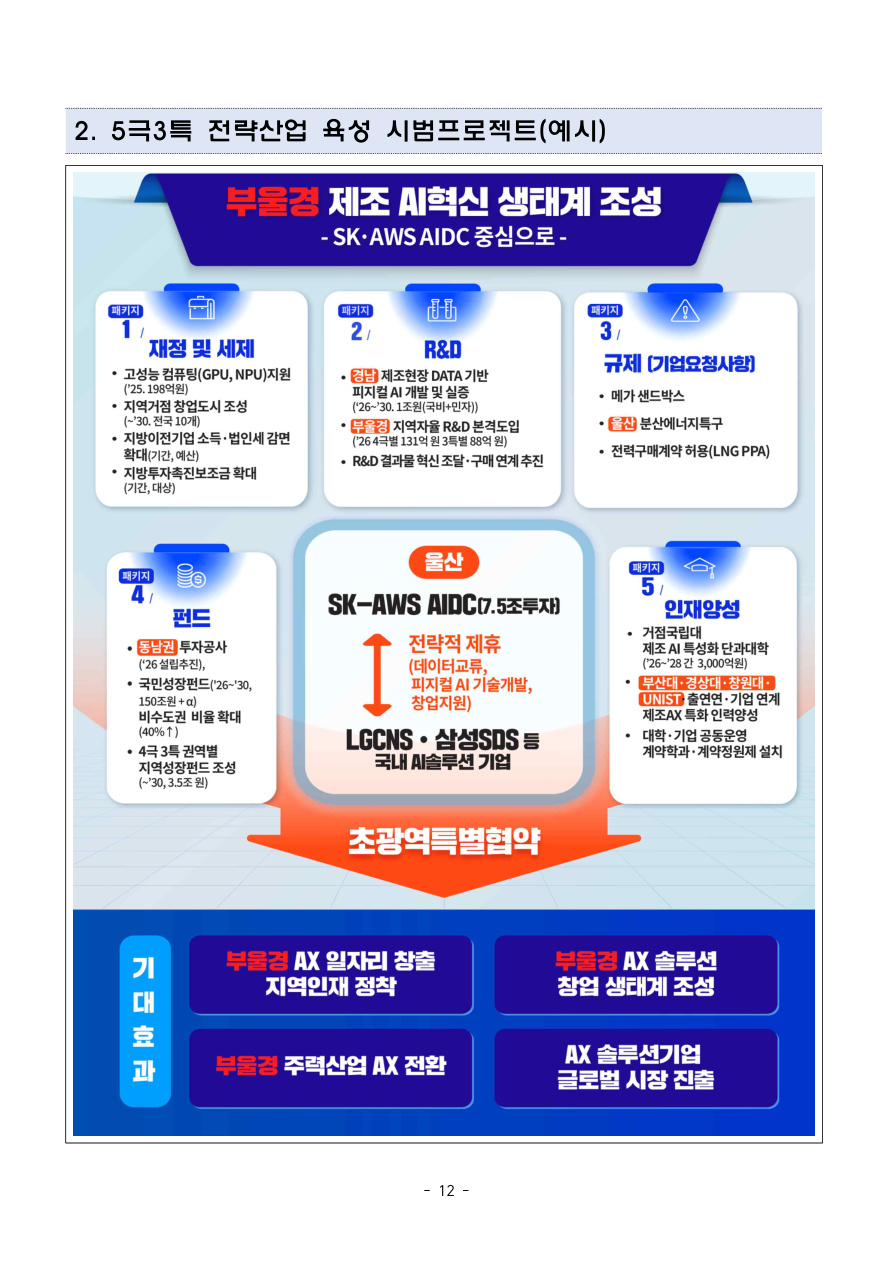
    Official chart showing pilot strategic-industry projects under the Five Poles and Three Special Regions strategy
    Source: Presidential Committee for Local Era and related ministries, Policy Briefing attachment

    This differs somewhat from earlier balanced-development policies. In the past, the central government often chose projects and local regions executed them. This approach emphasizes identifying strategic industries that match regional demand and bundling projects across ministries.

    ## The core of living regions is 60-minute connectivity

    Balanced growth is not only about jobs. For people to live in a region, mobility, healthcare, education, care services, and culture must be connected.

    A notable phrase in the living-region strategy is a 60-minute transport system by region. The idea is to connect hub cities through metropolitan rail, buses, BRT, transfer centers, and integrated mobility services, while expanding demand-responsive transport in underserved areas.

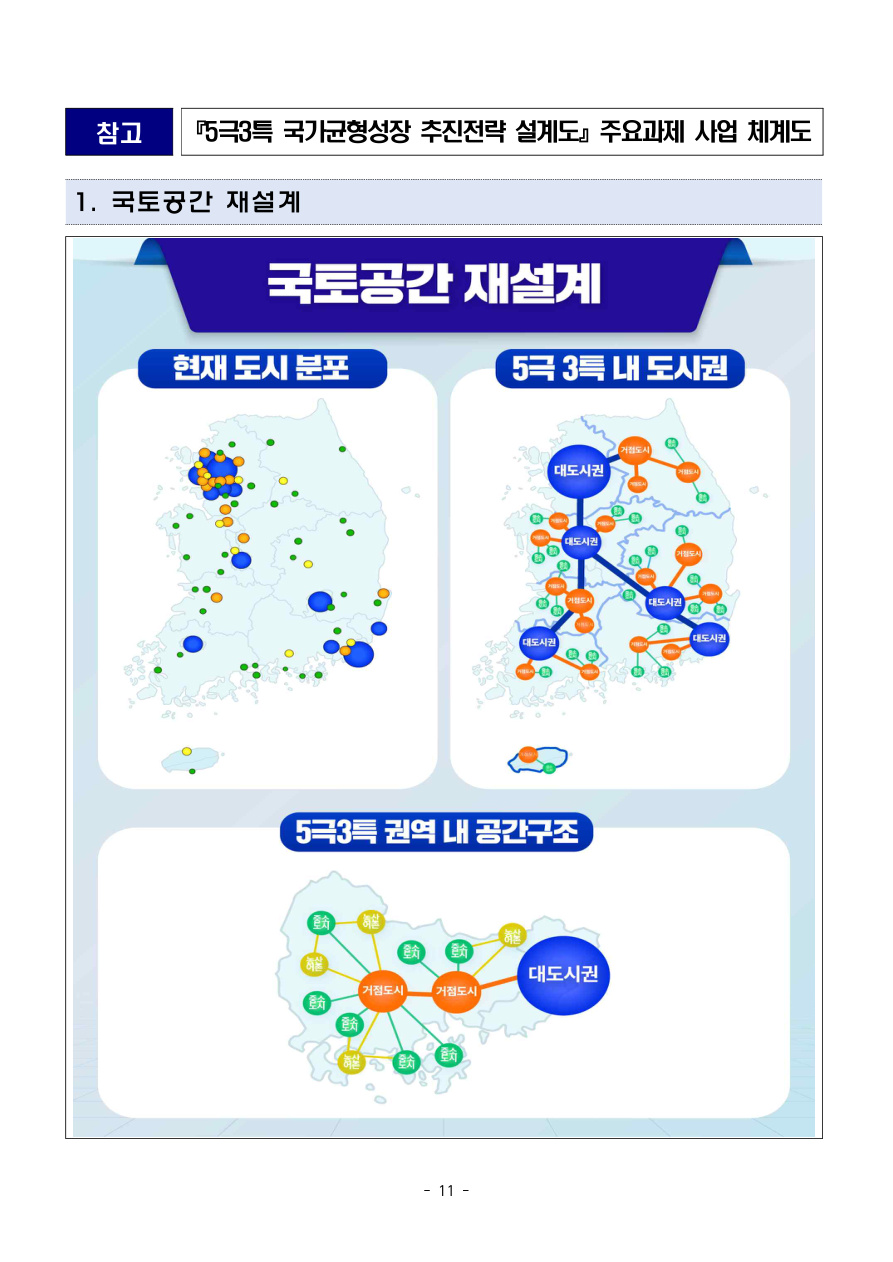
    Map-style chart comparing current city distribution with city regions under the Five Poles and Three Special Regions strategy
    Source: Presidential Committee for Local Era and related ministries, Policy Briefing attachment

    This is the part residents may feel most directly. If commuting and school travel become easier within a region, job options widen. Access to healthcare and culture also changes. If transport connections remain weak, even excellent industrial complexes will struggle to retain people.

    ## The three special regions connect autonomy experiments to growth strategy

    The three special regions are Gangwon, Jeonbuk, and Jeju. They are not merely places with special administrative names. Based on special laws and autonomy, they can design strategies suited to local strengths in tourism, agri-bio, energy, marine industries, forests, data, and AI.

    Still, the label “special self-governing province” does not guarantee growth. Regulatory exceptions, fiscal support, transport networks, talent development, and business attraction must move together. That is why the national strategy says the three special regions should be developed to a level comparable with the five poles.

    ## Administrative and fiscal foundation: cooperation must be institutional

    Mega-regional strategy cannot rely on verbal cooperation alone. Different administrative districts divide budgets, authority, responsibility, and performance evaluation. That is why the strategy treats administrative and fiscal foundations as a separate pillar.

    Government materials propose tools such as special local governments, mega-regional special agreements, special accounts, broader block grants, and preferential support for local regions. In plain terms, the aim is to create a structure in which regions plan together, invest together, and share responsibility together.

    Official chart explaining the administrative and fiscal foundations for implementing the Five Poles and Three Special Regions strategy
    Source: Presidential Committee for Local Era and related ministries, Policy Briefing attachment

    This may determine success or failure. Industrial projects are visible. But if the rules of administration and finance do not change, regional cooperation can easily end as a one-off project.

    ## Five things to check when evaluating the strategy

    • Are regional strategic industries connected to actual investment and hiring?
    • Does the 60-minute living-zone plan change daily mobility, not only maps?
    • Can universities, companies, and research institutes operate as one ecosystem?
    • Are central ministries and local governments sharing budgets and authority?
    • Can the special self-governing regions turn autonomy into measurable growth?

    ## Balanced development is not “redistribution”; it is a redesign of the growth map

    If this strategy is seen only as support for local regions, its core is missed. It is not a proposal to shrink the capital region. It is closer to a judgment that one capital region alone cannot carry the nation’s growth and quality of life.

    For local regions to grow, jobs, education, healthcare, transport, and culture must circulate within the region. That is why the strategy emphasizes living regions over administrative borders, packages over isolated projects, and regional growth engines over short-term support.

    ## Related reading

    ## FAQ
    ### What exactly does Five Poles and Three Special Regions mean?
    It is a policy framework for balanced national growth centered on five mega-regions and three special self-governing provinces. It prioritizes regional economic and living zones over individual administrative districts.
    ### Is it a policy to suppress the capital region?
    Not simply. Official materials describe it as a strategy to ease the one-pole structure centered on Seoul and to connect regional industry, transport, education, and administration so local regions can also become growth engines.
    ### Which regions are the three special regions?
    They are Gangwon State, Jeonbuk State, and Jeju Special Self-Governing Province.
    ### What change would ordinary citizens feel most?
    Transport and daily living zones: 60-minute regional mobility, better healthcare, education and cultural access, and stronger links between local jobs and universities.
    ### What will determine success?
    Whether strategic industries lead to investment and jobs, whether transport links real living zones, and whether central and local governments coordinate budgets and authority.

    ## References

    Original Korean article

  • 2026 Cancer Insurance Comparison Platform Market Forecast

    2026 Cancer Insurance Comparison Platform Market Forecast

    2026 Cancer Insurance Comparison Platform Market Forecast

    Industry future outlook based on regulatory, economic, social, and technological factors

    Original Korean article: Original Korean article.

    Political

    • Platform deregulation: Possibility of formal institutionalization and legislation of comparative recommendation services
    • MyData 2.0: Allows combining public health data and private insurance data
    • Commission rate cap system: Introducing commission guidelines as platform influence expands
    • Strengthening non-benefit management: standardizing new medical technology coverage and increasing comparability

    Economic

    • Medical inflation: Increasing burden of expensive anti-cancer treatment costs such as intermediate treatment
    • Polarization of consumption: Explosion of demand for cost-effective comparisons such as ‘mini cancer insurance’
    • IFRS17 & K-ICS: Intensifying competition in sales of cancer insurance with high profitability (CSM) for insurance companies
    • Demand for sophisticated comparison: Need to find the ‘true lowest price’ due to widening price gap

    Social

    • Entering the super-aging market: mainstreaming of the 5060 active seniors and people with medical conditions market
    • Increase in single-person households: Emphasis on care services such as ‘nursing/housework support’ in addition to diagnosis fees
    • Cancer becomes a chronic disease: Preference for ‘living expenses/recurrence’ coverage rather than death coverage
    • Healthy Pleasure: Discounted insurance premiums for health care (health promotion type) trend

    Technological

    • AI underwriting: Real-time subscription review and approval through health data linkage
    • Hyper-personalized recommendation: Generative AI interprets terms and conditions and curates customized special contracts
    • Consultation automation: 100% AI-complete signup process without human agents
    • Dynamic Pricing: Insurance Premium Calculation Model Based on Wearable Biometric Data

    Insight Summary

    In 2026, the cancer insurance comparison market will evolve from “simple price comparison” to “hyper-personalized recommendations combined with healthcare data.” The combination of deregulation and AI technology expands the market to include the sick and the elderly. ‘Curation capability’ will be the platform’s core competitiveness.

    Article image 1
    Article image 1

    📋 Executive Summary: Beyond price comparison to ‘data curation’

    In 2026, Korea’s cancer insurance comparison and brokerage market will go beyond simply ‘finding the lowest price’ and evolve into a ‘hyper-personalized recommendation market combining healthcare data’**. The structural reorganization of the industry is expected due to the huge wave of financial authorities’ platform deregulation, the full-scale entry of big tech, and the entry into a super-aging society. This report excludes emotional predictions and closely analyzes the 2026 market environment using the PEST technique based on current policy trends and data.

    1. ⚖️ Political (political/institutional environment): Balance between regulatory sandbox and platform fairness

    Government policy is the most powerful variable that determines the ‘fee structure’ and ‘data accessibility’ of cancer insurance comparison services. 2026 will be the first year in which the current pilot operation phase becomes formal legislation.

    📌 Key analysis and status

    • Institutionalization of platform insurance comparison and recommendation services: Services such as Naver Pay, Kakao Pay, and Toss, which are currently operating as innovative financial services (regulatory sandbox) of the Financial Services Commission, will secure legal stability by 2026. However, it is expected that the ‘commission rate upper limit guideline’ for coexistence with the existing insurance industry will become clearer.
    • Strengthening the management of non-covered medical expenses: The government is strengthening the management of manual therapy and non-covered anticancer drugs to ensure financial soundness of health insurance. This leads to the standardization of cancer insurance product structure (special provisions), resulting in increased **’ease of comparison between products’** within the platform.

    🔮 2026 Scenario (Checklist)

    • ✅ [Data Sovereignty] Comprehensive expansion of My Data 2.0: The ‘right to request transmission’ is activated, and the barrier to combining public medical data (National Health Insurance Service examination results) and private insurance company data is lowered. Rather than simply entering age/gender, the process of “being screened directly based on my examination results” is institutionally permitted.
    • ✅ [Sales responsibility] Reinforcement of platform explanation obligations: Brokerage platforms may also be subject to some responsibility for incomplete sales, which will accelerate the introduction of AI terms and conditions analysis technology.

    💡 Insight: Regulations are moving in the direction of lowering the entry barrier for platforms and strengthening ‘responsibility’ at the same time. Compliance capabilities become the competitive edge of the platform.

    2. 📉 Economy: Medical cost inflation and the paradox of cost-effectiveness

    Economic factors provide the fundamental motivation for consumers as to why they compare on platforms. The economic environment of 2026 will explode the need to maximize **’cost efficiency’**.

    📌 Key analysis and status

    • Medical Inflation: The rising rate of medical costs remains higher than the general inflation rate. In particular, the emergence of expensive new medical technologies such as ion therapy and cancer immunotherapy drugs increases the cost of cancer treatment from tens of millions of won to billions of won, stimulating demand for high-coverage cancer insurance.
    • IFRS17 and insurance companies’ strategies: Under the new accounting standard (IFRS17), insurance companies are putting their lives on the line by selling protection insurance (cancer insurance) with high profitability (CSM, contractual service margin) instead of savings insurance that is held as liabilities. This increases price competition between providers within the platform.

    🔮 2026 Scenario (Checklist)

    • ✅ [Consumption polarization] Premium vs. mini insurance: Due to concerns about a prolonged economic downturn, the market is divided into **’DIY mini cancer insurance’**, which excludes unnecessary special provisions, and **’all-in-one premium insurance’**, which completely covers high treatment costs. It is essential for the platform to have a UI/UX that clearly distinguishes between these two needs.
    • ✅ [Price sensitivity] Focus on direct (CM) channels: Preference for direct products without designer fees will peak in 2026, and the proportion of subscriptions through platforms will grow to a level that threatens offline channels.

    3. 👥 Social (social and cultural environment): Combination of super-aging and ‘nursing care’ trends

    Social changes change the very nature of cancer insurance products. By 2026, South Korea will be deep into a super-aging society (more than 20% of the population over 65 years old), which will completely change the target users of the comparative market.

    📌 Key analysis and status

    • Mainstreaming the market for the sick/elderly: If cancer insurance comparisons were the exclusive domain of the 3040 generation in the past, the 5060 generation (active seniors) who are familiar with smartphones will become the key users in 2026. The comparative search volume for ‘simple screening (3-2-5, etc.)’ products will increase rapidly.
    • Single-person households and ‘care’ needs: The increase in single-person households, where it is difficult to expect care from family, makes not only cancer diagnosis fees, but also additional services (Care) such as ‘cancer outpatient treatment costs’, ‘caregiver support’, and ‘housekeeper support’ as key measures of comparison.

    🔮 2026 Scenario (Checklist)

    • ✅ [Perception shift] From treatment to ‘management’: With improved cancer survival rates, cancer is recognized from a ‘deadly disease’ to a ‘chronic disease that can be managed.’ Consumers focus on comparing special contracts for **‘recurrence/metastasis coverage’** or ‘living expenses after treatment’ rather than death insurance benefits.
    • ✅ [Healthy Pleasure] Health-promoting products: Products that provide discounts on insurance premiums based on the amount of daily exercise (walking, etc.) will become common, and the platform will be equipped with a wearable device data linkage function as standard.

    4. 🤖 Technological: AI underwriting and hyper-personalization

    Technology revolutionizes the ‘accuracy’ and ‘speed’ of comparison services. The technological environment of 2026 will elevate services to the level of AI-based consulting, rather than simply listing databases.

    📌 Key analysis and status

    • AI-based pre-underwriting: The moment a consumer accesses the comparison platform, AI analyzes health data and pre-calculates the ‘probability of subscription refusal’**. Technology eliminates the negative experience of “applying to sign up and then being rejected.”
    • Generative AI agent: A service where a chatbot interprets difficult phrases in terms and conditions in 3 seconds and recommends a special contract that is perfect for the user will be commercialized.

    🔮 2026 Scenario (Checklist)

    • ✅ [Process Innovation] 100% non-face-to-face completion: By 2026, the process of completing registration through AI consultation alone without a call to an agent will be established. This dramatically lowers platform operating costs, creating room for additional premium discounts.
    • ✅ [Dynamic Pricing] Dynamic Pricing: A technical foundation has been established in which an individual’s real-time health status (blood pressure, activity level, etc.) is immediately reflected in the insurance premium, allowing the platform to check monthly changing insurance premiums.

    📝 Comprehensive conclusion and suggestions

    In 2026, the cancer insurance comparison market will enter a phase where it is “opened by regulation, expanded by population structure, and completed by AI technology”**.

    🚀 Key suggestions from industry consultants

    1. Simple listing is a failure: simply showing insurance premiums in order is no longer competitive. **’Subscription approval probability-based recommendation’** linked to health examination data will be the winning decision.
    2. Senior UX Optimization: As the 5060 generation emerges as the main consumer group, an interface with **’Aging Tech’** such as large text, intuitive voice search, and easy terminology is essential.
    3. Discovering non-price competitive factors: The ability to curate products that include services that care for life after cancer, such as ‘nursing hospital matching’ and ‘psychological counseling’ in addition to price, will determine the reliability of the platform.

    Good article to read together

    • 🚀 [2026 Forecast] In the era of 400 trillion won in retirement pension, who will win the ‘return war’?
    • 2024-2025 E-Commerce Industry Outlook
    • [HRD Trend] HRD Consulting Industry PEST Analysis: Beyond Education to Tech Solutions
    • 🏛️ How to survive in Jeju’s tourism industry in 2026

    Related Reading

    Continue with these related Thinknote English articles in the Korea Policy & Economy cluster.

    FAQ

    What is this article about?

    This article explains a Korean policy, economy, finance, election, media, job-market, or industry trend for readers who need broader context on Korea.

    How should I use this guide?

    Use it as contextual analysis rather than personal financial, legal, or administrative advice. Check official notices and current data before making decisions.

    Where can I read the original Korean article?

    The original Korean article is available here: Original Korean article.

  • In the 2026 retirement pension era of 400 trillion won, who will be the winner in the competition

    In the 2026 retirement pension era of 400 trillion won, who will be the winner in the competition

    [2026 Outlook] In the era of 400 trillion won in retirement pension, who will win the ‘return war’?

    2026 Retirement Pension Market PEST Analysis

    Profit improvement and operation market outlook

    Original Korean article: Original Korean article.

    • Enhancing default options: Resolving principle and interest guaranteed concentration and inducing competition in returns
    • Introduction of a fund-type system: ‘Economies of scale’ and expansion of expert management through the establishment of a trust corporation
    • Strengthening tax benefits: increasing IRP tax credit limit and maintaining tax deferral
    • Stabilization/falling of interest rates: ‘Performance dividend-type’ money move due to decreasing attractiveness of deposits
    • Global asset allocation: increasing investment in developed/emerging countries and increasing importance of exchange rate strategy (H/UH)
    • Inflation hedge: Seeking real returns to protect against decline in cash value
    • Entering a super-aging society: ‘Withdrawal (TIF)’ strategy beyond simple accumulation and explosion of pension receipt needs
    • Emergence of smart ants: Subscribers with high financial literacy prefer low-cost, high-efficiency products (ETFs, etc.)
    • Personalization of retirement preparation: Increase in single-person households and active asset management through IRP
    • Robo-advisor (RA) discretion: Popularization of AI-based automatic rebalancing and personalized management
    • Activation of platform transfer: One-click ‘retirement pension transfer’ through open banking/my data
    • Hyper-personalized service: Provides AI coaching based on specific goals through big data analysis
    Article image 1
    Article image 1

    The Korean retirement pension market has now passed the era of ‘accumulation’ and entered the era of ‘operation’ and ‘withdrawal’. The size of reserves, which was 382 trillion won in 2023, is expected to reach 500 trillion won in 2026. However, the proportion of products with guaranteed principal and interest, which still remains in the 1-2% range, is the biggest risk in our retirement. Today, in preparation for 2026, I would like to analyze the opportunities and threats in the retirement pension market from a macroscopic perspective (PEST) and share without hesitation the flow of change that I personally felt in the field.

    🏛️ 1. Political (Political·Regulatory Environment): “There is no sleeping money” Forced increase in rate of return

    The first aspect of government policy is clear. **”We will not leave people’s retirement funds sitting in bank deposits”**. This policy drive is expected to become even stronger in 2026.

    ✅ Upgrading and strengthening the evaluation of default options (pre-designated management system)

    • Status: The default option introduced in 2023 will reach maturity in 2026.
    • 2026 Forecast: Beyond the stage of simply introducing a system, the ‘profit rate disclosure’ and ‘product withdrawal’ systems will work strongly. Default option products with low returns are likely to have their approval revoked or be banned from sale.
    • 👨‍💼 Consultant’s Insight: “What I felt during a recent meeting with people in charge of financial companies is that the pressure from the financial authorities is beyond imagination. In the past, only ‘stability’ had to be emphasized, but now there is an atmosphere in which managers who cannot make ‘profits above the inflation rate’ are virtually kicked out of the market. Even corporate human resources (HR) managers are asking ‘yield defense strategy’ as the number one question when selecting managers.”

    ✅ Full establishment of the ‘retirement pension in-kind transfer system’

    • Contents: The physical transfer (moving to another financial company without canceling existing products) system, which was implemented at the end of 2024, will be fully established in 2026.
    • Implications: Barriers between financial companies are breaking down. ‘Money Move’, where funds flow out to places where the rate of return is even 0.1% higher and the fees are lower, has become routine.

    📉 2. Economy (economic environment): Fear of interest rate cuts and ‘real rates of return’

    It is highly likely that the economic situation in 2026 will see a break in the high interest rate trend and a return to medium or low interest rates. This is fatal to products with guaranteed principal and interest.

    ✅ Declining interest rate cycle and decreasing attractiveness of bonds/deposits

    • Analysis: If the deposit interest rate falls from the 3-4% range to the 2% range, the rate of return on retirement pensions cannot keep up with the inflation rate, causing the real value to fall.
    • Response: The transition from fixed interest rate (DB) to performance dividend type (DC, IRP) is bound to accelerate.

    ✅ Global Asset Allocation becomes essential

    • Trend: Domestic stock market (KOSPI) breaking out of box range Due to uncertainty, investment in overseas ETFs such as the US S&P 500, NASDAQ, and Indian markets become the core of retirement pension portfolios.
    • 👨‍💼 Consultant’s Insight: “Looking at actual consulting cases, the IRP account portfolios of office workers in their 30s and 40s are changing rapidly. Customers who had 70% of their deposits just two years ago are currently rebalancing their share of US tech ETFs and TDFs (Target Date Funds) to over 60%. The perception that ‘the director has no answers’ has penetrated deep into the pension market.”

    👥 3. Social (social and cultural environment): The birth of ‘pension ants’ and hyper-aging

    The social atmosphere has changed 180 degrees from ‘passive subscription’ to ‘active investment’.

    ✅ Entry into a super-aging society (population over 65 years old increases by 20%) and emergence of withdrawal strategies (Decumulation)

    • Change: 2025-2026 is the first year that Korea enters a super-aging society. Now, rather than ‘how can I collect it?’, **’how can I subtract it and spend it?’** is more important to look at.
    • Product: The TIF (Target Income Fund) market, which manages assets after retirement and withdraws them like a salary, will grow explosively.

    ✅ Increase in ‘smart pensioners’ with high financial literacy

    • Phenomenon: Individuals who learn through YouTube and investment communities have become more knowledgeable than financial company employees.
    • 👨‍💼 Consultant’s Insight: “When conducting corporate retirement pension training in the field, there are many times when you are surprised. In the past, employees who used to ask, ‘Which is the safest?’ are now asking sharp questions such as ‘How much is the total compensation (TER) of this product?’ and ‘Is it a currency hedging (H) type or an exposure type (UH)?’ ** The ‘good times’ when financial companies only collected fees are over.”

    🤖 4. Technological (technological environment): My retirement assets driven by AI

    Technology is evolving to solve complex pension investments with ‘one click’.

    ✅ Popularization of robo-advisor (RA) discretionary services

    • Innovation: The ‘Retirement Pension Robo-Advisor Delegation’ service, which went through the sandbox in 2024-2025, will become a universal service in 2026.
    • Function: AI analyzes market conditions in real time, adjusts stock/bond proportions, and even performs rebalancing automatically.
    • Outlook: AI operation will become a necessity, not an option, for office workers who have difficulty investing time and effort.

    ✅ UI/UX is competitiveness

    • Platform competition: An intuitive UI that allows you to view your pension assets at a glance, simulate expected receipts, and change products on the fly in a mobile app determines the survival of a financial company.

    💡 [Conclusion and Recommendations] In 2026, only those who are prepared will smile

    The keywords for the retirement pension market in 2026 are **’Active Movement’** and **’AI-based management’**. The key strategies I recommend as an industry expert can be seen as follows:

    1. Individual investor: If your retirement pension account is still 100% in the ‘principal and interest guaranteed type’, start asset allocation using TDF or ETF right now. Prices won’t wait for your retirement savings.
    2. Corporate managers: Rather than insisting on only the defined benefit plan (DB), a systematic financial education program should be introduced so that executives and employees can increase their own returns by switching to the DC plan.
    3. Financial companies: You must keep in mind that the only way to retain customers is not ‘friendly counter staff’, but ‘overwhelming returns’ and ‘convenient AI platform’**.

    “Pension is not a story of the distant future. Only those who read and prepare for the changes of 2026 in advance can enjoy a comfortable retirement.”

    Good article to read together

    • [2026 Industry Outlook] Future of Cancer Insurance Comparison Platform Market
    • 2024-2025 E-Commerce Industry Outlook
    • [HRD Trend] HRD Consulting Industry PEST Analysis: Beyond Education to Tech Solutions
    • 🏛️ How to survive in Jeju’s tourism industry in 2026

    Related Reading

    Continue with these related Thinknote English articles in the Korea Policy & Economy cluster.

    FAQ

    What is this article about?

    This article explains a Korean policy, economy, finance, election, media, job-market, or industry trend for readers who need broader context on Korea.

    How should I use this guide?

    Use it as contextual analysis rather than personal financial, legal, or administrative advice. Check official notices and current data before making decisions.

    Where can I read the original Korean article?

    The original Korean article is available here: Original Korean article.

    Image source: Captured images used in this article are stills from the original YouTube video. They are used for review, commentary, and educational explanation, and copyright remains with the original rights holders and the channel.

  • How to apply for high oil price subsidies: Eligibility, period, and usage at a glance

    How to apply for high oil price subsidies: Eligibility, period, and usage at a glance

    If you are looking for how to apply for high oil price subsidies, it is best to check the official name first. The name of the system used in the government’s official guidance is High Oil Price Damage Subsidy. When searching, the expressions high oil price livelihood support fund, high oil price support fund, and high oil price damage support fund are used together, but actual application and use must follow the official guidance standards.

    Original Korean article: Original Korean article.

    This article is based on official guidance from the Ministry of the Interior and Safety and focuses on who can receive it, when to apply, where to apply, and where it can be used. In particular, it is easy to miss the application period and expiration date. Before applying, please check your eligibility and payment method at the official app, community center, bank branch, or call center.

    Policy Information Confirmation Guide This article was written based on the official guidance confirmed on May 20, 2026. Policy details are subject to change. Before actually applying, check the latest information at the official Ministry of the Interior and Safety information, credit card company app, local love gift certificate app, community center, bank branch, or dedicated call center.

    Image of a domestic gas station to provide guidance on how to apply for subsidies for high oil prices in Korea
    Image of a domestic gas station to provide guidance on how to apply for subsidies for high oil prices in Korea

    Key summary of high oil price subsidies

    Confirmation items Official information standard Key contents Official system name High oil price damage support fund Search expression High oil price livelihood support fund, high oil price support fund, High oil price damage support fund Support targets Official guide standard 70% of citizens Support amount KRW 100,000 to 600,000 per person, differential application method by target and region Online or offline application Online application Card company app/homepage, local love gift certificate App/homepage offline application Community center, bank branch Payment method Local love gift certificate, credit/check card, Choose between prepaid cards. Expiration date: Until August 31, 2026. Contact: High oil price damage relief fund dedicated call center 1670-2626

    The first thing to look at is simple. Confirm the target → Confirm the application period → Select payment method → ​​Confirm where it will be used. You should not judge your amount just by looking at the expression “up to 600,000 won.” The amount of support varies depending on target category and region.

    index

    1. What is high oil price damage subsidy?
    2. Eligibility for application for high oil price subsidies
    3. How much is the support amount?
    4. When is the application period?
    5. How to apply for high oil price subsidies
    6. How to choose a payment method
    7. Where high oil price subsidies are used
    8. Pre-Application Checklist
    9. Frequently Asked Questions
    10. Beware of smishing and fake application sites
    11. Official References

    What is high oil price damage subsidy?

    The high oil price damage subsidy is a policy subsidy introduced to reduce the burden of living caused by high oil prices, high exchange rates, and high inflation. The official guidance from the Ministry of Public Administration and Security uses the name high oil price damage support fund. “High oil price livelihood support fund,” which readers often search for, can be understood as an expression to find this system.

    This system is not a way for cash to be deposited freely. Payment is made through designated payment methods such as local love gift certificates, credit/debit cards, and prepaid cards. There are also criteria for available regions and industries.

    Distinguish it from other oil price support systems

    There are several systems with similar names. For example, the targets and application routes for the truck fuel price subsidy and the agricultural duty-free oil price-linked subsidy are different. This article explains the high oil price damage relief funds for the general public.

    Category Check whether this article is subject to explanation Points Subsidy for damage to high oil prices Yes Based on official guidance from the Ministry of the Interior and Safety Fuel price subsidy for trucks No Separate system related to transportation business operators and vehicles Oil price-linked subsidies for agricultural duty-free oil No Separate system related to agricultural businesses and duty-free oil

    Eligibility for application for high oil price subsidies

    Based on official information, 70% of the population is eligible to apply for high oil price subsidies. One thing to be careful of is that it is difficult for an individual to arbitrarily calculate and determine income and qualifications. It is safe to check whether you are actually eligible through official application channels such as credit card company apps, local love gift certificate apps, community centers, and bank branches.

    Target classification

    The main divisions that can be found in the official guide are as follows.

    • Basic beneficiary
    • Second lower class, single parent family
    • Those in the bottom 70% of income bracket
    • Preferential support by region

    Principles for applying for adults and minors

    Category Application/receipt principle Application/payment for each individual adult Minor householder application/receipt principle Check at the application office whether the minor householder can apply directly

    Adults can understand by applying on their own. In principle, for minors, the head of the household must apply and receive it. One thing to be careful of is that household composition or whether a representative can apply may vary depending on the region and place of application.

    How much is the support amount?

    The amount of high oil price subsidies varies depending on the target category and region. You should not think that everyone receives the same amount just by looking at the phrase “up to 600,000 won.”

    Category Metropolitan area Non-metropolitan area Remarks Basic recipient 550,000 won 600,000 won Official guide standard Second highest income/single parent 450,000 won 500,000 won Official guide standard Bottom 70% income 100,000 won 150,000 won Official guide standard Area with declining population Preferential support area 200,000 won 200,000 won Separate preference Special support area 250,000 won 250,000 won Separate preference

    For example, basic beneficiaries are advised to receive 550,000 won in metropolitan areas and 600,000 won in non-metropolitan areas. On the other hand, those in the bottom 70% income bracket are advised to receive 100,000 won in metropolitan areas and 150,000 won in non-metropolitan areas. Please check your amount on the application screen or through the official consultation channel.

    When is the application period?

    The application period for high oil price subsidies varies depending on the target category. In particular, a distinction must be made between the first application for basic and second-level applications and the second application for 70% of the population.

    Category Application/Payment Period Remarks Basic/Next-highest 1st round 2026.4.27.(Mon) ~ 2026.5.8.(Fri) Priority payment to vulnerable groups Basic/Next-highest 2nd 2026.5.18.(Mon) ~ 2026.7.3.(Fri) 1st Non-applicant, etc. Need to be confirmed 70% of citizens 2nd Application period for general applicants: 2026.5.18. (Mon) ~ 2026.7.3. (Fri)

    If you have already applied and received payment in the first period, you are informed that duplicate applications and payments cannot be made in the second period. If you are confused about which period you are eligible for, check first whether you are eligible on the application screen.

    Check the day schedule for the first week of application

    There may be a lot of connections and visits in the early stages of application. In some guides, a day system is based on the last digit of the year of birth. Check the information on the card company app, local love gift certificate app, community center, and bank branch before applying.

    How to apply for high oil price subsidies

    Image of a domestic card terminal to provide information on payment methods for Korea's high oil price subsidies.
    Image of a domestic card terminal to provide information on payment methods for Korea’s high oil price subsidies.

    Application methods for high oil price subsidies are largely divided into online and offline. If you are familiar with using the smartphone app, applying online is easy. If you need to check in person or have difficulty using the app, you can use a community center or bank branch.

    How to apply online

    Online application can be made through the following route:

    • Card company app or card company website
    • Local Love Gift Certificate app or website
    • Call center/ARS information for some application channels

    The general flow can be seen like this.

    1. Access card company app or local love gift certificate app
    2. Identity verification
    3. Check whether you are eligible for oil price damage subsidies
    4. Select payment method
    5. Check application details
    6. Application completed
    7. Confirm payment or recharge

    Menu names may vary depending on the credit card company. Check out “High Oil Price Damage Subsidy,” “High Oil Price Subsidy,” and “People’s Livelihood Support Fund” in the search box. It’s safest to look for it within the official app.

    How to apply offline

    Offline applications can be made at the following locations:

    • Community center with jurisdiction over address
    • Affiliated Bank Branch

    Please have your ID ready before your visit. It is a good idea to check in advance the operating hours, whether the day of the week system applies, and whether proxy applications are possible. The counter may be crowded, especially on closing days, so please allow plenty of time.

    How to choose a payment method

    High oil price damage subsidies are received by selecting a payment method. The official guide informs you that you can choose between local love gift certificates, credit/check cards, and prepaid cards.

    Advantages of payment methods Points to check Local Love Gift Certificates Good to use at local merchants Need to check available merchants Credit/debit cards Can be used with cards you normally use Need to check if card company can apply Useful if using prepaid card app is difficult Need to check pickup location and stores that can be used

    Which method is best depends on your lifestyle. If you use cards a lot on a regular basis, credit or check cards may be convenient. If you frequently use local stores, a local love gift certificate is a good choice.

    Where high oil price subsidies are used

    An image of a domestic traditional market that can be seen as an example of how Korea's high oil price subsidy funds can be used
    An image of a domestic traditional market that can be seen as an example of how Korea’s high oil price subsidy funds can be used

    The confirmation method for the use of high oil price livelihood support funds is slightly different depending on the payment method. This is a structure commonly used in the jurisdiction of the applicant’s address. Check the standards for special/metropolitan cities and city/county levels.

    Basic usage criteria

    Item Content Expiration date Until August 31, 2026 (Monday) Area of ​​use Applicant’s jurisdiction Special/metropolitan city and city/county Local Love Gift Certificate Local Love Gift Certificate Credit, check, and prepaid cards cannot be used at affiliated stores Focused on small business stores with sales of KRW 3 billion or less, excluding businesses

    Where use may be restricted

    The official guidance explains that industries that cannot be used, such as entertainment and gambling industries, are excluded. In general, department stores, hypermarkets, corporate supermarkets, and online shopping malls may be restricted. One thing to note is that detailed standards may vary depending on region and payment method.

    Before use, check whether the merchant is affiliated with the card company app or local love gift certificate app. You can also receive guidance on how to use it at community centers or call centers.

    Be sure to check the expiration date

    The expiration date is until August 31, 2026. After the period expires, the remaining amount may not be available or refunds may be limited. If you have received a subsidy, it is recommended that you use it within the deadline according to your living expenses spending plan.

    Pre-Application Checklist

    Please check the items below in order before applying.

    • [ ] It was confirmed that the official name of the system is High Oil Price Damage Support Fund.
    • [ ] I checked whether I was a basic recipient, second-lowest income/single parent, or bottom 70% of income earner.
    • [ ] I confirmed the application period.
    • [ ] Checked whether the day system applies in the first week of application.
    • [ ] I decided whether to apply online or offline.
    • [ ] The payment method was decided among cards, local love gift certificates, and prepaid cards.
    • [ ] We confirmed the area and place of use.
    • [ ] It was confirmed that the expiration date is August 31, 2026.
    • [ ] Instead of using a text link, I accessed the official app or official website directly.
    • [ ] If you have any questions, please contact the dedicated call center at 1670-2626 or the community center.

    Frequently Asked Questions

    Will all citizens receive subsidies for high oil prices?

    no. Based on official guidance, 70% of the population is eligible. Please check whether you are actually eligible through official channels such as the application screen or community center.

    Is the official name of the high oil price livelihood support fund?

    The name of the system in the government’s official information is High Oil Price Damage Subsidy. One thing to watch out for is that in searches, the expressions “high oil price support fund” and “high oil price support fund” are also used.

    If I get it in the first round, can I also get it in the second round?

    According to the official information, if you applied and received payment in the first period, you cannot apply or receive payment twice in the second period.

    Where do I apply online?

    You can apply through the card company app/homepage or the Local Love Gift Certificate app/homepage. Some channels also provide call center or ARS guidance.

    Can I apply at a community center?

    yes. Offline applications can be made at community centers and bank branches. Please check operating hours and required documents before visiting.

    Is the subsidy paid in cash?

    Based on the official guide, you can choose between local love gift certificates, credit/check cards, and prepaid cards. It should not be understood as a regular cash deposit.

    Where can I use it?

    It can be used mainly at local love gift certificate affiliated stores in the jurisdiction of the address or small business stores with sales of 3 billion won or less, excluding businesses where use is not allowed. Please check the app or official instructions for actual availability.

    When is the expiration date?

    According to official information, the expiration date is August 31, 2026.

    Beware of smishing and fake application sites

    During the subsidy application period, the number of impersonated text messages and fake application sites may increase. Do not immediately click on the link included in the text. It is safer to access directly through trusted channels such as the credit card company’s official app, local love gift certificate official app, official information from the Ministry of Public Administration and Security, and community centers.

    We recommend that you avoid the following actions:

    • Click on text link from unknown source
    • Accessing unofficial sites that request personal and account information
    • Install the Local Love Gift Certificate app from a location other than the App Store
    • The act of providing an authentication number or password over the phone
    • Responding to SNS messages impersonating official organizations

    If you receive any suspicious information during the application process, please contact the dedicated call center or community center first.

    finish

    The method of applying for high oil price subsidies may seem complicated, but it is not difficult if you break down the steps. First, check if you are eligible and check the application period. Then, select the online or offline application route and confirm the payment method and usage.

    The first thing to look at is using the official route. Please apply at card company apps, local love gift certificate apps, community centers, bank branches, etc. Before use, be sure to check with the affiliated store and the expiration date.

    Policy-related articles can also be found in the policy information category.

    Official References

    • Ministry of the Interior and Safety — Official information on high oil price damage subsidies
    • Busan Metropolitan City — Example of high oil price damage subsidy information
    • Kookmin Shinmungo — Link to objection information

    image source

    • Wikimedia Commons — Hyundai Oilbank Songak Gas Station 20240729.jpg , CC0
    • Wikimedia Commons — YeongchunBus-Cardreader.jpg , Public Domain
    • Wikimedia Commons — Gukje Market Busan South Korea 01.jpg , CC0

    Good article to read together

    • Summary of festivals in Korea in May 2026: Schedule by region and theme
    • Top 10 Hydrangea Spots in Korea, from flowering time to parking check
    • Top 10 Korea travel destination recommendations for June, from hydrangeas to festivals, all in one place
    • Summary of festivals in Korea in June 2026: Schedule by region and theme

    Related Reading

    Continue with these related Thinknote English articles in the Korea Policy & Economy cluster.

    FAQ

    What is this article about?

    This article explains a Korean policy, economy, finance, election, media, job-market, or industry trend for readers who need broader context on Korea.

    How should I use this guide?

    Use it as contextual analysis rather than personal financial, legal, or administrative advice. Check official notices and current data before making decisions.

    Where can I read the original Korean article?

    The original Korean article is available here: Original Korean article.

  • Frame analysis of Samsung Electronics union article: Between “Let’s talk” and “We refused”

    Frame analysis of Samsung Electronics union article: Between “Let’s talk” and “We refused”

    This is an article about the same Samsung Electronics union, but in some media it looks like Samsung Electronics is trying to talk, while in other media it looks like the union is rejecting the mediation plan. Facts are one thing, but your title and word choice make a different first impression on the reader.

    삼성전자 노조 보도의 상반된 미디어 프레임을 분석하는 이미지
    같은 이슈를 서로 다른 기사 프레임으로 비교 분석하는 장면을 표현한 이미지

    Original Korean article: Original Korean article.

    This article is not intended to judge whether the labor-management conflict itself at Samsung Electronics is right or wrong. The first thing to look at is the Samsung Electronics union report frame. Let's compare what titles and keywords Chosun Biz, Dong-A Ilbo, Yonhap News, Kyunghyang Shinmun, and Korea Economy reports presented on the same issue.

    The positive and negative nuances mentioned in this article do not refer to the overall tendency of the media company, but rather the impression that the title of the article and the first part of the text may give to readers.

    1. Same incident, different first impressions

    The first aspect of the labor-management conflict at Samsung Electronics is the institutionalization and payment standards for performance bonuses. The union requested the institutionalization of performance bonus resources and the abolition of the upper limit, and Samsung Electronics management was reported to be maintaining the existing performance bonus operation principles but suggesting the possibility of additional compensation. The Central Labor Relations Commission requested the resumption of follow-up mediation, and Samsung Electronics also proposed additional talks to the union.

    However, the titles of each media company create slightly different impressions.

    • Samsung Electronics is expressed as ‘let’s talk’, sending official documents, and suggesting further dialogue.
    • The union is associated with statements such as “there is no reason for dialogue,” “rejecting the mediation plan,” and “forcing a strike.”
    • The Central Labor Relations Commission appears as a mediator requesting resumption of negotiations and substantive negotiations.

    This difference is the sidewalk frame.

    2. Analysis criteria: title, verb, keyword, information placement

    When looking at the nuances of an article, it is good to check four things.

    1. The reader's perspective changes depending on who the subject of the title is: Samsung Electronics, the labor union, or the government and the Central Labor Relations Commission.

    2. Key verbs such as proposed, requested, refused, and forced something all have different emotional values.

    3. To whom are negative keywords attached? If refusal, force, confrontation, and impossible are repeatedly attached to the union, the union appears to be hard-line.

    4. Where are counterarguments and backgrounds placed? The reader's first impression varies depending on which position appears first in the text.

    Let’s look at the reports by media companies based on this standard.

    3. Chosun Biz: Samsung Electronics is a “proponent of dialogue,” and the union is a “conditional rejecter.”

    • Article link: Chosun Biz article
    • Representative title: Samsung Electronics “Let’s talk directly”… Send an official letter to the union
    • Nuance Keywords: Let’s talk directly, send an official document, no reason for conversation, institutionalization of performance bonuses

    The central subject of the Chosun Biz title is Samsung Electronics. Samsung Electronics appears as the entity that proposed “let’s talk directly.” Just looking at this title, it looks like Samsung Electronics is moving to solve the problem.

    On the other hand, the union's position is presented in the text as a conditional rejection: “There is no reason for dialogue unless performance-based pay is institutionalized and made transparent.” In this structure, it seems as if Samsung Electronics is opening the door to dialogue and the union is not responding by putting forward conditions.

    In other words, the Chosun Biz report places Samsung Electronics' willingness to negotiate at the forefront while making the union's position appear to be presenting strong conditions.

    4. Dong-A Ilbo: The union criticism frame created by “rejecting the arbitration plan”

    • Article link: Donga Ilbo article
    • Representative title: Samsung union rejects ‘12% operating profit’ arbitration proposal
    • Nuance Keywords: Rejecting arbitration proposal, maintaining 15% operating profit, going ahead with strike, unprecedented in history

    The word that feels most strongly in the Dong-A Ilbo report is rejected. In particular, we need to look more closely at the expression “arbitration plan.” It gives the impression that they did not simply reject the company's proposal, but did not even accept the compromise proposed by the government or arbitration organization.

    Additionally, expressions such as maintaining 15% operating profit, going on strike, and unprecedented semiconductor strike make it seem like the union is focusing on meeting demands rather than negotiation. In this case, readers may naturally get the impression, “Aren’t the union’s demands excessive?”

    The Dong-A Ilbo report is read as a frame that highlights the union's intransigence more strongly than Samsung Electronics' management.

    5. Yonhap News: The format is balanced, the title structure is confrontational.

    • Article link: Yonhap News article
    • Representative title: Government, Samsung Electronics, proposal for additional dialogue… Union: “There is no reason for dialogue”
    • Nuance Keywords: additional conversation suggestion, no reason for conversation, confrontation, parallel line

    As a news agency, Yonhap News conveys both sides' positions relatively in parallel. The government, Samsung Electronics, and labor unions also appear in the title.

    However, if you look at the title structure alone, the impression may be one-sided. In the first part, there is a proposal for additional dialogue between the government and Samsung Electronics, and in the latter part, the union says, “There is no reason for dialogue.” This arrangement gives the impression that although the government and Samsung Electronics have offered talks, the union is being shut out.

    So, the Yonhap News report is formally balanced, but just looking at the placement of the verbs in the title, it can be read as one in which the union maintains a confrontational structure.

    6. Kyunghyang Shinmun: Focus on resumption of negotiations and industrial impact rather than criticism of union

    • Article link: Kyunghyang Shinmun article
    • Representative title: [Breaking News] Central Labor Relations Commission requests Samsung Electronics labor and management to resume negotiations on the 16th
    • Nuance keywords: request to resume negotiations, sincere dialogue, substantive negotiations, industry-wide ripple effect

    The central subject of the Kyunghyang Shinmun title is neither Samsung Electronics nor the labor union. This is the Central Labor Committee. The title itself focuses on calls to resume negotiations rather than criticism of specific parties.

    The text can also be seen as explaining why the Central Labor Relations Commission requested post-adjustment again and what kind of ripple effect it could have on the entire industry if the Samsung Electronics labor-management conflict is prolonged.

    Rather than directly criticizing the union, this report emphasizes the situation in which negotiations have stalled and its social and economic impact. So it gives a relatively more neutral impression than other articles.

    7. Korean Economy: Burden of institutionalizing performance bonuses from an economic magazine perspective

    • Article link: Korea Economy article
    • Representative title: Samsung Electronics “Let’s talk”… Union: “It is impossible without performance-based pay systemization”
    • Nuance Keywords: Let’s talk, institutionalization of performance bonus, transparency, impossible

    The Korean Economic title juxtaposes Samsung Electronics and labor unions. Samsung Electronics is expressed in terms of “let’s talk,” and the union is expressed in terms of putting forward the condition that it cannot be done without the institutionalization of performance bonuses.

    From a business magazine's perspective, institutionalization of performance-based pay, the possibility of strikes, and the burden of corporate management naturally become important issues. So, even if the background to the union's demands is explained, the reader is also reminded of the burden on the operational side of the company.

    The Korean economic report is close to a frame that reads Samsung Electronics as a requester for dialogue and the labor union as a conditional rejecter.

    8. Frame comparison table by media company

    Media company's title's central subject Impression attached to the union Impression attached to Samsung Electronics and the government Key keywords Chosun Biz Samsung Electronics Conditional rejection Proposal for dialogue Direct dialogue, official document, no reason for dialogue Dong-A Ilbo Union hard-line and non-compromising Possibility of accepting mediation and compromise proposal Rejects arbitration plan, sticks to it, goes ahead with strike Yonhap News Government-Samsung Electronics vs. labor union Proposal for additional dialogue Proposal for dialogue, no reason for dialogue, parallel line Kyunghyang Shinmun Central Labor Relations Commission Relatively neutral mediation necessary Resumption of negotiations, substantive negotiations, industrial impact Korea Economy Samsung Electronics vs. Union's conditional rejection Request for dialogue Let's talk, impossible without institutionalization

    Looking at the table, the differences are clearer. In many articles, Samsung Electronics and the government are linked to dialogue, proposals, and arbitration. On the other hand, unions are often associated with refusal, impossibility, and enforcement.

    9. Positive/negative keyword mapping

    Expression Mainly connected target Impression that can be given to the reader Let's talk Willingness to resolve the Samsung Electronics issue Proposal for further dialogue Government-Samsung Electronics negotiation efforts Request for resumption of negotiations Role as mediator of the Central Labor Relations Commission No reason for dialogue Union's hard-line attitude Rejecting mediation proposals Union's intransigent attitude Going on strike Expansion of industrial risks of union Impossible without institutionalization of performance bonus Union's conditional negotiation attitude

    What is important here is who the word is attached to rather than the word itself. If dialogue is attached to Samsung Electronics and refusal is attached to the union, readers are naturally more likely to perceive Samsung Electronics as the negotiating party and the union as the opposing party.

    10. Readers should read the news with this in mind

    When reading the Samsung Electronics union report frame, it is necessary to ask the following questions.

    • Who is the subject of the title?
    • What is the strongest verb? Is it an offer, a rejection, or a push?
    • On which side are negative words repeatedly attached?
    • Is the rebuttal included in the title or placed at the end of the main text?
    • Can you tell whether the article conveys facts or is an expression mixed with interpretation?

    News conveys facts, but it also conveys a framework for interpreting those facts. So, rather than drawing conclusions by looking at just one article, you should get into the habit of comparing titles and keywords from different media outlets.

    11. Conclusion: News conveys not only facts but also frames

    Reports on the Samsung Electronics labor-management conflict were generally structured so that Samsung Electronics and the government were read as proponents of dialogue, and the labor union was read as a proponent of hard-line conditions or a rejecter. In particular, the contrast between Let's Talk and I Rejected makes it easy for readers to perceive Samsung Electronics and the government as negotiating entities and the union as non-compromising entities.

    Of course, this does not mean that union demands are necessarily unreasonable. On the other hand, this does not mean that Samsung Electronics management is always rational. The first part of this article is to check how the article title and keywords affect the reader's judgment.

    Comparing multiple articles covering the same event makes the news appear more three-dimensional. In particular, when it comes to issues with complex interests such as economic and labor issues, we must read not only the facts but also the frame.

    reference article

    https://n.news.naver.com/mnews/article/366/0001164259?sid=105

    https://n.news.naver.com/mnews/article/020/0003719512?sid=101

    https://n.news.naver.com/mnews/article/001/0016076990?sid=101

    https://n.news.naver.com/mnews/article/032/0003445710?sid=102

    https://n.news.naver.com/mnews/article/015/0005286917?sid=101

    • Chosun Biz, Samsung Electronics “Let’s talk directly”… Send an official letter to the union
    • Dong-A Ilbo also rejected Samsung union’s ‘12% operating profit’ arbitration proposal
    • Yonhap News, government, Samsung Electronics propose additional dialogue… Union: “There is no reason for dialogue”
    • Kyunghyang Shinmun, [Breaking News] Central Labor Relations Commission requests Samsung Electronics labor and management to resume negotiations on the 16th
    • Korea Economy, Samsung Electronics “Let’s talk”… Union: “It is impossible without performance-based pay systemization”

    Good article to read together

    • [HRD Trend] HRD Consulting Industry PEST Analysis: Beyond Education to Tech Solutions
    • 2024-2025 E-Commerce Industry Outlook
    • 🚀 [2026 Forecast] In the era of 400 trillion won in retirement pension, who will win the ‘return war’?
    • [2026 Industry Outlook] Future of Cancer Insurance Comparison Platform Market

    Related Reading

    Continue with these related Thinknote English articles in the Korea Policy & Economy cluster.

    FAQ

    What is this article about?

    This article explains a Korean policy, economy, finance, election, media, job-market, or industry trend for readers who need broader context on Korea.

    How should I use this guide?

    Use it as contextual analysis rather than personal financial, legal, or administrative advice. Check official notices and current data before making decisions.

    Where can I read the original Korean article?

    The original Korean article is available here: Original Korean article.