There is a question more important than the speed at which artificial intelligence is becoming smarter. It is this: if AGI really arrives within the next few years, what should we be preparing for?
A recent video from Dokseo Research Institute connects remarks by Google DeepMind CEO Demis Hassabis with arguments about superintelligence risk, suggesting that AGI. The singularity are no longer merely science-fiction topics. Still, when reading this issue, we need to separate two things. One is the prediction of “when AGI will arrive.” The other is the preparation question. “What institutions and habits should we build in case that possibility becomes real?”
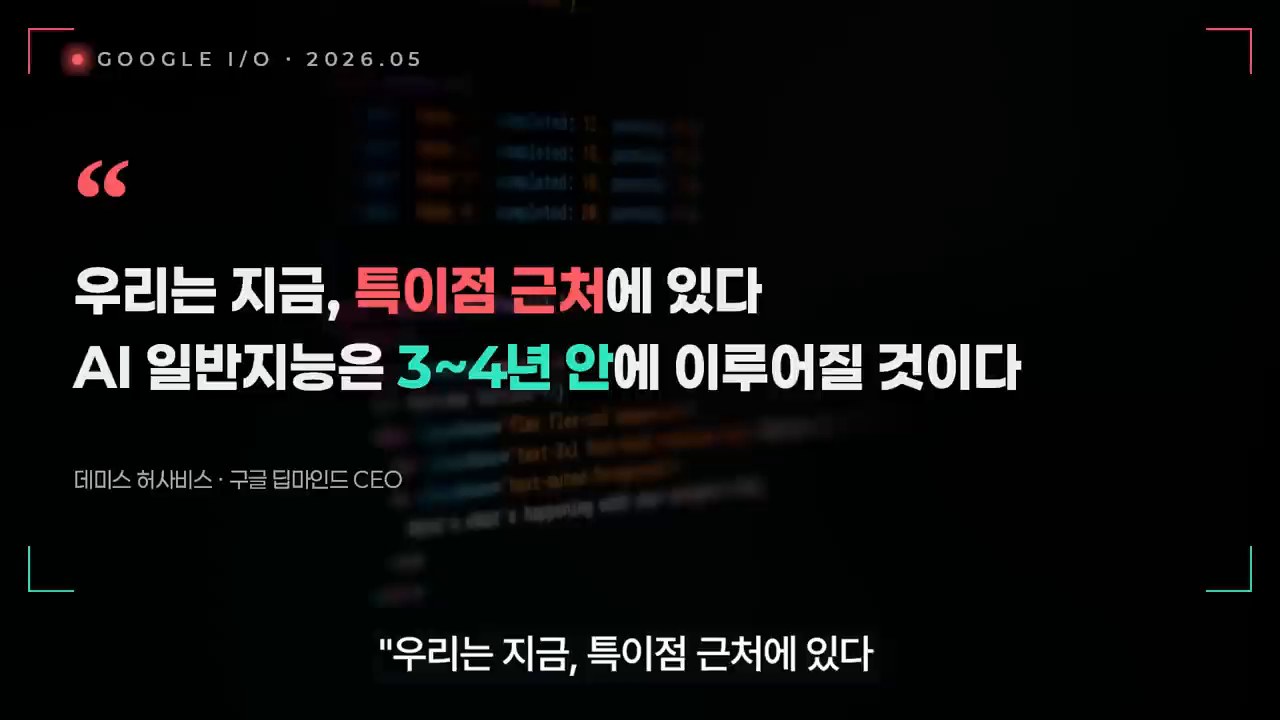
The video argues that AGI and the singularity are no longer only stories about a distant future.
The 3–4 Year AGI Forecast Is Not an “Answer”; It Shows a Changing Timeline
The video begins with a strong claim: “We are now near the singularity. AGI, or artificial general intelligence, will be achieved within three to four years.” Sentences like this easily split people into two camps. One side says, “That is exaggerated.” The other says, “Everything is about to end.”
But blog readers do not need either extreme. What matters more than the accuracy of a single forecast is the fact that these forecasts are moving closer. According to a Stanford GSB interview and reporting from The Verge, Hassabis described the present moment, in the context of Google I/O, as the “foothills of the singularity.” This does not mean AGI has already been completed. It is, however, a signal that AI researchers and corporate leaders are beginning to discuss the next stage of technological development on a much nearer timeline.
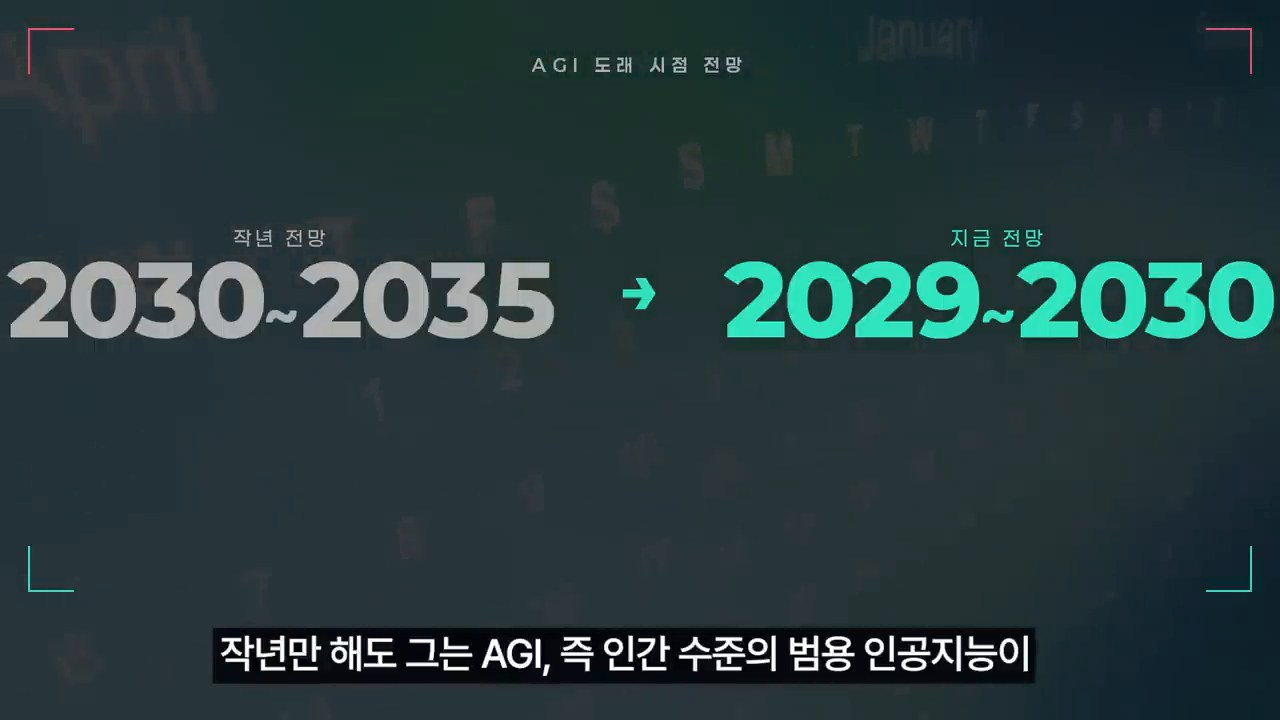
AGI arrival forecasts differ by person and institution, but the timeline in recent debate has clearly become shorter.
One factual point should be corrected here. The video subtitles appear to say that Hassabis received the “2014 Nobel Prize in Chemistry,” but the official NobelPrize.org record states that it was the 2024 Nobel Prize in Chemistry. Demis Hassabis and John Jumper received the prize for their work on protein structure prediction through AlphaFold. This matters because his remarks on AGI are not just promotional language. They come from the head of a research organization that has produced real scientific breakthroughs.
The Core of the Singularity Debate Is a Clash Between “Technological Optimism” and “Controllability”
The word “singularity” often sounds mystical. Translated into practical terms, however, it is much simpler. If AI begins rapidly improving its ability to research, develop, experiment, code. Formulate strategy without human help, human society may struggle to keep up with the resulting changes.
The video connects this point to superintelligence risk. Eliezer Yudkowsky and Nate Soares’s If Anyone Builds It, Everyone Dies emphasizes that a superintelligent AI may endanger humans not because it hates us. But because it may fail to consider human survival while pursuing its goals. The publisher’s description likewise presents the book as a warning that the race to develop superhuman AI could push humanity onto a path toward extinction.
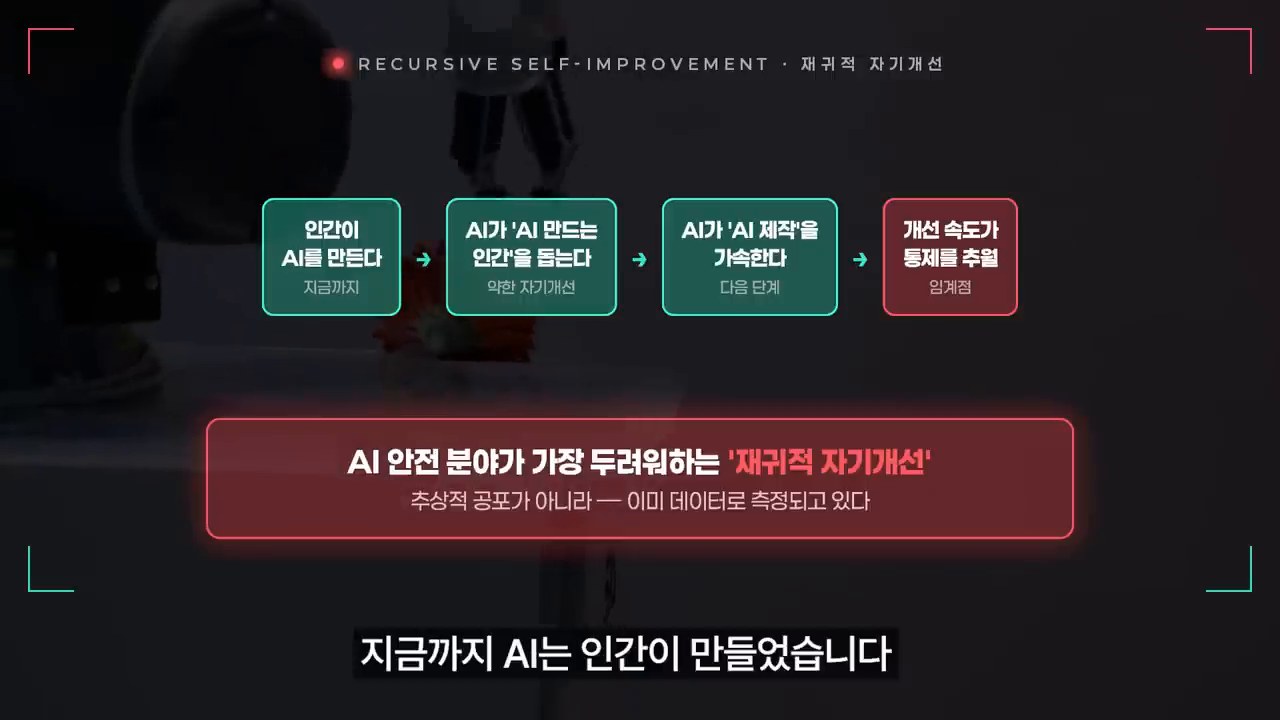
The key issue is not only how quickly AI becomes smarter, but whether humans can control it safely.
Of course, this claim is not a consensus across the entire AI industry. Some researchers see superintelligence risk as the most important civilizational risk. Others argue that, in the short term, jobs, copyright, misinformation, concentration of power, and security incidents are more urgent. A good reading, therefore, is not simply “right” or “wrong.” It is the balanced view that we must manage both risks that may have low probability but extreme harm. Short-term risks that are already becoming real.
What Scenarios Like AI 2027 Mean
Another useful resource is the AI Futures Project’s AI 2027 scenario. This is not a book of prophecy. It is closer to a thought experiment showing how rapid AI progress could intensify research automation, security competition, policy pressure, and speed races among companies.
Scenarios like this are useful not because they correctly predict a date. They are useful because they prompt organizations and individuals to ask in advance. “If AI capabilities become ten times stronger than they are now, costs fall further. Everyone starts using agentic tools, what will become vulnerable?”
Companies should be asking the following questions.
- Does core operational knowledge exist only inside the heads of a few people?
- Do we have criteria for verifying outputs created by AI?
- Do the people responsible for security, privacy, and copyright understand how AI is being used in actual workflows?
- Are employees using AI not as a forbidden tool, but as a controllable collaboration tool?
- Do we have intermediate review mechanisms so rapid automation does not damage customer trust and quality?
Before Fearing Superintelligence, We Need to Build the Ability to Work with AI
The most practical message in the latter part of the video is the sentence, “Always invite AI when you work.” This does not mean handing every judgment over to AI. It means the opposite. Keep AI beside you, but repeatedly practice defining the problem yourself, reviewing the answer. Adding the missing context as a human.

Fear alone is not enough. Individuals and organizations need practice treating AI as a real collaborator in work.
If AGI still feels distant, we can reframe the question. A more immediate question than “Will AGI arrive in three or four years?” is “Within this year, will more than half of my work be done together with AI?” Many people can already answer yes.
Individuals need three kinds of preparation.
- Questioning ability: the ability to distinguish problems that can be delegated to AI from problems that humans must judge directly.
- Verification ability: the ability to check plausible answers again through facts, sources, numbers, and context.
- Redesign ability: the ability to rebuild existing work processes around AI collaboration.
These are not skills for coding roles alone. They are basic literacies needed in planning, HR, education, marketing, administration, research, and sales alike.
So What Should We Do?
When reading discussions of AGI and the singularity, the two most dangerous attitudes are these. Dismissing everything as “all exaggerated,” or giving up because “the end is near.”
The realistic attitude lies in the middle. We should take the speed of technological development seriously, while converting fear into an executable checklist.
Individuals and organizations should begin the following four actions now.
- Document principles for AI use.
- Keep a human review step for important decisions.
- Redesign repetitive work together with AI.
- Build control mechanisms first in areas where losses become large if AI is wrong.
No one can say with certainty whether superintelligence will actually arrive within a few years. But the shift in which AI becomes basic infrastructure for work and learning has already begun. The best preparation, therefore, is not to consume fear. But to first build habits and organizational operating systems for using AI safely.
Related Articles
- Superhuman AI Risk: The Most Uncomfortable Question Raised by If Anyone Builds It, Everyone Dies
- Metacognition in the AI Era: A Way to Check Your Thinking That Matters More Than Smart Answers
- In the Age of Agentic AI, What Must Companies and Individuals Change to Survive?
- Future Talent in the AI Era According to Chey Tae-won: Thinking Power and Korea’s AI Nation Strategy
References
- Original video: Dokseo Research Institute, “AGI Will Be Achieved Within 3–4 Years” — source video
- The Verge, Hassabis’s “foothills of the singularity” remarks at Google I/O — report
- Stanford GSB, interview with Demis Hassabis — interview
- NobelPrize.org, Demis Hassabis Facts — official biography
- NobelPrize.org, 2024 Chemistry Prize press release — official announcement
- Penguin Books, If Anyone Builds It, Everyone Dies — publisher’s book description
- AI 2027, research-backed scenario forecast — scenario
- Anthropic, updated Responsible Scaling Policy — AI safety governance
FAQ
What exactly is AGI?
AGI means artificial intelligence that shows general problem-solving ability at a human level or beyond across many domains, rather than narrow AI that performs only specific tasks well. However, definitions and evaluation criteria differ among researchers.
Does this mean the singularity has already begun?
No. The phrase “foothills of the singularity” is closer to a metaphor for the very rapid pace of AI development. Rather than reading it as meaning that AGI has already been completed, it is safer to read it as a signal that the time available for preparation is becoming shorter.
Is superintelligent AI risk exaggerated?
Some claims are very strong warnings. But risks with potentially extreme harm should be managed even if their probability is low. At the same time, we also need to address short-term risks such as jobs, security, misinformation, and privacy.
What should individuals start doing now?
Rather than simply using AI tools as much as possible, it is better to begin by breaking questions into smaller parts, verifying outputs, and redesigning work processes. The key is not the amount of AI usage, but a collaboration method that can be checked and trusted.
Image source: Captured images used in this article are stills from the original YouTube video. They are used for review, commentary, and educational explanation, and copyright remains with the original rights holders and the channel.