
Have you ever opened an app to look at fortune tellers or Tojeong secrets, but were suddenly blocked by the word “Manpower Calendar”? Anyone can find it difficult if they just enter their date of birth, but encounter Chinese characters and unfamiliar terms such as Byeong-o-nyeon, Imjin-wol, and Eulhae-il.
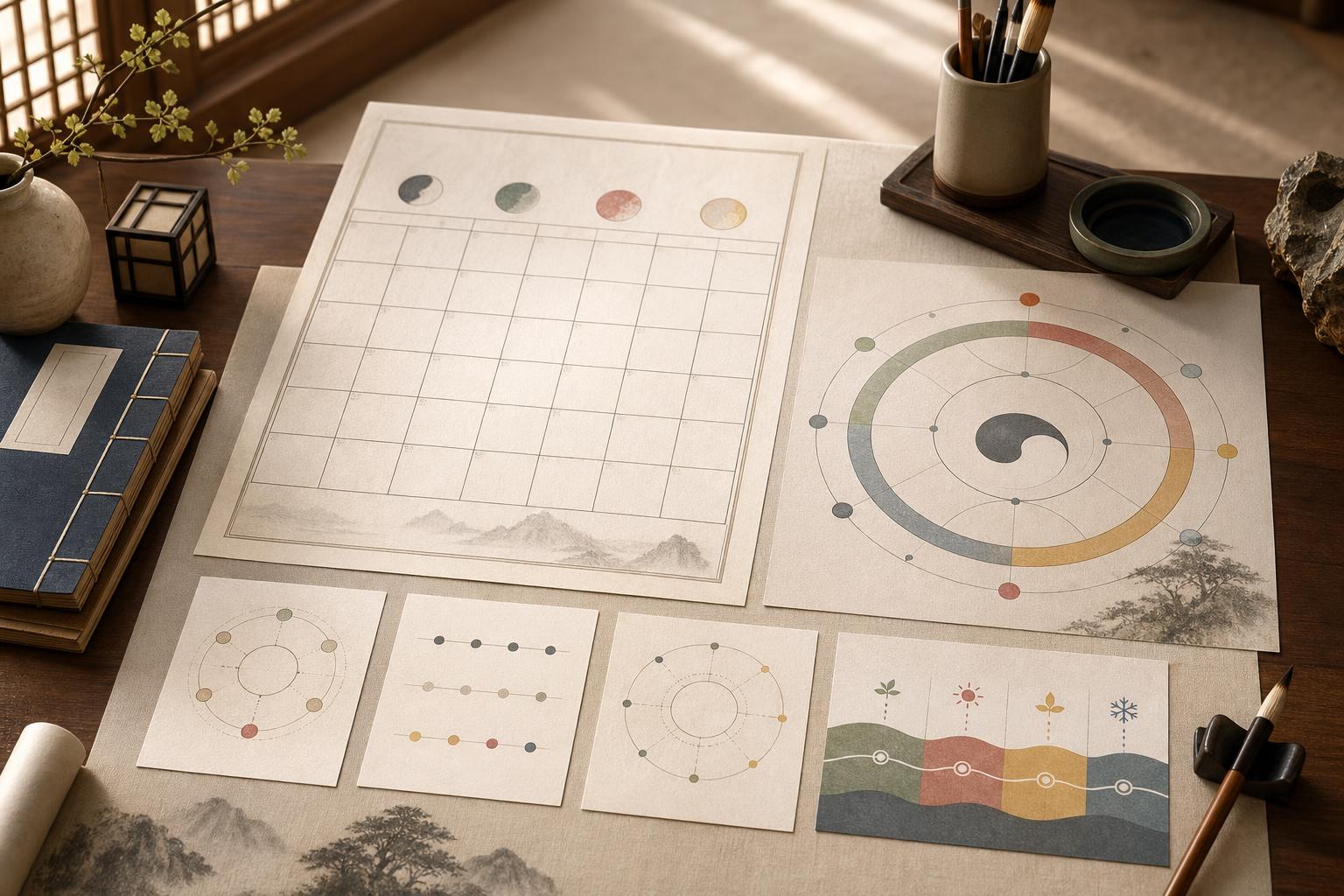
Original Korean article: How to Read the Korean manse calendar: An Introduction to the Meaning and Principles of Saju for Beginners
But the Korean manse calendar is not a mysterious code table. To put it simply, it is a calendar that shows the date and time of my birth in the form of four weeks. This article will organize the meaning of the Korean manse calendar, the heavenly cycle and support, the 24 solar terms, and the four pillars of fortune telling in detail so that even those who are new to fortune telling can understand them.
This article is an explanation to help you understand traditional culture and the calendar. Sajumyeongrihak is closer to a traditional interpretation system than a scientifically proven prediction tool. It is best to make important decisions with realistic information.
What is the Korean manse calendar?
The Manpower Calendar is the calendar used to look at the four weeks and eight quarters of life. While a regular calendar shows solar dates, lunar dates, and days of the week, the Korean manse calendar displays the dates and times using the zodiac sign.
The kanji mentioned in fortune telling is a name that combines the heavenly kanji and jiji, such as Gapja, Eulchuk, and Byeongin. The Korean manse calendar displays the year, month, day, and time of birth in the Chinese zodiac sign. These four bundles are the four pillars mentioned in the Saju.
To summarize, the role of the Universal Powers is as follows.
Category General calendar Korean manse calendar Basic information Solar calendar dates, lunar calendar dates, days of the week Solar and lunar calendar dates, zodiac signs, season information Purpose of use Check schedule Check standards for interpreting the 4th week Key result Date Yeonju, Moonju, Ilju, Siju
In other words, the Korean manse calendar is closer to a reference table that converts dates to begin the interpretation of fortune telling rather than a “table that directly tells the future.”
Why is the Manpower power needed when looking at Saju and Tojeongbigyeol?
Four Pillars literally means four pillars and eight letters. Based on a person's date of birth, the Yeonju, Wolju, Ilju, and Siju pillars are established, and each pillar consists of one character for Cheongan and one character for Jiji.
For example, let's say the result of a certain Korean manse calendar comes out as follows.
Pillar meaning example performance The zodiac sign of the year of birth The zodiac sign of the year of birth The zodiac sign of the year of birth The zodiac sign of the month of birth The zodiac sign of the month of birth The zodiac sign of the month of birth The zodiac sign of the day of birth The zodiac sign of the day of birth
If you combine these four pillars, you get eight letters. That's why it's called fortune-telling.
Tojeongbigyeol is also a traditional way of interpreting fortunes based on the date of birth and the flow of the year. Although the detailed calculation method is different from the Four Pillars of Myeongri, it is connected to the Korean manse calendar in that the reader must understand his or her date of birth based on the lunar, solar, and zodiac calendars.
Core ingredients of the Manpower: Cheongan, Jiji, Sixty Gapja
To understand the Korean manse calendar, you only need to grasp three words.
To put it simply, the 10 upper letters of the heavenly stem, Gap, Eul, Byeong, Jeong, Mu, Ki, Gyeong, Shin, Lim, Realm, Jiji, Ji, Axis, In, Myo, Jin, Sa, Five, Mi, Shin, Yu, Sul, Hae. The 12 lower letters, connected to the 12 zodiac signs.
There are 10 Cheongan and 12 Jiji. If you pair the two in order, it will take 60 times to return to the first combination. That's why it's called sixty-six pairs.
It is this zodiac system that we commonly refer to as “Gapjanyeon” and “Byeongonyeon.” The Korean manse calendar displays this zodiac sign not only for the sun, but also for the month, day, and time.
Why the 24 solar terms are important
The most confusing part for beginners in the Korean manse calendar is “Why do solar calendar birthdays and quarterly months look different?” The reason is that when looking at the months in the Saju, the 24 solar terms are considered important rather than just January and February in the solar calendar.
The 24 solar terms are the seasons divided into 24 sections based on the movement of the sun. Names like Ipchun, Gyeongchip, Cheongmyeong, and Ipha go here.
In Saju, the seasonal criteria must be considered especially when determining the moon week. For example, even if you were born in early February according to the solar calendar, the standard for the year or month of the four quarters may be set differently depending on whether it is before or after the first spring.
For beginners, it is enough to remember this.
In the Korean manse calendar, dates are not viewed simply as calendar months. In Saju, seasonal standards work together.
Since the exact incision time varies from year to year, it is best to check the actual calculation based on reliable chronological calendar or astronomical/calendar data.
Four Pillars of Four Pillars: Yeonju, Wolju, Ilju, Siju
When looking at the results of the Korean manse calendar, the first thing to check is the four pillars.
1. Performance: Pillar of the year of birth
Yeonju is the zodiac sign of the year of birth. This is a part that is often thought of as connected to the zodiac sign. One thing to be careful of is that fortune telling is often based on the beginning of spring rather than the Lunar New Year, so people born in January or early February may perform differently from the general zodiac calculation.
2. Weolju: Pillar of the Moon at birth
The moon is a pillar that shows the seasonal flow of the month of birth. Seasonal standards must be considered more than the solar calendar month numbers. Since the moon week is often viewed as very important in the interpretation of fortune telling, check how the moon week appears in the Korean manse calendar.
3. One week: Pillar of the day of birth
Ilju is the zodiac sign of the day of birth. In many interpretations of the four fortunes, the daily life, or the heavenly cycle of a week, is considered the center of seeing “myself.” For example, if one week is Eulhae, the above letters are considered as daily days.
4. Donor: Pillar of birth time
The lord is a pillar determined based on the time of birth. Therefore, if you do not know the time of birth, your prayers may not be accurate. If you have access to birth certificates, family records, hospital records, etc., it's a good idea to check those first.
How to read the Korean manse calendar: Beginners, read it in this order
When using a free almanac app or website, it can be complicated to try to see all the interpretations from the beginning. It's much easier if you check them in the order below.
Step 1: Determine whether your date of birth is solar or lunar
First, check whether your birthday is in the solar or lunar calendar. Especially if your parents tell you that it is your “lunar birthday,” you must not forget to select the lunar calendar in the input window.
Step 2: Check for leap months
Some lunar birthdays may include leap months. If you enter a leap month incorrectly, the results may vary, so if your birthday falls on the lunar calendar, check whether it is a leap month or not.
Step 3: Enter your birth time
The more accurate your birth time is, the more accurate your prayers will be. If you do not know the time, it is best to take a limited view of the stock price analysis.
Step 4: Check the performance, monthly cycle, daily week, and hourly week
The first thing to see in the All Powers results is the four pillars. Items such as Daeun, Seun, Sipseong, and Shinsal are the next level.
Step 5: Check your daily
If you're a beginner and only want to see one more thing, it's a good idea to check the dailies. Il-il is the upper letter of Il-ju, and is used as a standard to represent myself in many interpretations of four weeks.
Terminology that beginners often confuse
Easy explanation of terms A calendar that shows the date and time of birth based on the zodiac signs and seasons A name that combines the zodiac signs and the zodiac signs A name that combines the zodiac signs The 10 zodiac signs Gap, Eul, Byeong, Jeong, Mu, Ki, Gyeong, Shin, Im, Realm 12 supporting characters, axis, person, myo, Jin, Sa, Oh, Mi, God, Yu, Sul, and the sun 60 zodiac signs Combination of 60 zodiac signs Performance Pillar of the year of birth Moon week Pillar of the moon of birth Circle of birth Pillar of the day of birth Offering birth Pillar of Time Great Luck The flow of luck seen in a long cycle The flow of a specific year established
If you just know the terms in this table, the Calendar results screen will look much less unfamiliar.
Lunar, Solar, and Chinese Calendar: Frequently Asked Questions
What if I don’t know if my birthday is on the lunar or solar calendar?
Check with your family or see if the birthday on your resident registration is different from the birthday you actually celebrated. Older generations often remember their birthdays based on the lunar calendar. Before entering the Korean manse calendar, the distinction between solar and lunar calendars is the most important thing to consider.
Can't you see the calendar if you don't know your birth time?
You can see it. One thing to watch out for is that the stock price may be missing or inaccurate. In this case, it is best to refer to the year, month, and week, and be careful about interpretations that vary depending on time.
Does the date change if you are born at 11pm?
In traditional fortune telling, midnight is considered to be from 11 PM to 1 AM. Opinions may differ depending on the school of thought as to which date this section should be attached to. For those born around 11 p.m., it is recommended to check the perpetual calendar settings or interpretation standards.
Are the results of the Tojeongbi and the Korean manse calendar the same?
It's not the same. The Mansae Calendar is a calendar that organizes dates and times using the Chinese zodiac sign, and Tojeongbigyeol is a traditional interpretation method that interprets the year's fortunes. One thing to watch out for is that both require an understanding of the date of birth and the lunar calendar and zodiac sign.
Can your zodiac sign be different if you are born before Ipchun?
In general life, people often refer to their Chinese zodiac signs based on the Lunar New Year or year of birth. However, in Saju, there are cases where the performance is divided based on the beginning of spring, so people born in late January or early February may have different results from the zodiac sign and general recognition of the zodiac sign.
What does the Korean manse calendar tell us, and what does it not tell us?
What the Korean manse calendar tells us is relatively clear.
- Chinese zodiac sign of my date of birth
- Yeonju, Wolju, Ilju, Siju
- Correspondence information between lunar and solar calendars
- Division of months according to seasonal criteria
- Basic information on Daeun and Seun calculations
On the other hand, there are some things that the Korean manse calendar itself does not tell you right away.
- A definite future where “something like this will definitely happen”
- A categorical personality judgment that applies equally to everyone
- Final decisions on important matters such as health, investments, career, and marriage
The Korean manse calendar is the starting point for interpretation. It is not a tool that judges the situation, choices, or environment of the person looking at the results.
How to use the All Powers wisely
The Korean manse calendar is most healthy when used as a tool for self-understanding or learning about traditional culture. It can help you reflect on your personality, use it as a topic of conversation with your family, or understand the Eastern calendar and sense of the seasons.
One thing to be careful of is that you must be careful about interpretations that stimulate anxiety. It is best to be wary of statements such as “You will definitely fail during this period,” “If you don’t use this name, you will be in big trouble,” and “This can only be resolved through expensive counseling.”
If you are interested in Saju and Tojeongbigyeol, first understand the structure of the Manseryeok. Knowing the structure reduces the need to be overly scared and trust blindly.
Checklist before viewing the free Manpower Calendar
Please check the items below before opening the Korean manse calendar app or website.
- I checked whether the date of birth was solar or lunar.
- If it was a lunar birthday, we checked whether it was a leap month or not.
- Birth time was confirmed as accurately as possible.
- People born in late January or early February know that the standards before and after the start of spring may vary.
- First, I decided to check only Yeonju, Wolju, Ilju, and Siju.
- I decided to watch Daeun, Seun, and Sipseong after understanding the basic structure.
- It was decided not to make important decisions based solely on universal power.
Conclusion: The first thing to look at in the Korean manse calendar is “changing the date to the four weeks language”
The Korean manse calendar looks difficult, but the first thing to look at is simple. It is a calendar that changes the date and time of my birth based on the heavenly period, jiji, and season, and shows the results in annual, monthly, daily, and hourly weeks.
If you want to understand Saju or Tojeongbigyeol more deeply, it is better to first learn the basic structure of the Manse calendar rather than memorizing the interpretation first. If you understand the Korean manse calendar, you can more naturally accept the term 'four major signs', the term 'zodiac sign', and the explanation that your zodiac sign may change before and after spring.
Just remember four things at first:
- The Manpower Calendar is a calendar for interpreting the four fortunes of heaven.
- Date of birth is changed to four pillars.
- The four pillars are made up of the ceiling and supports.
- In Saju, the 24 solar terms standard is important.
Knowing just this much will change the way you look at the Calendar results screen.
References
- Korea Astronomy and Space Science Institute astronomy and space knowledge information, monthly yin-yang calendar: https://astro.kasi.re.kr/life/pageView/5
- Korea Astronomy and Space Science Institute astronomy and space knowledge information, yin-yang power conversion calculation: https://astro.kasi.re.kr/life/pageView/8
- Wikipedia, Korean manse calendar: https://ko.wikipedia.org/wiki/Almanac
- Wikipedia, Kanji: https://ko.wikipedia.org/wiki/Sanji
- Wikipedia, Seasons: https://ko.wikipedia.org/wiki/Jeongi
- Wikipedia, Four Pillars of Myeongrihak: https://ko.wikipedia.org/wiki/Four Pillars of Myeongrihak
Good article to read together
This is a related article on thinknote.co.kr that can help broaden the context when read along with this topic.
- More traditional culture categories
- thinknote.co.kr View latest posts
Related Reading
Continue with these related Thinknote English articles in the Psychology & Society cluster.
- Thinknote English article
- Thinknote English article
- Thinknote English article
- Thinknote English article
- Thinknote English article
- Thinknote English article
FAQ
What is this article about?
This article explores psychology, society, culture, or Korean interpretive frameworks for global readers who need context and careful explanation.
How should I use this guide?
Use it as cultural and conceptual context. Interpretive traditions should be read thoughtfully rather than as deterministic claims.
Where can I read the original Korean article?
The original Korean article is available here: Original Korean article.