
Organizations that use AI agents well do not stop at choosing a good model. The more important question is: what should the agent learn, where should it remember that knowledge, and what standards should it follow while working?
A video from Hyoyul Kim’s AI Development Team shows this question through an example of operating Hermes Agent. It creates multiple agents divided into roles such as development, design, content, and lecture assistance, gives remote instructions through Telegram, and shares context through an Obsidian Wiki.
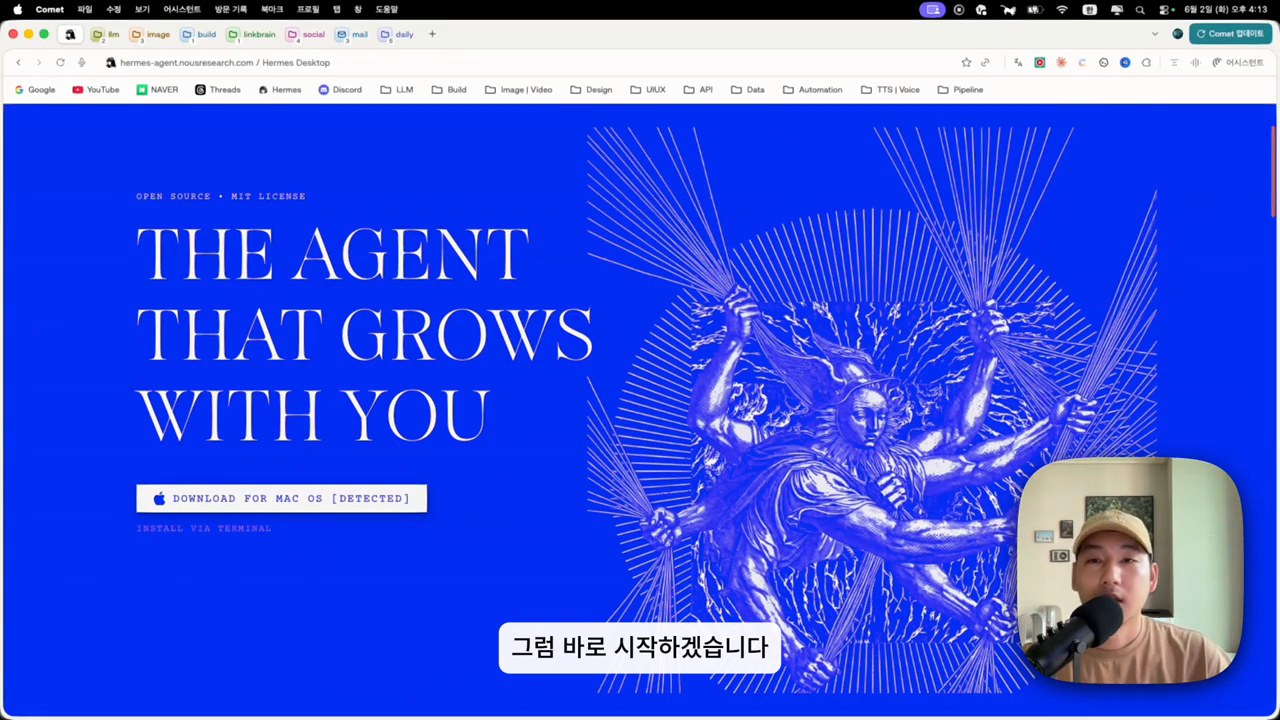
The First Thing to Watch Is Operations, Not Installation
The video’s title emphasizes how to “train” AI agents. The actual content is also closer to operations architecture than to installation commands. The central flow is connecting Hermes Agent to Telegram and combining it with tools such as Codex or Claude Code while dividing several agents by role.
According to the official Hermes Agent description, Hermes is an open-source AI agent framework that runs in terminals, messaging platforms, and IDEs. It also supports skills, memory, profiles, gateways, cron, MCP, and connections to multiple model providers. The video can be read as an example of weaving these functions into a personal work system.
The important point is not simply to “create many AI employees.” Each agent needs a role, knowledge to reference, a learning loop to repeat, and a reporting method. Otherwise, the number of chat windows increases while actual productivity does not.
Why AI Agents Should Be Divided Like Employees
The video introduces agents with roles such as development, UI design, testing, content, and lecture assistance. This resembles role division in a human organization. If one agent handles everything, contexts mix, instructions become longer, and results are harder to verify.
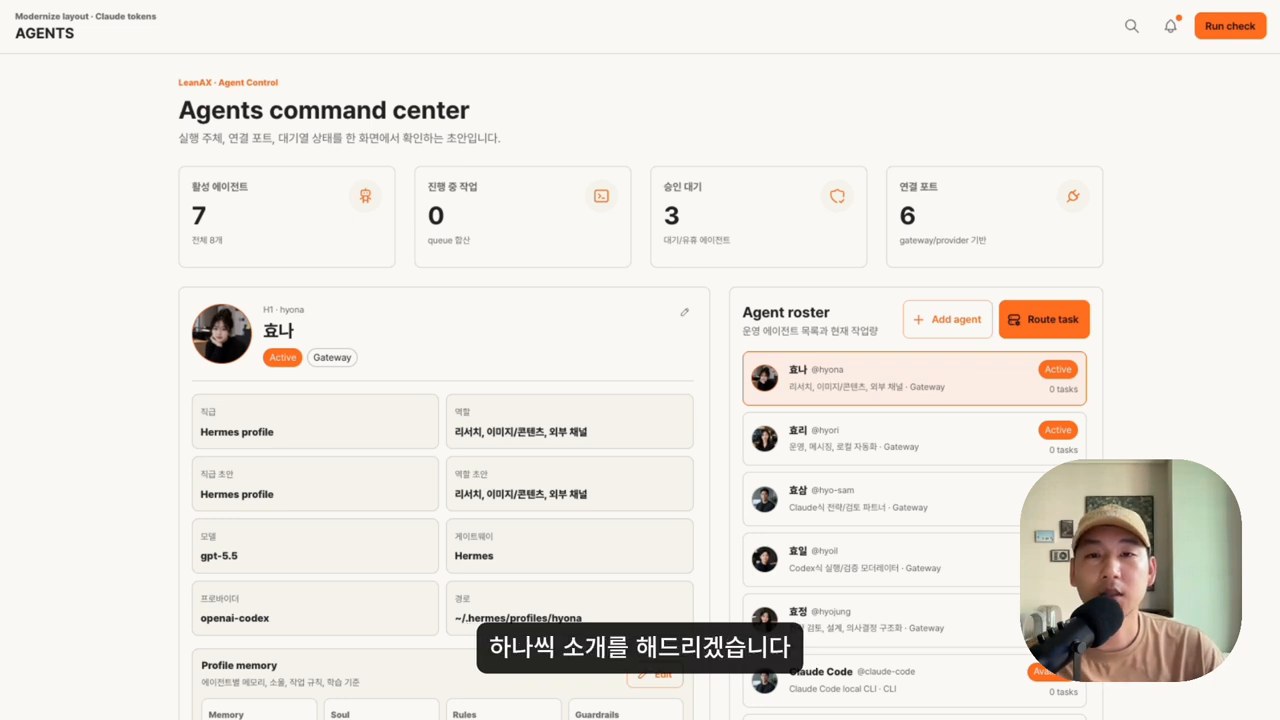
Dividing roles creates three advantages.
- Instructions become shorter. A development agent can focus on code and tests, while a design agent can focus on layouts and references.
- Standards become clearer. Each agent’s rule file or skill document can separate what it should and should not do.
- Verification becomes easier. The creator and reviewer can be separated by dividing a generation agent from a review agent.
This approach also connects to the article on building an Agent OS that unifies AI tools. The essence of using AI is not individual chatbot use, but the design of work flows and knowledge flows.
Real Deliverables Require a Supervisor Role
One interesting part of the video is the example that “five agents built a website.” It describes several role-based agents collaborating to build a site that collects and displays short-form videos.
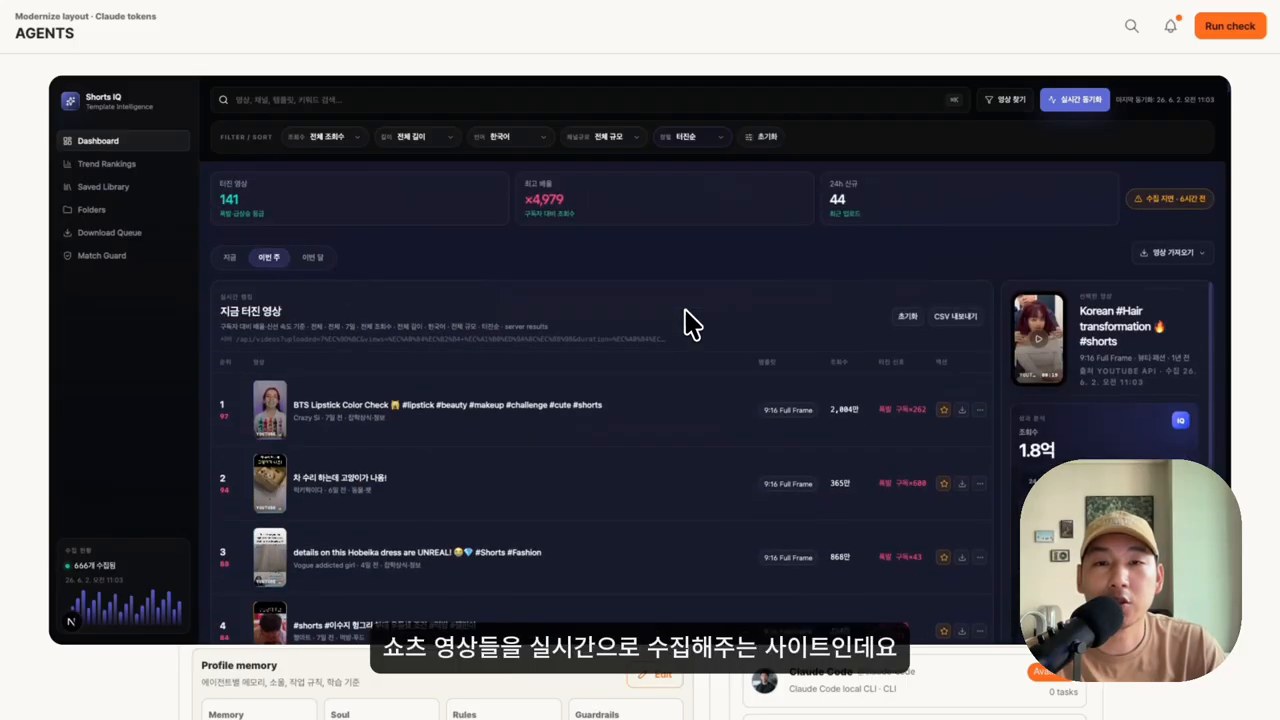
There is one caveat in this scene that should not be missed. The speaker in the video also says he did not simply take his hands off the work. The human provided the plan, supervised the direction, and checked the results.
That is why the realistic structure for adopting AI agents is closer to this.
- Human: owns goals, priorities, standards, and final judgment.
- Agent: handles research, drafts, coding, repeated revisions, and organization.
- System: handles memory, files, versions, schedules, notifications, and verification loops.
Without this balance, AI agents can quickly produce many outputs, but it becomes difficult to know whether those outputs match the organization’s standards. As discussed in the article on harness engineering, the technology for “harnessing agents so they work well” is becoming increasingly important.
The First Point in a Learning Loop Is Not Simply Increasing Memory
The video’s most important message is context sharing through an Obsidian Wiki. Even if agents are made to research and learn every night, pushing everything into agent memory can actually degrade performance.
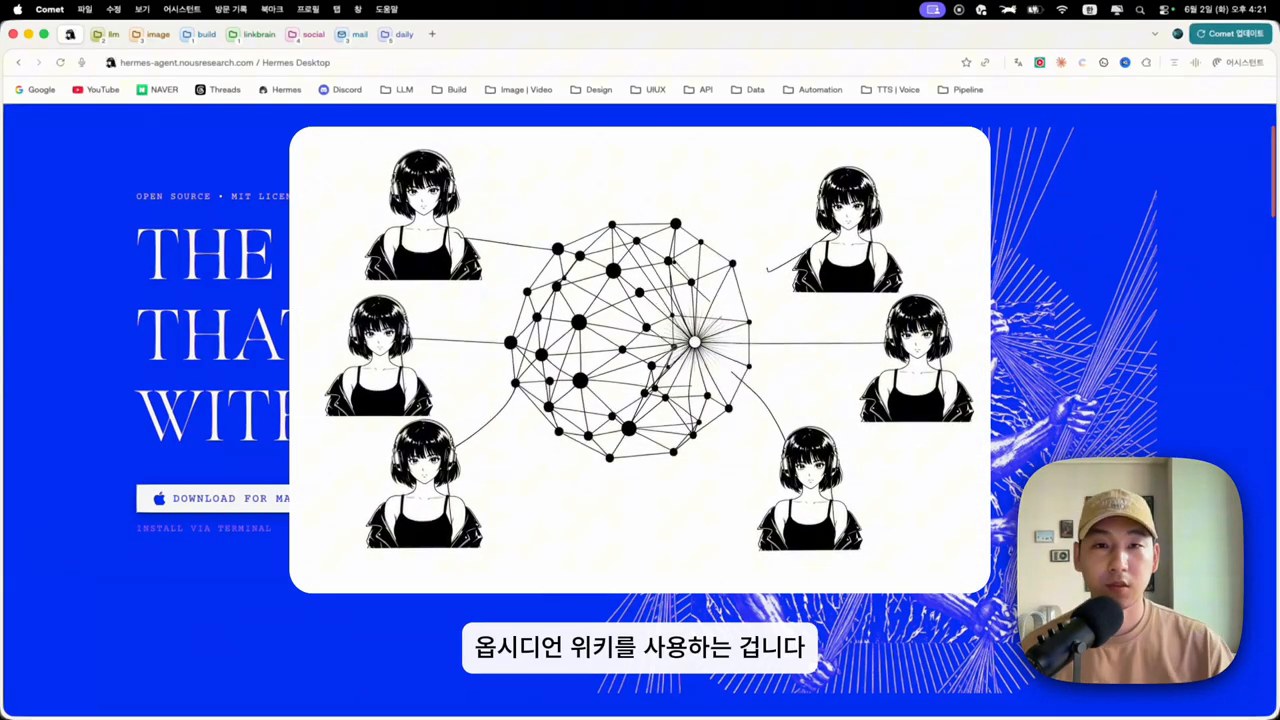
A better approach is to separate long-term memory from working memory. The agent should not always carry everything. Instead, it should retrieve relevant information from the wiki when needed.
In practice, the following structure is safer.
| Component | Role | Caution | |—|—|—| | Rule documents | Behavioral standards for the agent | If they are too long, execution criteria become blurry | | Wiki or notes | Long-term knowledge store | Sources and dates should be recorded | | Cron jobs | Repeated learning and storage automation | Accumulating results without verification is risky | | Review agent | Checks errors and omissions | Final responsibility should remain with humans | | Work logs | Tracks what was done | Manage them so secrets are not mixed in |This perspective connects to the theme of second brains and LLM Wikis. In the AI era, a knowledge system becomes both notes for humans and operating infrastructure that agents can search and reference.
Telegram Remote Execution Is an Operations Channel, Not Just “Assign Work Anytime”
The video explains that Hermes Agent is connected to Telegram. Slack could also be used, but the presenter chose the lighter Telegram setup as a one-person business.
This is more than a convenience feature. A messaging platform becomes the intake window for AI-agent work. Users can assign work while on the move, receive completion notifications, and get files or outputs back.
One caveat is that remote execution is powerful, so it needs operating principles.
- Place approval procedures around dangerous commands.
- Separate permissions and work scopes by agent.
- Exclude sensitive files and credentials from task instructions.
- Keep logs and result reviews for automated work.
- Create checkpoints that allow rollback after failure.
Hermes Agent’s gateways, profiles, and cron features are useful when building this operating system. But having the tools does not automatically make automation safe.
AI-Native Organizations Need Operating Rules Before Dashboards
Near the end of the video, a concept for an AI-native organization dashboard appears. It brings together work status, schedules, messengers, agent status, scheduled tasks, skills and plugins, and token usage in one view.
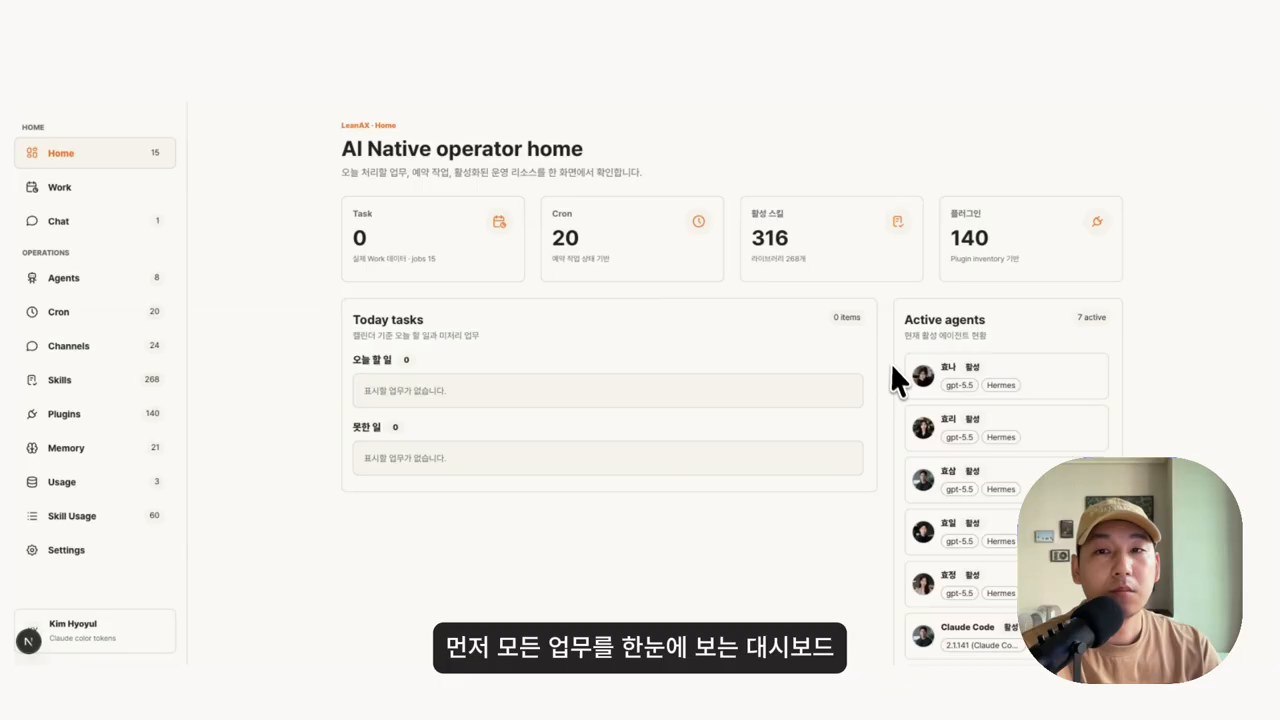
This concept is very practical. The caveat is that something must be decided before the dashboard: what to automate, how to judge success, and where humans should intervene.
For teams beginning AI-agent operations, the following order is better.
- Choose three recurring tasks.
- Document each task’s inputs, outputs, and verification criteria.
- Assign only one role to each agent.
- Have humans review the outputs and improve the rules.
- After stabilization, automate through cron jobs or messaging channels.
Rather than creating “ten AI employees” from the beginning, it is faster to make one agent consistently good at one task.
Pre-Adoption Checklist
Before adopting Hermes Agent or a similar AI-agent system, check the following questions first.
- Is the recurring work assigned to this agent clear?
- Is there a human or review agent to inspect the outputs?
- Is there a wiki or document repository for long-term knowledge?
- Have you decided how far secrets and permissions will be allowed?
- Are there logs and backups that allow rollback after failure?
- Can you track cost, token usage, and execution time?
If these questions cannot be answered, increasing the number of agents is more likely to create confusion than automation.
Related Reading
- Hermes Agent Deliverable Mode: How to Receive AI Outputs Directly in Chat
- AI-Native Transformation: Changing How Work Gets Done With a Digital Brain and AI Agents
- Second Brain and LLM Wiki: A Personal Knowledge System for the AI-Agent Era
- How to Build an Agent OS That Unifies AI Tools: A Seven-Layer Blueprint
- Harness Engineering Is Coming: How to Make AI Agents Work Properly
Conclusion: AI-Agent Training Starts With Operations Design, Not Learning Alone
The core question in the video is not “how many AI agents can we create?” It is how agents learn the organization’s knowledge and standards, how they collaborate, and how they are verified.
Hermes Agent provides a useful operational foundation for this experiment. It can run through messaging platforms, separate profiles, build skills and memory, and run repeated tasks through cron jobs.
But final results depend more on design than on the tool itself. Roles must be kept small, a knowledge repository must be built, verification loops must be attached, and human decision points must remain. Only then do AI agents become less like automated responders and more like an operating system for working together.
FAQ
Can Hermes Agent be used like an AI employee immediately after installation?
No. Installation is only the start. Roles, rules, reference knowledge, and verification criteria must be defined before it can be used for real work.
Does training an AI agent mean fine-tuning a model?
In this article, training is closer to operational learning than fine-tuning. It means helping the agent better reference the context of repeated work through rule documents, skills, wikis, and work logs.
Is Obsidian Wiki required?
It does not have to be Obsidian. The important point is to have a long-term knowledge repository that agents can search and reference. Notion, a Markdown wiki, a Git repository, or an LLM Wiki can also work.
Is a Telegram connection safe?
The connection itself is less important than permission design. Dangerous-command approval, sensitive-information separation, log review, and permission limits must be designed together.
How many agents should a team start with?
One or two is appropriate at first. Start with one recurring task and one verification task, then add only roles that have stabilized.
References
- Hyoyul Kim’s AI Development Team, a video on an AI-agent training method most people do not know
- Official Hermes Agent documentation
- NousResearch Hermes Agent GitHub repository
Original Korean article: How to Train AI Agents: Building an AI-Native Organization with Hermes Agent
Image source: Captured images used in this article are stills from the original YouTube video. They are used for review, commentary, and educational explanation, and copyright remains with the original rights holders and the channel.