



Image source: Captured images used in this article are stills from the original YouTube video. They are used for review, commentary, and educational explanation, and copyright remains with the original rights holders and the channel.

jhshin@thinknote.co.kr
Image source: Captured images used in this article are stills from the original YouTube video. They are used for review, commentary, and educational explanation, and copyright remains with the original rights holders and the channel.
The difference between people who use AI well and those who do not—where does it come from? People often answer, “It depends on whether you know good prompts.” In reality, it is a little different. The core issue is not a handful of prompt sentences. It is whether I can say what I want while also including the context and criteria behind it.
The Ildangbaek video “Human Intelligence Expressed Delicately Through Language! The Beginning of AI Prompt Engineering” illustrates this point well. The video begins with the book AI Language Lessons for Intellectual Conversation, but rather than being a simple book introduction, it is closer to a conversation that asks what kind of language sense we need in the AI era. For Korean-language users in particular, there is an even more important question: when we talk with AI in a language like Korean, where omissions and nuance are common, what do we need to say more clearly?
When many people first use AI, they say things like this:
“Just organize this for me.” “Don’t make it too long.” “Don’t use a stiff tone.” “Don’t draw an image—just show me the prompt.”
Between people, this level of instruction usually works to some extent. That is because we read the surrounding situation, facial expressions, prior conversations, organizational culture, and tone of voice together. But AI guesses the context the user has not provided. If the guess is right, it feels convenient. If it is wrong, the result becomes completely off target.
The prompt guides from OpenAI and Anthropic both emphasize “clear instructions, sufficient context. The desired output format.” Ultimately, a good prompt is not a magic sentence. It is a sentence that reduces the parts AI has to guess.
This is where an important difference appears. People who use AI well are not necessarily people who write longer questions. They are people who structure context. They provide purpose, audience, constraints, examples, preferences rather than only prohibitions, output format, and validation criteria together.
One of the most interesting points in the video is the high-context nature of Korean. Korean frequently omits subjects and objects. A single particle can change the focus of a sentence. Honorifics may be handled reasonably well at the surface level. Sarcasm and irony are entirely different matters.
For example, “Cheolsu-neun went to school” and “Cheolsu-ga went to school” may look similar, but their focus is different. “It’s okay” can mean that something is truly okay, or it can mean refusal. “Siwon-seopseop-hada”—a Korean expression that combines feeling refreshed or relieved with feeling sad or regretful—has a different ratio of relief to regret depending on the situation.
People read these differences through the situation. AI mostly receives them as text. That is why Korean users need to provide AI with more context. “Take care of it” is convenient, but from AI’s point of view it is an instruction with too little information.
This issue also appears in translation. Anthropic’s interpretability research shows that large language models can connect inputs from multiple languages to a shared internal conceptual space. But that does not mean Korean nuance is perfectly preserved. In the movement between languages, emotion, omission, irony, and the speaker’s intent can be lost.
The video distinguishes between prompts and prompt engineering. Everyday users can simply ask questions as if they were talking with AI. But the story changes in work systems, customer service, automation, and content production pipelines.
Prompt engineering is not simply “the skill of asking pretty questions.” It involves looking at how answer tendencies differ from model to model. It analyzes why wrong answers emerged. It designs structures that reduce cost. It connects multi-step tasks reliably. It controls the consistency of results.
For example, writing requires creativity, but customer guidance copy or legal and policy guidance becomes problematic if it changes every time. In these cases, generation settings such as temperature, example-based output, validation steps, and retry conditions are needed.
In other words, prompt engineering is a language skill and, at the same time, an operational skill. It begins with an individual’s way of asking questions. In organizations it expands into quality management and cost management.
One practical tip repeated in the video is to use positive statements rather than negative ones. “Use everyday words” is better than “Don’t use technical terms.” “Keep each paragraph to three sentences or fewer” is better than “Don’t write too much.” “Write it as a short explanatory passage” is clearer than “Don’t write it as a list.”
AI does not always process a user’s negative phrasing reliably. In image, video, and multimodal models in particular, negative words can blur the desired result. Even in text models, saying “don’t do this” can sometimes place the prohibited element at the center of the context.
At work, it is better to change requests like this:
| Common request | Better request |
|---|---|
| Don’t write it too difficult. | Write it in everyday language that a middle school student can understand. |
| Don’t make it long. | Explain only the three core points within 600 Korean characters. |
| Don’t make it sound like AI. | Mix short and long sentences, and reduce repeated expressions. |
| Just organize it for me. | Organize it in the order of background, key issues, and action items. |
| Don’t include subjective opinions. | Separate verified facts from interpretation. |
This difference may look small, but the results change significantly. When you reduce the room AI has to guess, you reduce the time you spend revising.
Opinions differ on whether AI actually increases productivity. Still, some studies have already observed concrete effects. The NBER paper “Generative AI at Work” found. Generative AI tools increased average productivity in customer support work, with especially large effects for less experienced employees.
By contrast, the ILO’s analysis of generative AI and jobs suggests. Many occupations are more likely to see some tasks automated or supported than to be completely replaced. This perspective also connects with the video’s conclusion. AI does not necessarily eliminate all work; rather, it redivides the components of work.
The question is not “Do you use AI a lot?” It is the ability to decide what to delegate and what humans should judge. Simple summaries, drafts, format conversions, and repeated responses are easy to delegate to AI. But reading a customer’s anxious feelings, judging field context. Carefully confirming unspoken needs are still largely human responsibilities.
Before writing “Organize this,” write what should be organized, for whom, and for what purpose. In Korean conversation, omission is natural, but for AI it becomes a blank space.
Instead of saying “Don’t write in a stiff way,” say “Write in a friendly but not exaggerated tone.” Giving a goal is more stable than giving only a prohibition.
A table, list, paragraph, report, blog post, email, and presentation script are all different outputs. If you do not set the format, AI produces an average answer.
Separate the background as background, requirements as requirements, and validation criteria as validation criteria. If you mix everything into one sentence, AI can also miss the relative importance.
Good AI use is closer to multi-turn collaboration than to a single turn. Receive a draft, strengthen the criteria, revise it again, and validate it at the end. This is not a command; it is collaboration.
UNESCO’s AI competency framework sees the abilities needed in the AI era not as simple tool usage. As human-centered thinking, ethics, critical judgment, and practical application. Prompts are the same. They are not something to memorize like keyboard shortcuts.
Talking with AI is a process of making my own thinking clearer. If I do not know what I want, AI does not know either. If I do not provide criteria, AI produces an average value. If I omit context, AI guesses.
That is why the core of the video goes deeper than “Let’s write better prompts.” Competitiveness in the AI era comes not to people who know a lot of techniques. To people who can examine their own language and design context.
To put it a little strongly, future AI literacy may be a language issue before it is a coding issue. This is especially true for Korean-language users. The words we naturally omitted, the things we passed over through atmosphere. The tasks we handed off by saying “take care of it” must all become sentences again in front of AI.
It is not accurate to say they are always at a disadvantage. However, Korean relies heavily on omission, particles, honorifics, and context. AI often has to guess the user’s intent. That is why, when writing in Korean, it is better to state the situation and criteria more clearly.
Everyday users do not need to learn grand, formal engineering. But if you use AI for work, you do need the basic habit of providing purpose, context, output format, and validation criteria.
Negative sentences place the prohibited object inside the context. Some models do not reliably reflect the intention behind the prohibition. That is why it is better to specify the desired behavior positively rather than saying only “don’t.”
To some extent, yes. Adjusting sentence length, repeated expressions, subject and object omission, inversion, rhythm. Concrete situations can reduce the mechanical feeling. However, AI does not actually possess real experience or judgment on your behalf.
Humans should interpret context, set criteria, and make final judgments. Areas that are difficult to fully standardize in words—such as customer emotions, field situations, an organization’s tacit knowledge. Ethical judgment—still depend heavily on human roles.
Original Korean article: https://www.thinknote.co.kr/ai-korean-prompt-literacy/
Image source: Captured images used in this article are stills from the original YouTube video. They are used for review, commentary, and educational explanation, and copyright remains with the original rights holders and the channel.
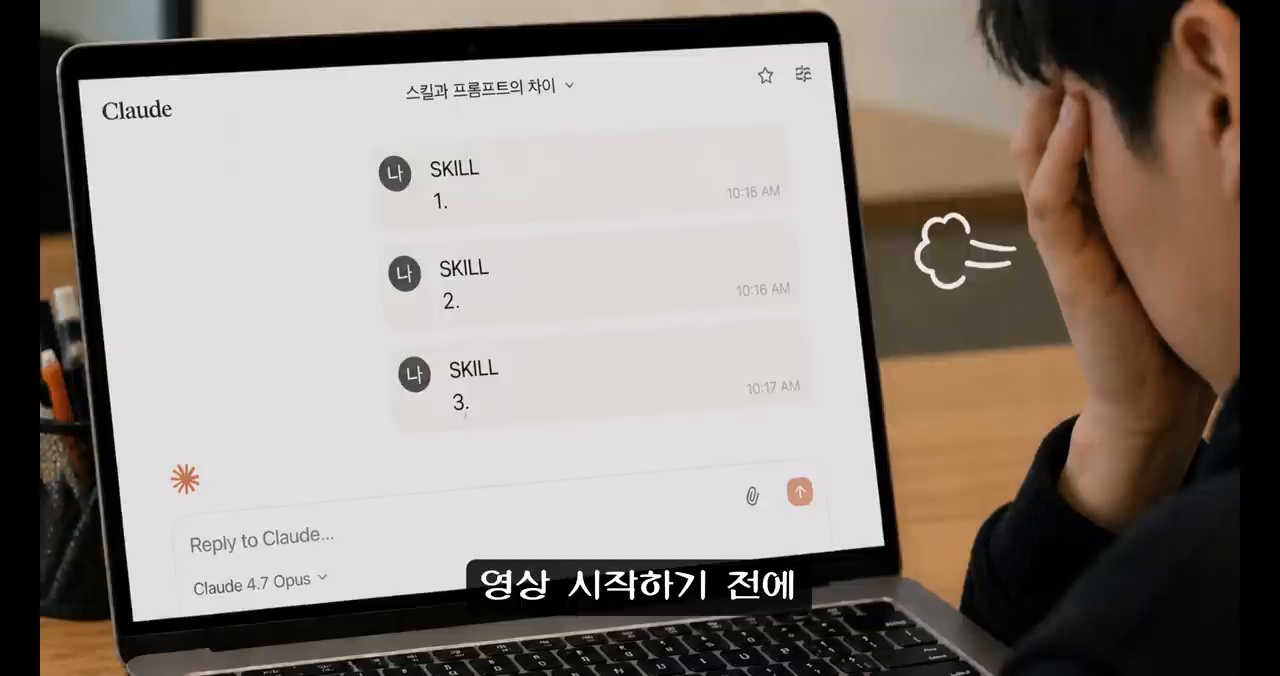
This English version is a fuller translation and adaptation of the original Korean article, “AI 스킬 만들기, 파일 3개로 시작하는 Claude·GPT 업무 자동화,” for global readers. The article discusses the importance of creating AI skills, which involves turning prompts into reusable work automation. It highlights the difference between project instructions and skills, and how skills can be used to automate repetitive tasks. The article also provides a step-by-step guide on how to create AI skills using Claude and GPT/Codex, and offers tips on how to review and refine the skills.
Original Korean article: AI 스킬 만들기, 파일 3개로 시작하는 Claude·GPT 업무 자동화
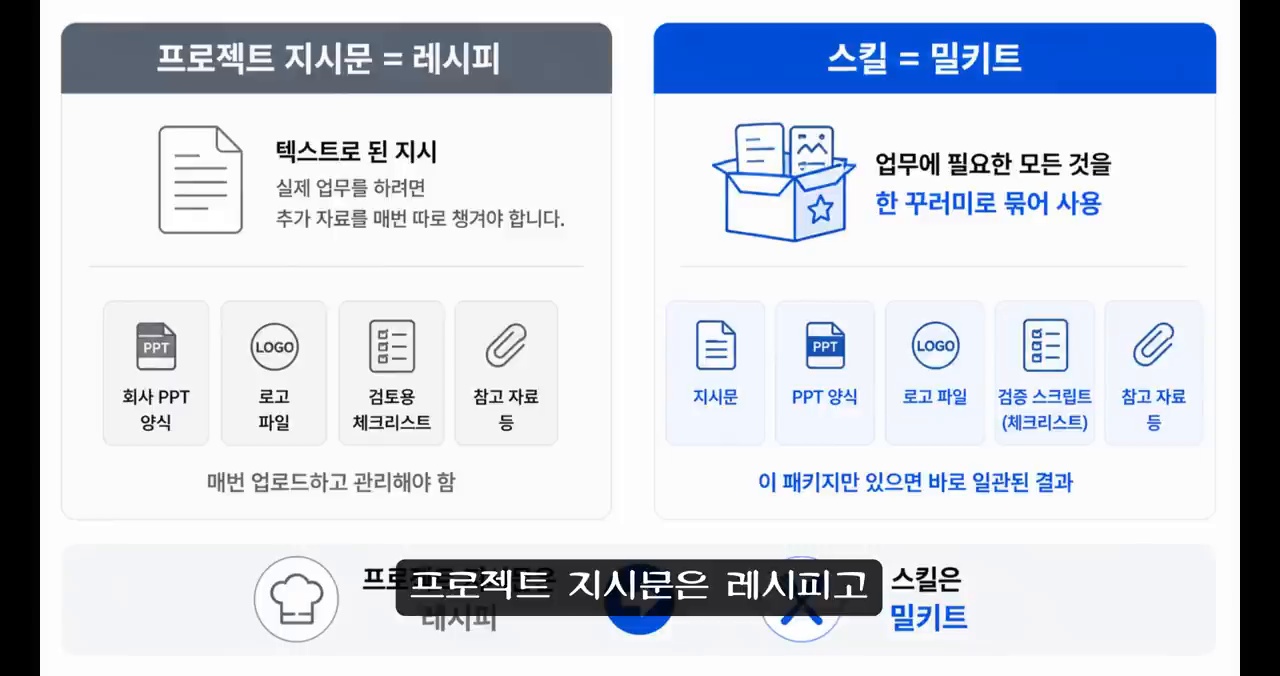
The process of creating AI skills involves turning prompts into reusable work automation. This means that instead of writing a new prompt every time, you can create a skill that can be reused multiple times. The article uses the analogy of a recipe and a meal kit to explain the difference between project instructions and skills. Just as a recipe provides a set of instructions for cooking a meal, a skill provides a set of instructions for completing a task.
Project instructions are specific to a particular project and provide a set of rules for completing a task. Skills, on the other hand, are more general and can be applied to multiple projects. Skills can include not only the instructions for completing a task but also the necessary materials, tools, and standards. This means that skills can be used to automate repetitive tasks and improve efficiency.
AI skills are important now because they can be used to automate repetitive tasks and improve efficiency. The article highlights the difference between early AI systems, which were limited to answering simple questions, and modern AI systems, which can perform complex tasks and make decisions. The article also discusses the role of prompt engineering in creating AI skills, and how it has changed over time.
Prompt engineering involves designing and optimizing prompts to get the best results from an AI system. The article highlights the importance of structuring prompts to get the best results, and how this can be used to create AI skills. The article also provides examples of how prompt engineering can be used to create AI skills, such as creating a skill for generating reports or creating a skill for automating data entry.
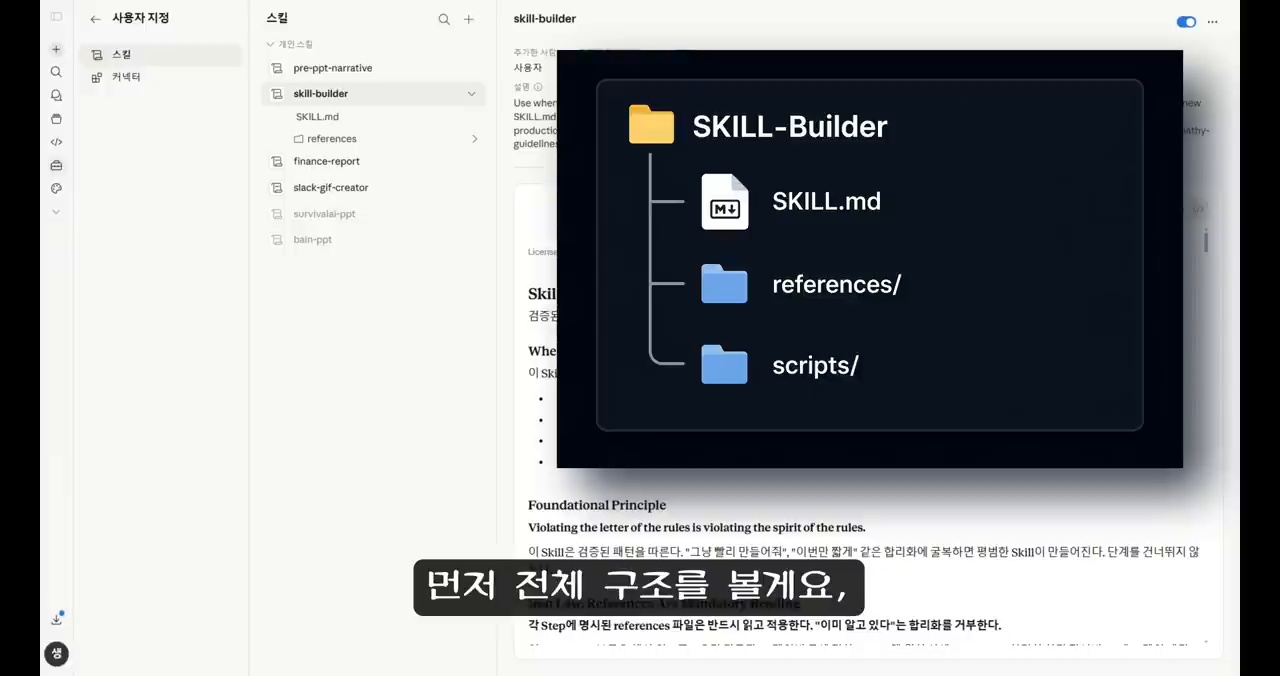
The basic structure of AI skills involves creating a set of instructions and materials that can be used to complete a task. The article highlights the importance of creating a clear and concise set of instructions, and how this can be used to create AI skills. The article also discusses the role of references and scripts in creating AI skills, and how these can be used to improve efficiency and accuracy.
SKILL.md is the execution manual for an AI skill. It provides a set of instructions for completing a task, and can include information such as the materials and tools needed, the steps to follow, and the standards to meet. The article highlights the importance of creating a clear and concise SKILL.md, and how this can be used to create AI skills.
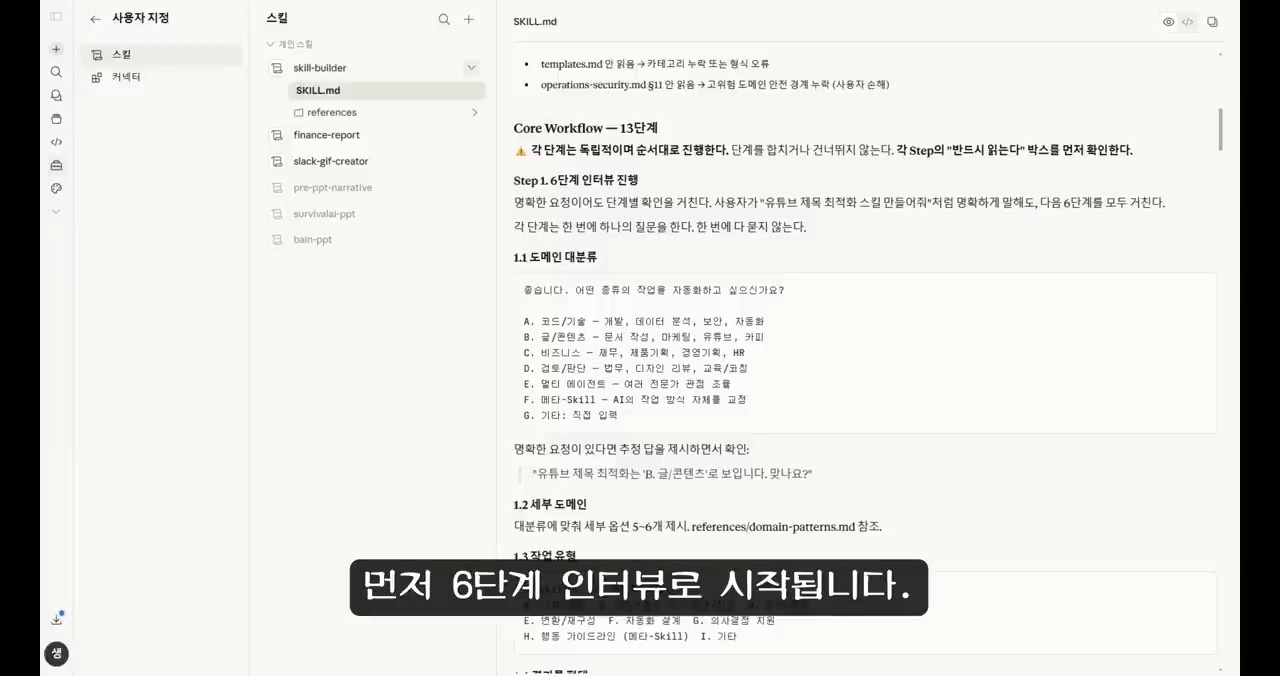
References are the knowledge base for an AI skill. They provide additional information and materials that can be used to complete a task, such as documents, templates, and scripts. The article highlights the importance of creating a clear and concise set of references, and how these can be used to improve efficiency and accuracy.
Scripts are the automation tool for an AI skill. They provide a set of instructions that can be used to automate repetitive tasks, such as data entry or report generation. The article highlights the importance of creating clear and concise scripts, and how these can be used to improve efficiency and accuracy.
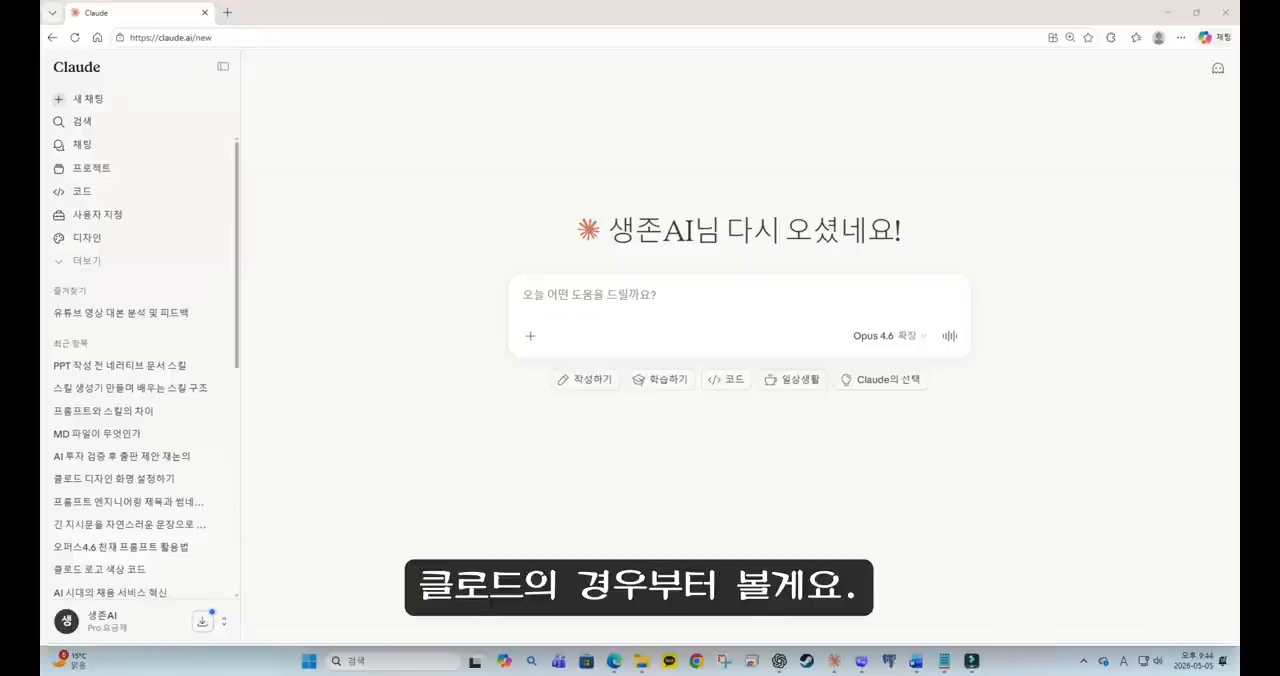
Creating AI skills involves a step-by-step process that includes defining the task, creating the SKILL.md, references, and scripts, and testing and refining the skill. The article provides a detailed guide on how to create AI skills using Claude and GPT/Codex, and offers tips on how to review and refine the skills.
AI skills are the assets of the AI era. They can be used to automate repetitive tasks, improve efficiency, and enhance productivity. The article highlights the importance of creating AI skills, and how these can be used to improve business outcomes. The article also provides a checklist for creating AI skills, and offers tips on how to get started.
Continue with these related Thinknote English articles in the Digital Transformation cluster.
This article explains a digital transformation, platform, market-structure, or technology-adoption topic with Korea-specific context and global implications.
Use it to understand market signals and strategic patterns. Combine it with current market data before making business or investment decisions.
The original Korean article is available here: How to Create AI Skills: Turning Prompts Into Reusable Work Automation.