[태그:] software engineering

  • REA Reverse Engineering: Possibilities and Limits of a 23-Minute App Rebuild

    REA Reverse Engineering: Possibilities and Limits of a 23-Minute App Rebuild

    If AI builds a similar app without receiving its source code, can we say it understood the original? A similar-looking interface is different from understanding the data structures and exception handling.

    Dante’s Datalab’s REA experiment illustrates this distinction. The creator had it analyze an asset management app whose source code he owned. A separate evaluation agent then compared the original with the result. It reimplemented the main features in about 23 minutes, but scored 74 out of 100 rather than achieving a complete replica. One misinterpreted piece of evidence, in particular, sent the internal design in a different direction.

    REA Is More an Integration Layer for Analysis Tools Than a New Decompiler

    REA stands for Reverse Engineer Anything. Its official documentation describes connecting agents to tools for investigating native binaries, JavaScript and Electron apps, websites, and other targets. The agent reads analysis results, decides what to investigate next, and records both the evidence behind its judgments and their limitations.

    It is therefore inaccurate to see REA as a new analysis engine that replaces Ghidra, Hopper, and IDA altogether. It instead brings existing analysis tools and runtime observation into a coding agent’s workflow. The official documentation also distinguishes static JavaScript analysis of Electron apps, which does not require a native analysis engine.
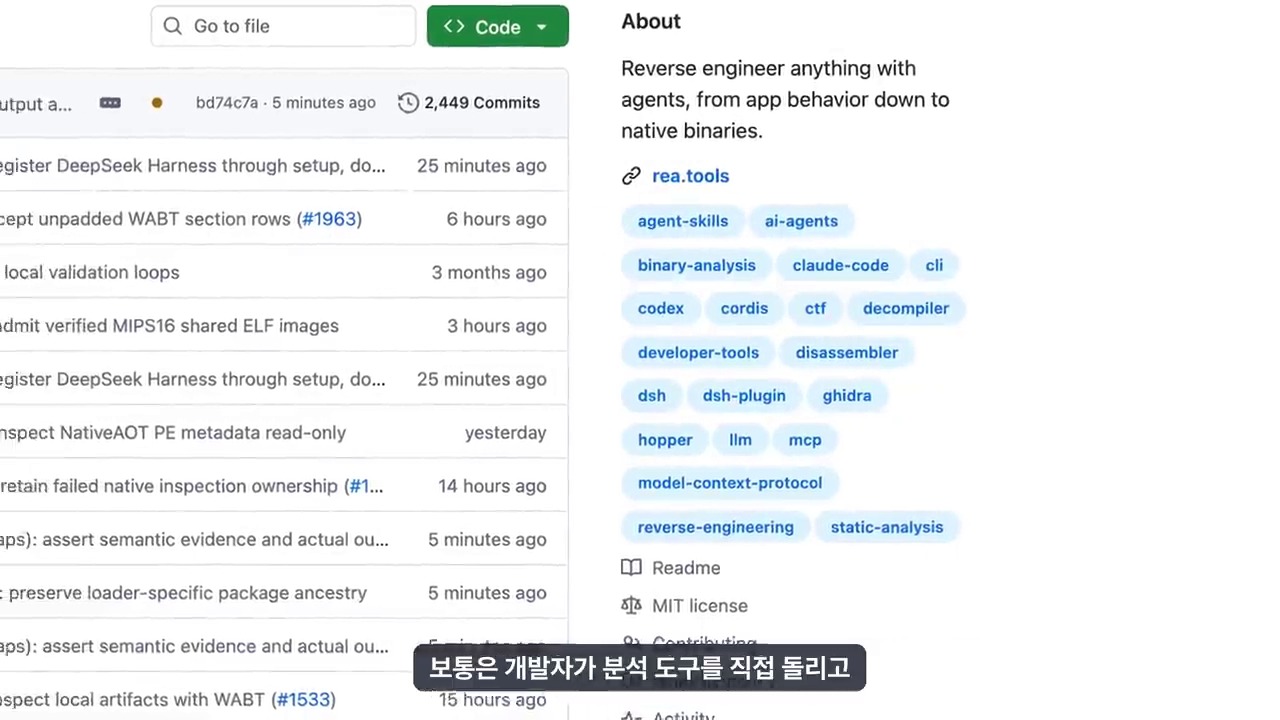
    REA repository and the concept of connecting reverse engineering tools
    Source: Dante’s Datalab, original video at 02:50. Frame quoted to illustrate the discussion.

    An important term in the video is Evidence. Rather than simply saying, ‘This is probably how it works,’ the agent records which files, analysis results, or runtime observations informed its judgment. But keeping a record does not guarantee that its interpretation is correct.

    Original Source Access Was Blocked, but the Distributed App’s Internals Were Analyzed

    The experiment targeted a Serpent-based asset management app that the creator was modifying. He held the original project’s source, allowing him to compare the analysis with the actual implementation. This differs from starting with an unauthorized attempt to copy a commercial app.

    The experiment divided the work into three roles.

    • Preparation agent: Packaged the app and prepared test materials and instructions.
    • Analysis agent: Investigated the installed app and built a new app with the same user-facing functions.
    • Evaluation agent: Examined both the original source and the reimplementation code to compare behavior and evidence.
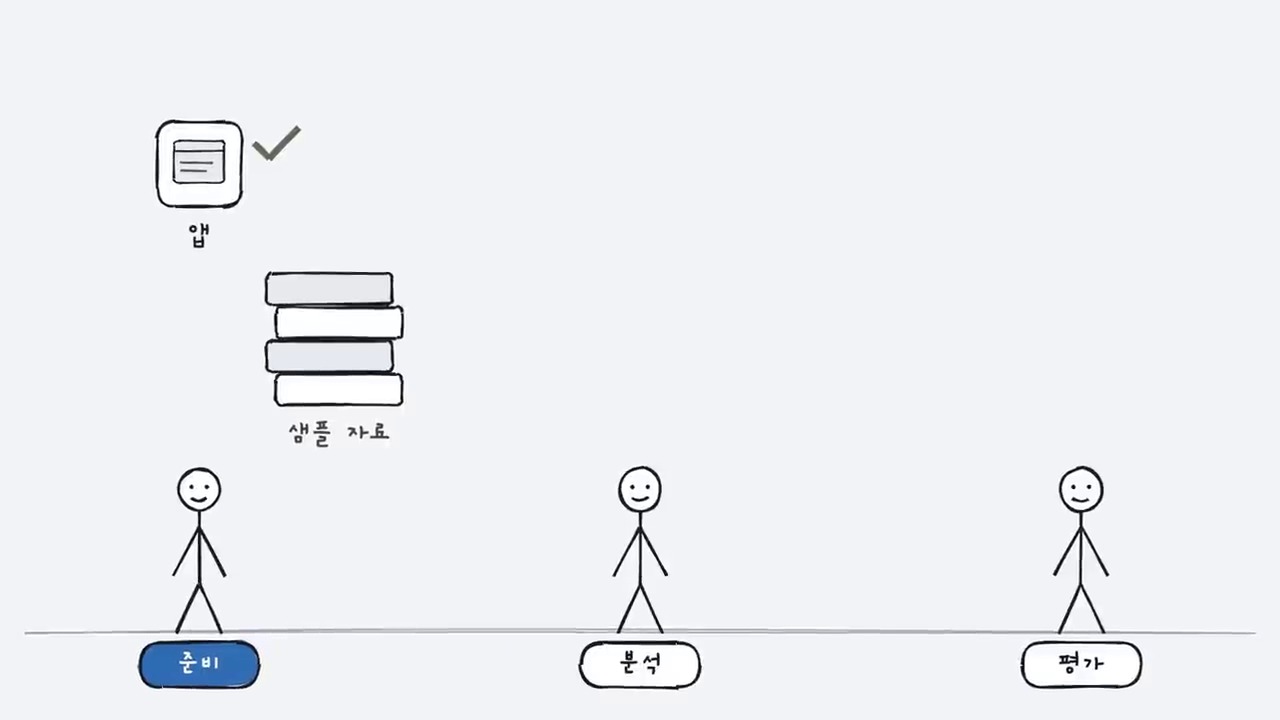
    Experimental design separating preparation, analysis, and evaluation agents
    Source: Dante’s Datalab, original video at 07:50. Frame quoted to illustrate the discussion.

    The analysis agent could not access the original project folder, perform external searches, or look things up on GitHub. It could, however, inspect the installed app’s bundled code and files left on disk. ‘The original source was not provided’ does not mean ‘no code was visible.’

    This should also be distinguished from clean-room development in the strict sense. The analysis agent handled implementation too. The video acknowledges that the analyst and implementer were not separated. The agent also encountered the original name in files left by the app. Its identity was therefore not completely concealed throughout the experiment.

    The 23-Minute Result Recreated Major User Flows, Not a Finished Product

    According to the creator’s published record, reimplementation took about 23 minutes. It involved 9 REA calls and produced 949 lines of code without external packages. These figures describe the creator’s particular run, not a benchmark independently reproduced here.

    The original was an Electron desktop app, while the rebuild used a Node.js server and a browser interface. The approach was that matching functionality need not require matching technology.

    Working features included opening libraries, importing assets, grid display, tags, search, details, trash, and preserving state after restarting. Folders, collections, undo, and some views and filters were missing.
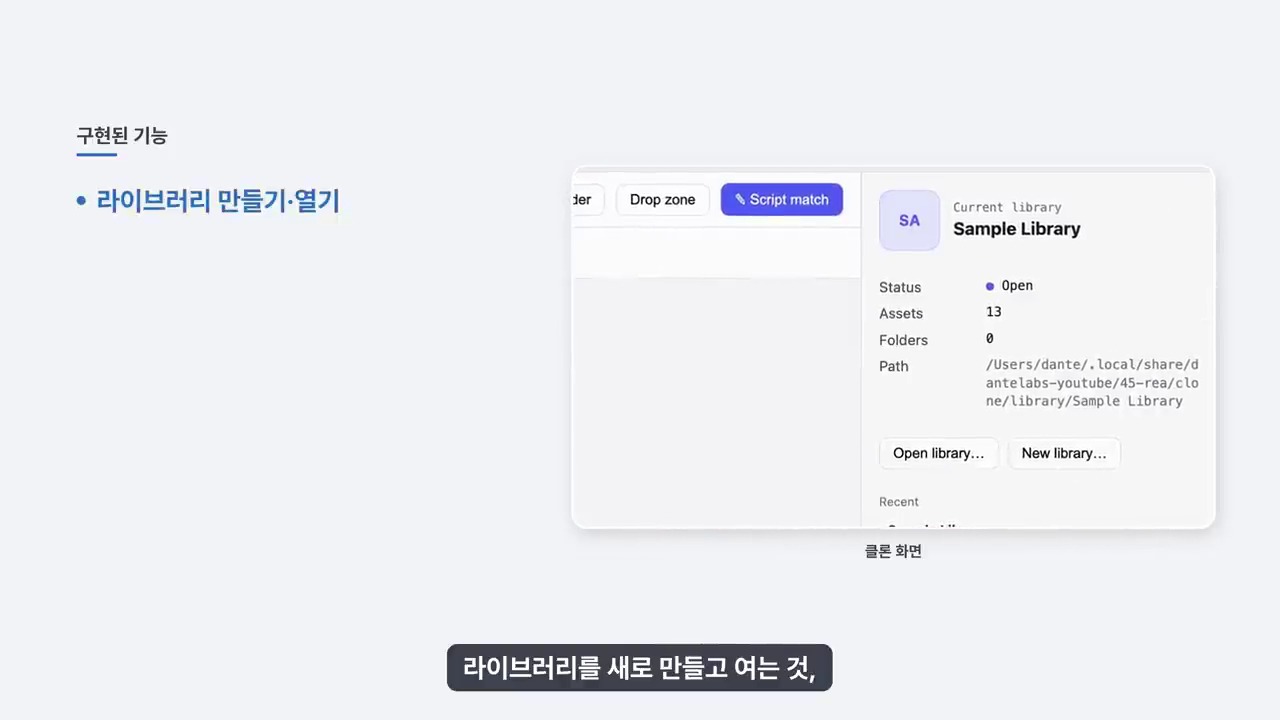
    Creating and opening a library in the rebuilt app
    Source: Dante’s Datalab, original video at 13:50. Frame quoted to illustrate the discussion.

    The published scorecard gave the following results.

    • Interface structure: 16/20 points
    • Data model: 16/20 points
    • Core behavior: 25/30 points
    • Edge cases: 8/15 points
    • Code structure similarity: 9/15 points
    • Total: 74/100 points

    The score of 74 should not be read as ‘74% complete’ or as the probability of copying any app. The evaluation agent assigned it to this result using five criteria set by the creator. Those criteria included whether it adopted the original’s internal structure. This is therefore not a conventional product quality score either.

    A Design Can Be Wrong Even When 22 of 24 Evidence Items Are Correct

    The most noteworthy aspect of this experiment is the error, rather than the speed. Of 24 Evidence items checked against the original source, 22 were correct, 1 could not be verified, and 1 was wrong.

    The problematic item concerned Electron IPC communication. Unable to find channel names, the analysis agent inferred that strings were assembled at runtime. It designed new feature-specific APIs on that basis. The original, however, used constants determined at compile time.
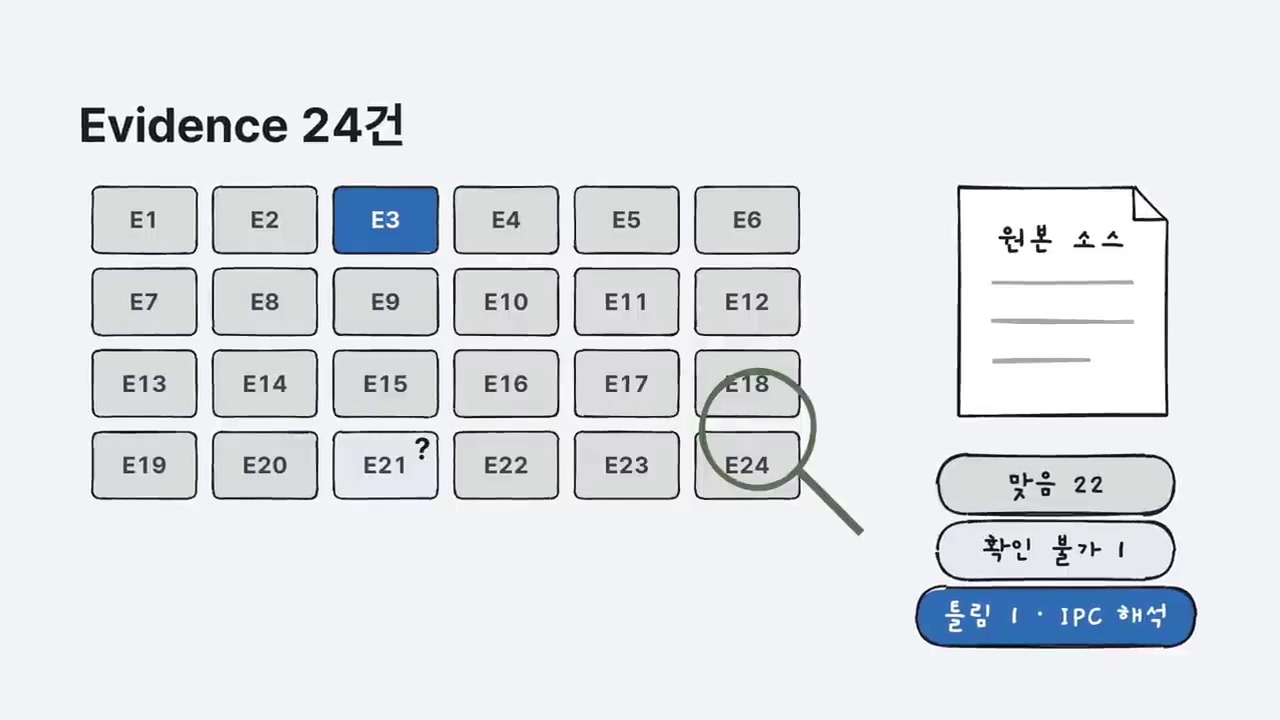
    Source-code checks of 24 Evidence items and the IPC interpretation error
    Source: Dante’s Datalab, original video at 16:50. Frame quoted to illustrate the discussion.

    Duplicate-file handling also differed. The rebuilt app stored file fingerprints but did not use them properly to detect duplicates. It also accepted unsupported formats that the original rejected. Discovering information and implementing the reason for that information turned out to be separate tasks.

    This case shows why verification cannot simply count pieces of evidence. Even when many items are correct, one mistaken core design assumption can redirect the entire result. The more important an inference, the more necessary it is to check both primary materials and actual behavior.

    Understanding and Extending Features May Be More Useful Than Copying

    After the rebuild, the creator added a panel that finds relevant assets when given a script paragraph. It compares tags, filenames, and notes to rank the assets. The key point is that this extension reused the data access and interface behavior already built.
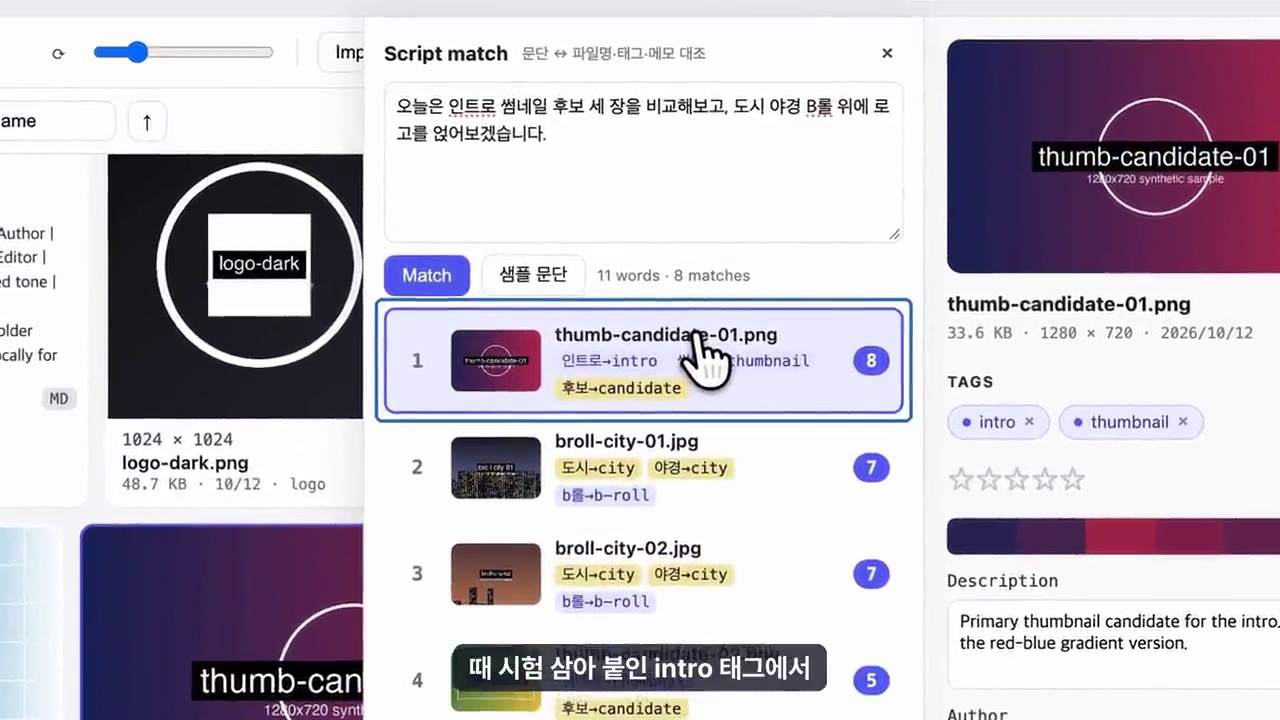
    Feature extension comparing a script paragraph with asset tags and filenames
    Source: Dante’s Datalab, original video at 18:20. Frame quoted to illustrate the discussion.

    However, tags added during testing also affected search scores. A working new feature does not, by itself, validate recommendation quality. That is why it needs retesting with separate real-world work data.

    From this perspective, REA is worth considering for more than other companies’ commercial apps. The following targets, for which analysis permission is clear, should come first.

    • In-house business software with inadequate internal documentation after its developer has left
    • Internal APIs whose actual responses have diverged from the documentation
    • Old proprietary file formats and data migration work
    • Existing programs that work but lack sufficient regression tests

    A broad goal such as ‘build the same app’ makes verification harder to define. Narrower questions clarify the criteria: ‘How does search work?’ or ‘What rules govern saving and restoring data?’

    An 11-Minute Paint Demo: The Features I Want, Not Just the Same App

    Success Knowledge Encyclopedia’s additional video shows a different use for REA. The presenter rebuilt a simple Paint-style app based on Windows Paint. He added a feature that accumulates pasted images in an asset list on the right. The video directly checks basic drawing, color changes, filling, and image pasting. It also demonstrates renaming, reusing, and downloading assets, and removing them from the list.

    The distinction here is that the presenter added custom features to a newly built app rather than modifying the existing Windows Paint product itself. The point is not to match the original perfectly. It is to combine a familiar workflow with features the user wanted.

    The presenter says the result took about 11 minutes. Unlike the earlier Serpent experiment, however, this video provides no scorecard comparing the original source with the result. Unfinished elements, including the cursor display, remain. Features working in a short demonstration should not be mistaken for product quality suitable for long-term use.

    11 Minutes and 23 Minutes Are Not a Performance Ranking

    The two videos cover the same tool but demonstrate different things.

    • Dante Labs’ roughly 23-minute experiment: Restricted access to the original source of an asset management app. A separate evaluation agent compared the original and rebuilt app, awarded 74 points, and disclosed incorrect evidence and missing features.
    • Success Knowledge Encyclopedia’s roughly 11-minute demo: Built a Paint-style app with an asset panel and tested its main functions on screen. It provided neither a score under the same criteria nor results checked against original source code.

    The apps’ complexity, implementation scope, execution environments, and evaluation methods differ. Comparing these times cannot establish which agent is faster or how much REA’s performance has improved. The former is better understood as a test of the accuracy of understanding, and the latter as a use case for building personalized features.

    What Has Fallen for Non-Specialists Is the Barrier to Starting Analysis

    The additional video locates REA’s value in making existing tools easier to access and connect, rather than inventing new reverse engineering technology. Previously, users had to learn tool installation and operation separately. The perspective here is that they can now start by requesting work from an agent.
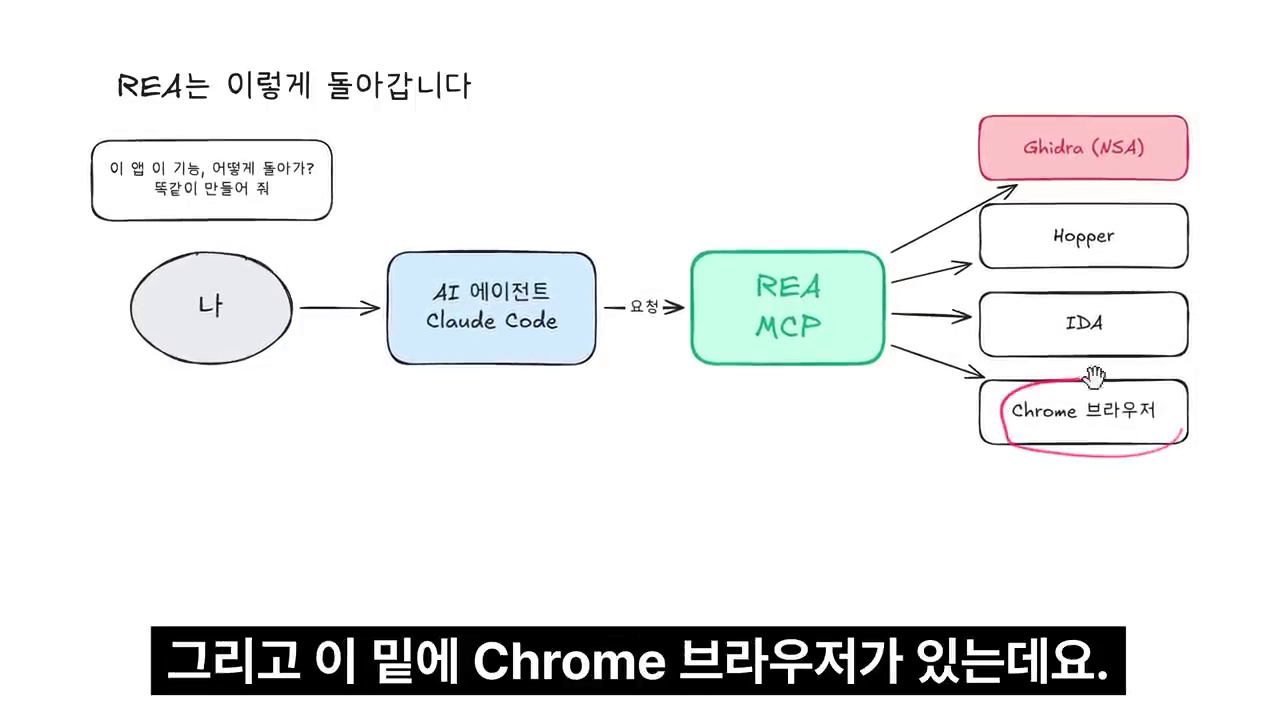
    Success Knowledge Encyclopedia's diagram connecting REA MCP with existing reverse engineering tools
    Source: Success Knowledge Encyclopedia, additional video at 01:50. Frame quoted to discuss the explanation and outlook.

    But ‘easier to start’ does not mean ‘no knowledge needed to review the result.’ The presenter also emphasizes learning enough to read, understand, analyze, and review the output. The earlier IPC interpretation error and duplicate-file handling failure show why.

    In practice, it is better to narrow the scope than to hand over an entire app from the outset. Start with a program you are authorized to analyze. Check one feature’s input, output, and storage rules, test its explanation and evidence, and then expand. Comparing the same task with an ordinary coding agent without REA can also help establish whether the extra tools are actually necessary.

    How Should We Interpret Predictions That Core Logic Will Move to Servers?

    Success Knowledge Encyclopedia predicts that easier analysis may encourage software companies to put core logic on servers rather than inside apps. The reasoning is that implementations distributed to user devices can be investigated, creating an incentive to change how software is delivered.
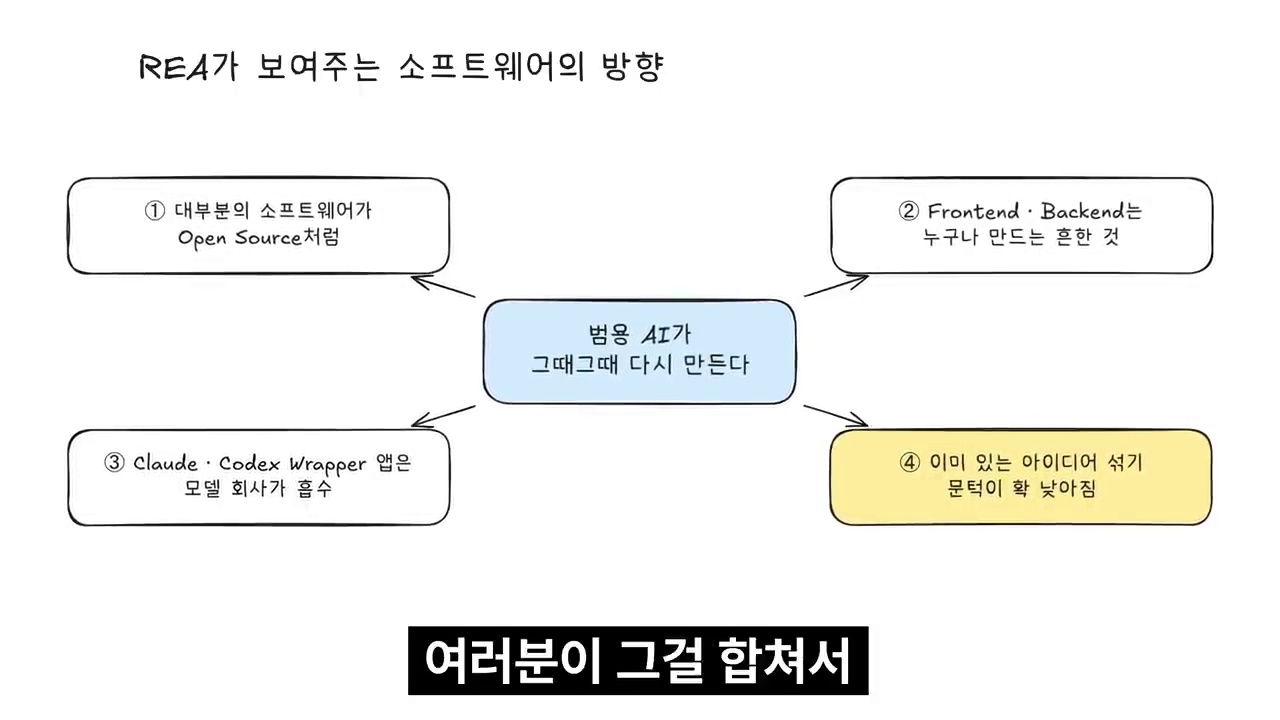
    Success Knowledge Encyclopedia's outlook on software development as REA spreads
    Source: Success Knowledge Encyclopedia, additional video at 10:20. Frame quoted to discuss the explanation and outlook.

    This is the presenter’s prediction, not an established fact that all apps will become server-centered. Server-based designs also require considering operating costs, network latency, offline usability, privacy, and access control. Hosting something on a server does not solve every security problem.

    Likewise, statements such as ‘software is over’ or ‘most apps will become open source’ should be read as predictions emphasizing the scale of change. Easier feature implementation is separate from continuously operating a product with maintenance, security, and support. Being able to analyze a product does not grant a license to use its code or assets.

    We should also avoid concluding that personal learning use is always acceptable. The additional video’s examples are useful references. But the purpose, authorization, terms, and licenses for analysis should be checked separately using the existing checklist.

    What a Web App Example Adds: What Did MathSheets Reproduce?

    AI with Hassan’s additional video uses Google Sheets’ interface and basic behavior as a reference to show how to build a simple spreadsheet called MathSheets. The presenter requests only the tools needed for web app analysis. He asks not to install native binary analysis tools such as Ghidra and Hopper.

    This approach distinguishes observable web functionality from internal analysis of installed programs, rather than using the same reverse engineering tools for every target. Inspecting a browser interface and its interactions does not establish an understanding of server-side implementation or operational architecture.

    The video demonstrates cell editing, selection, and a simple addition result. The presenter says the work took about 20–30 minutes, but provides neither precise measurement records nor repeated trials of the same task. There is also no basis for directly comparing this time with the 11-minute Paint demo or the 23-minute asset management app experiment.
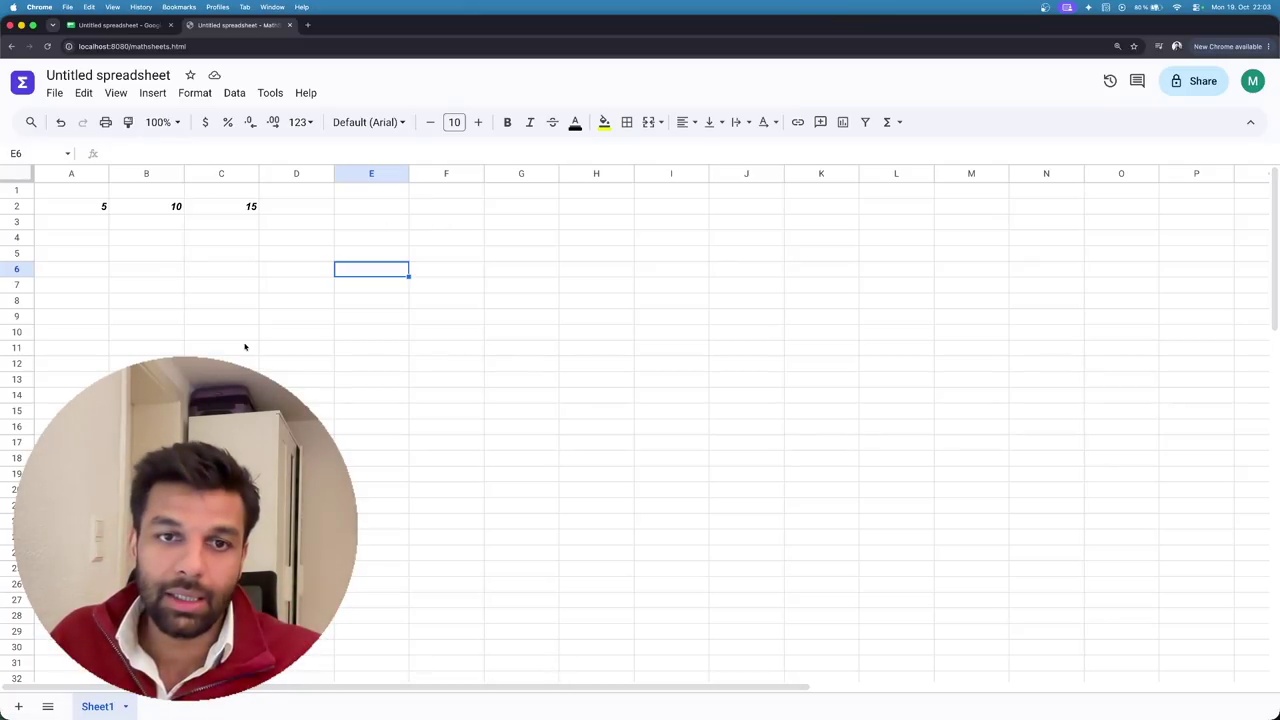
    AI with Hassan demonstrates cell input and an addition result in local MathSheets
    Source: AI with Hassan, additional video at 10:35. This demonstrates local MathSheets, not a reproduction of the entire Google Sheets service.

    A Share Button Is Not the Same as Working Collaboration

    The video alone may give the impression of a completed interface closely resembling Google Sheets. However, the creator’s published MathSheets repository README explains the implementation scope more specifically.

    • It describes a lightweight spreadsheet built with HTML, CSS, and JavaScript, and says the app itself needs no server.
    • It lists support for cell references, ranges, some formulas including SUM and AVERAGE, and CSV export.
    • Data is stored in the browser’s localStorage. It explicitly warns that clearing site data deletes it, and recommends exporting anything worth keeping as CSV.
    • Share and Email are unimplemented menu items marked ‘soon’, according to the documentation.

    This case should therefore not be read as restoring Google Sheets’ collaborative editing, accounts and access permissions, cloud storage, or operational infrastructure. A visible Share button is different from allowing multiple users to edit the same document safely. The feature list above follows public documentation. It is not the result of separately running and verifying the app here.

    The official REA repository must also be distinguished from the video’s example repository. The former is a reverse engineering tool; the latter is a learning project built using it. The example README’s License section says no license has yet been specified. Code being visible on GitHub does not, by itself, establish permission for unrestricted reuse or distribution. Before using it, separately check the repository’s latest license and usage permissions.

    Define Verification Boundaries Before Dividing Work Among Agents

    Hassan shows tasks such as the grid and formulas being divided among subagents. Separating interface work, such as input and selection, from formula interpretation can clarify each role. But using multiple agents does not itself demonstrate greater speed or accuracy. No comparison with a single agent performing the same task is provided.

    Using a spreadsheet for work requires tests beyond visual similarity, including the following. These are checks needed before actual use, not claims that the video verified them all.

    1. When a cell changes, do other cells referencing it recalculate correctly?
    2. How are empty cells, invalid formulas, circular references, and error values handled?
    3. Does data survive refreshing or closing the browser, and do CSV export and reimport work as intended?
    4. If collaboration is required, have per-user permissions, simultaneous editing conflicts, change history, and recovery been separately implemented and tested?

    The evidence REA returns and its unknowns can serve as starting points for this verification plan. Do not treat unknown items as completed implementations. Track verified behavior, inferred structures, and unimplemented features separately. Even when code generation is divided among multiple roles, final integration and verification need one consistent set of criteria.

    Taken together, the three videos do not establish that ‘any app can be perfectly copied for free.’ The asset management app experiment examines the accuracy of analytical evidence; the Paint demo explores personalized feature extensions; and the MathSheets case highlights the difference between an interface with basic behavior and an entire service. Lower barriers to development do not remove the need to decide which problem to solve and how far the result can be trusted.

    Three Remaining Limitations When Assessing REA’s Impact

    First, these are single-run examples. Times and results may change with the target app, model, prompt, and test data.

    Second, there is no comparison condition without REA. This result alone cannot show how much better it was than an ordinary coding agent or which gains came from REA.

    Third, an AI agent also performed the evaluation. Comparing with the original code is useful, but that scoring is not equivalent to an independent expert audit or security assessment.

    To assess the tool’s usefulness, it is therefore better to examine the experimental conditions and failures rather than just the video’s title.

    Check Analysis Permissions and Licenses Before Tool Performance

    REA being open source does not make the target app’s rights unrestricted. Check each separately: authorization to analyze, the target program’s license and terms, and permitted uses of code and assets such as images and icons.

    The video also introduces provisions concerning computer programs in South Korea’s Copyright Act. However, observing functionality, reverse-analyzing code, achieving interoperability, and distributing results differ in purpose and scope. This should not be simplified into ‘reverse engineering is always legal’ or ‘a similar interface is never a problem.’ If you plan to analyze a commercial app or distribute the result, consulting an expert about the specific conditions is safer.

    Before experimenting, check these five points.

    1. Did you create the program yourself, or confirm permission to analyze and use it?
    2. Have you checked the license terms for both the target program and the analysis tools?
    3. Are you avoiding unauthorized reuse of original code and design assets?
    4. Have you removed personal and confidential information from analysis logs and publicly shown screens?
    5. Do you distinguish observed facts from inferences and test edge cases as well as normal behavior?

    The REA experiment’s value is both broader and more limited than the phrase ‘copying apps’ suggests. It shows potential to shorten the time needed to understand existing programs, but does not remove responsibility for interpretation and verification. Start by understanding one small feature in a program you are clearly authorized to analyze. Then check that understanding with evidence and tests.

    Related Reading

    FAQ

    Can REA perfectly copy any app without source code?

    That has not been established. The video presents a single case of rebuilding major features while access to the original project source was blocked. The installed app’s bundled code remained available for analysis. Features were missing, and some internal design interpretations were wrong.

    Does REA replace Ghidra or IDA?

    The official documentation presents REA more as a layer connecting existing analysis engines and various observation tools to agents. The tools used vary with the analysis target and environment.

    Do 23 minutes and 74 points represent REA’s typical performance?

    No. They are results from one run under the creator’s chosen environment and evaluation criteria. Without repeated experiments or comparison against a condition without REA, they cannot be generalized as typical performance.

    Does purchasing a paid app allow unrestricted reverse engineering and redistribution?

    Purchase alone does not establish every right to analyze, reuse, or distribute it. Relevant law, terms of use, licenses, and the purpose and scope of analysis require separate review.

    Is the 11-minute Paint demo a better result than the earlier 23-minute experiment?

    The target apps, implementation scope, and evaluation criteria differ, so direct comparison is not possible. The Paint demo illustrates custom feature extensions. The earlier experiment focuses on checking against original source code and verifying missing features. Both videos show single-run examples.

    References

    The images are frames quoted to explain and critique relevant scenes from the original video. Experimental figures and evaluation results follow the video creator’s public records. They are not results from a separately reproduced experiment.
    Original Korean article

  • Cognitive Debt in AI Coding: What to Check Before Orca and Buzz

    Cognitive Debt in AI Coding: What to Check Before Orca and Buzz

    AI writes the code, another AI reviews it, and they even submit a PR. Work appears faster. But what remains if a person cannot explain why the changes were made or what they affect? Cognitive debt in AI coding is the gap between code generation speed and human understanding.

    Modu AI’s video reviewing Orca and Buzz addresses this problem. It does not conclude that either tool is bad. The creator acknowledges the potential of collaborative approaches but warns against expanding delegation before developing the ability to understand and control a single agent’s results. That makes it worth focusing on what developers should verify, rather than competition over tool features.

    Orca and Buzz May Be Convenient, but Review Responsibility Remains

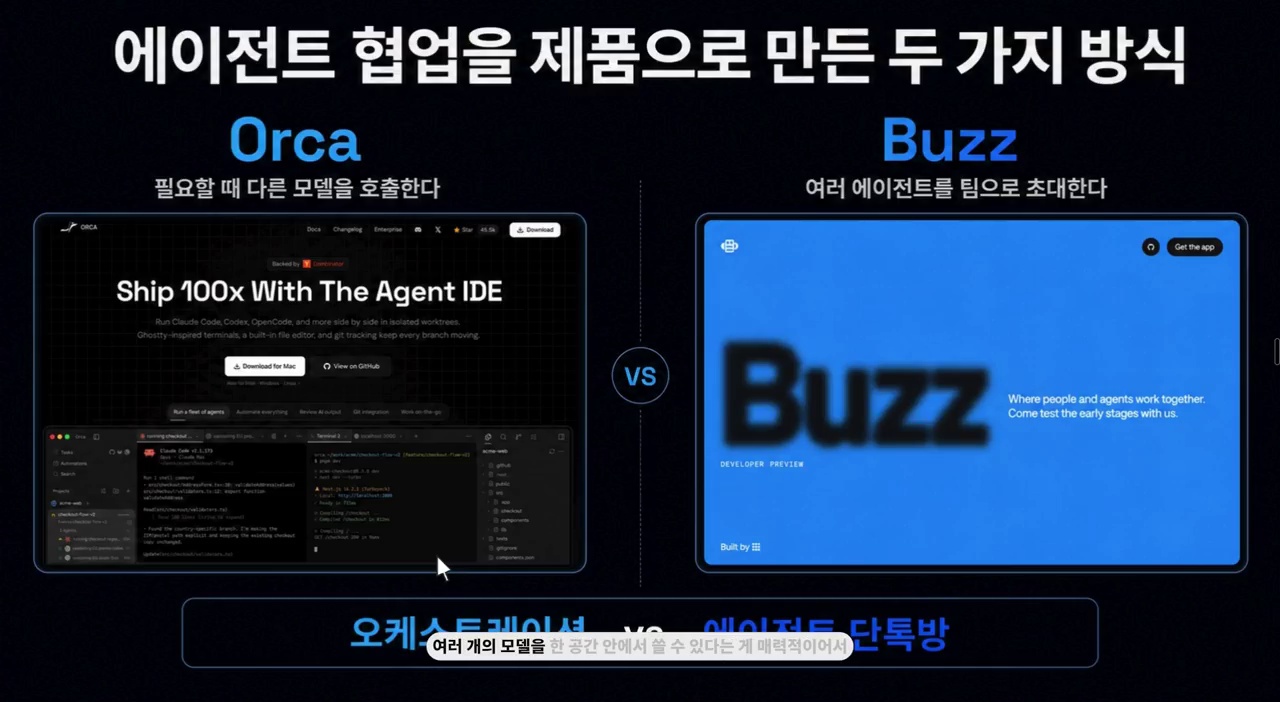
    The video presents Orca as connecting multiple coding agents and models in one workspace. It presents Buzz as a channel-based setting where people and agents converse together. The creator describes having another model review work, assigning development roles, and receiving a PR.

    Video comparing agent collaboration approaches in Orca and Buzz
    Source: Modu AI, source video at 01:35. Frame reproduced to explain the discussion.

    This is not an independent comparison of the two products’ latest specifications and performance. Promotional claims shown onscreen, such as productivity multipliers, are not cited as measured results. The focus is not the interface. It is who understands and approves results once delegation becomes easier.

    Having one AI ask another AI for a review does not establish that the review was independent or sufficient. They may have accepted the same assumptions, missed the same materials, or failed to test important failure conditions. Switching models can provide a different perspective. It does not prove that errors have been eliminated.

    The creator says the PR produced by several agents was satisfactory. Yet the creator also describes difficulty following the changed files and decisions. These observations are not contradictory. A plausible result and understanding it well enough to take responsibility for fixing it are different states.

    Cognitive Debt Means Putting Off the Work of Understanding

    In the video, cognitive debt is the burden that accumulates when understanding AI’s work is postponed. You may move on because the interface looks normal. But an incident or further development could force you to learn the structure from scratch later.

    This is not a formal metric measured here or a diagnosis applying to every AI user. It is a perspective for examining gaps in understanding during development. Consider the following situations.

    • A feature works, but you cannot readily explain which data and files it passes through.
    • You read AI’s summary but did not check whether it matches the actual changes.
    • Review comments were resolved, but you do not know which tests support those resolutions.
    • You cannot readily identify what to roll back after a problem or whether the data can also be restored.

    The point is not to memorize all the code. The creator does not argue that building a product requires reading every line. What matters is understanding enough to assess change scope and key connections as the system grows, and to recover from problems.

    What Else Should You Check as Agent Numbers Grow?

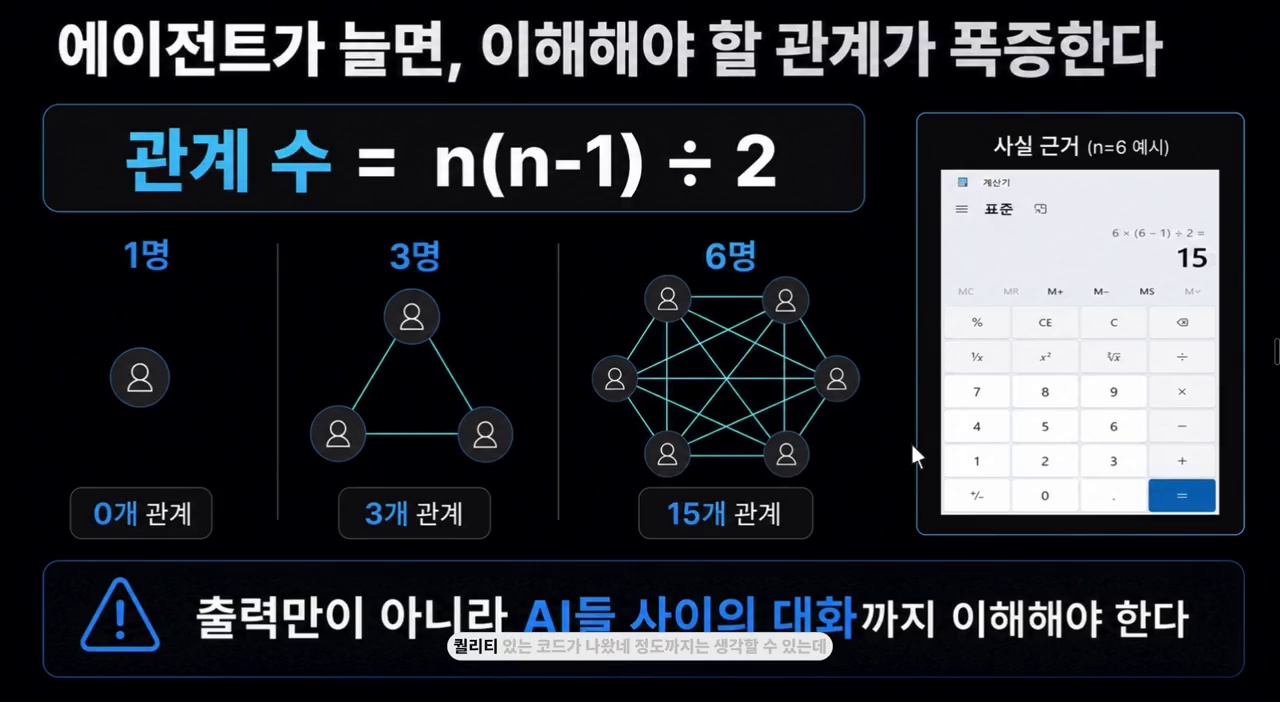
    The video shows a diagram of increasing possible relationships between agents. If every agent is paired with every other agent, without distinguishing direction, the number of possible relationships is n(n-1)/2. Under this assumption, 3 agents yield 3 pairs, 4 yield 6 pairs, and 6 yield 15 pairs.

    Video diagram explaining the number of possible relationships between agents
    Source: Modu AI, source video at 12:15. Frame reproduced to explain the discussion.

    However, this formula counts possible connections. It does not mean actual message volume or review costs must reach those numbers. The relationship count is quadratic, not mathematical proof of exponential growth. Actual overhead depends on whether there is a central coordinator and who passes results to whom.

    In practice, the following questions are more useful than asking how many agents were added.

    1. Do participants’ change scopes overlap?
    2. What supporting evidence accompanies one participant’s results when passed to the next?
    3. When opinions conflict, who decides, and by what criteria?
    4. Can the final PR’s actual changes be compared with what was agreed?
    5. Are test failures and uncertainties reported to a person?

    Checking these points does not require reading every conversation or private internal reasoning. What you should request is the reasons for changes, reviewable evidence, impact scope, execution results, and unverified items. A short decision record linked to the actual diff and tests may help more than a lengthy discussion transcript.

    A Visible Collaboration Interface Is Not the Same as Understood Results

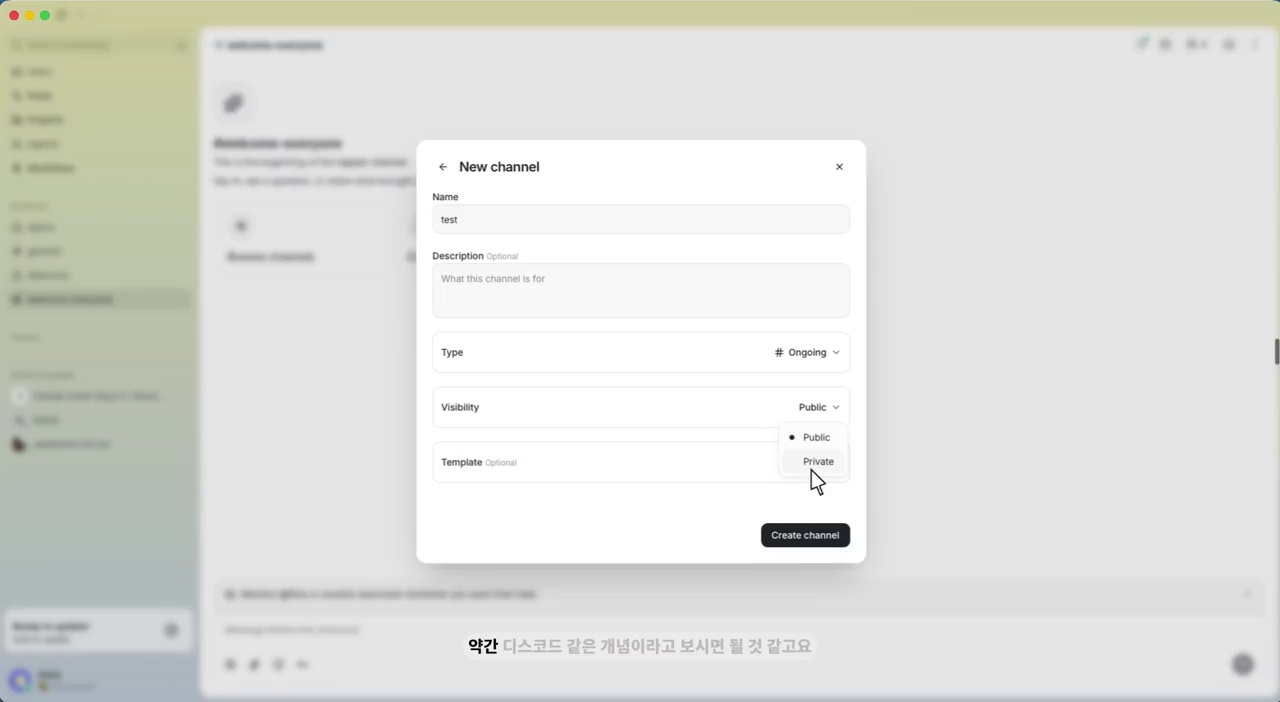
    The Buzz walkthrough shows creating a channel, inviting agents, and conversing with them. Seeing who is responding and in which role may help you follow the collaboration process.

    Buzz walkthrough showing creation of a channel for agents to join
    Source: Modu AI, source video at 05:50. Frame reproduced to explain the discussion.

    However, seeing a conversation differs from understanding the effects of actual code. Several agents may respond positively while collectively missing an important failure condition. A generated PR does not mean the work is ready for deployment.

    A final report should go beyond summarizing the conversation and cover the following items.

    • What changed: Features and major changed files.
    • Why it changed: Requirements and the rationale for the choices.
    • What it affects: Called functionality, data, permissions, and external integrations.
    • What was verified: Tests executed and their actual results.
    • What remains: Unverified conditions and items requiring approval.

    This list does not reproduce the video’s implementation. It is a suggestion for applying its concerns to practical review.

    A Teach-Back Hook: Asking What You Understand Before a Commit

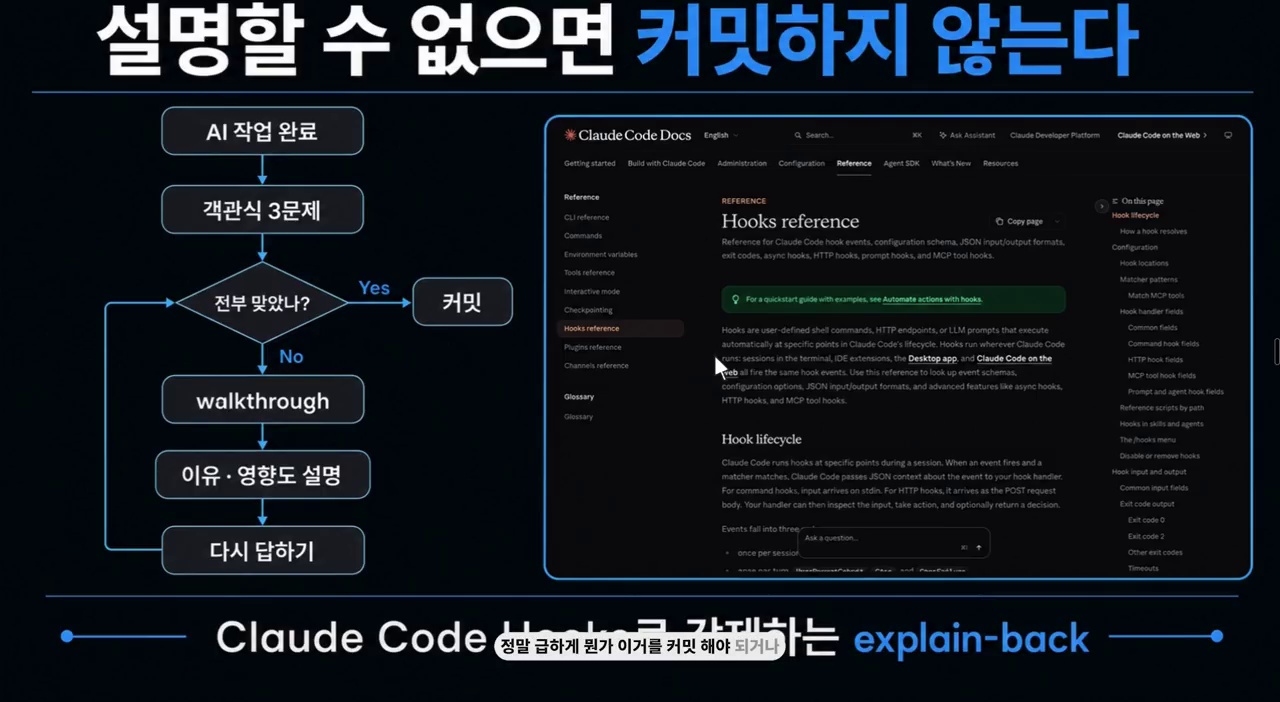
    The creator describes building a hook that checks understanding before commits to reduce cognitive debt. Initially, users had to explain the changes themselves. Later, the process allowed commits after passing multiple-choice questions. The video also introduces an HTML walkthrough that explains incorrect answers and checks understanding again.

    Concept diagram of pre-commit comprehension questions and a teach-back hook
    Source: Modu AI, source video at 18:05. Frame reproduced to explain the discussion.

    The useful idea is incorporating the intention to understand into the work process, rather than postponing it. However, the video’s description does not verify implementation code, check coverage, bypass prevention, or control over every commit path. Do not interpret the quiz as a built-in Claude Code feature.

    According to the official documentation, Claude Code hooks and Git pre-commit hooks are different systems. Claude Code hooks automate actions at particular events, such as session events or tool calls. Git hooks are separate mechanisms triggered by Git operations. Coverage depends on which conditions are connected to which system.

    Rather than assuming a hook completely blocks commits, check which execution paths it inspects and when it fails or permits execution. Do not treat a single local hook as equivalent to server-side approval rules or a security boundary.

    Correct Quiz Answers Do Not Guarantee Code Safety

    Comprehension questions can prompt a review. But their value weakens if AI-generated questions and answers are wrong, users merely memorize answers, or code changes after the questions.

    If applying this approach yourself, consider the following design choices. These are suggestions for improvement, not code reproducing the creator’s hook.

    • Tie questions to the changes under review. If those changes differ, reassess the previous pass status.
    • Ask about impact scope, failure conditions, and recovery methods, not just recall of code content.
    • When explaining correct answers, check the actual changes and test evidence together.
    • Even after a comprehension check passes, review tests, permissions, and data protection separately.
    • If an urgent exception is needed, record what was skipped and who is responsible for follow-up verification.

    For example, asking only for the name of a modified function may be less useful than asking about failure consequences. Having users explain which user flows would be affected and how to verify them may better serve a real review.

    What Coding-Learning Research Supports—and What It Does Not

    In research released in January 2026, Anthropic tested 52 software developers, mostly juniors, learning a new Python library, Trio. Its official overview reports average quiz scores of 50% for the AI group and 67% for those coding themselves. The difference in task completion time was not statistically significant.

    The researchers also discuss differences between simply receiving generated code and building understanding through follow-up questions, explanations, and conceptual checks. However, qualitative analysis of interaction types must not be treated as proof of a particular learning method’s causal effects.

    These results concern a specific task involving learning a new library. The experiment did not compare Orca with Buzz or measure multi-agent performance. It cannot support broader conclusions that AI reduces every developer’s understanding or that multiple agents lower productivity.

    The connection to the video’s concerns is narrow and clear. Completing a task and developing understanding during it need to be checked separately.

    Five Checks Before Adding More Agents

    You do not need perfect control over one agent before taking the next step. But before expanding delegation, check whether you can answer the following questions about your current work.

    1. Purpose: Can you explain the user problem this change is intended to solve?
    2. Scope: Can you identify the main changed files and connected features?
    3. Evidence: Can you compare key implementation and review decisions against actual changes and requirements?
    4. Verification: What was tested, and what remains unverified?
    5. Recovery: If something goes wrong, which code, settings, and data must you inspect and restore?

    If these questions are hard to answer, consider smaller tasks, narrower PRs, and clearer change explanations before adding agents. Conversely, if roles are clear and results can be independently checked, expand parallel work where needed.

    This single video cannot determine the optimal number of agents. The important criterion is not how many are working, but whether a person can understand and approve the results, then fix them when necessary.

    Related Reading

    FAQ

    Must I Read All AI-Written Code to Resolve Cognitive Debt?

    The point is not to memorize every line. It is to understand enough to judge key change rationales, impact scope, verification evidence, and recovery methods if something fails.

    Does This Mean I Should Not Use Orca or Buzz?

    No. The creator acknowledges both tools’ potential and strengths. It is better understood as experience-based advice against expanding collaboration while a single agent’s results remain difficult to understand.

    Does Claude Code Require Passing a Comprehension Quiz Before Committing by Default?

    The video describes a hook and walkthrough approach built by the creator. The quiz should not be considered a default feature. Its actual implementation and check coverage also require separate verification.

    Can I Skip Human Review After Passing an AI Review?

    Passing an AI review alone does not guarantee safety or compliance with requirements. Define the scope of human approval using actual changes, tests, permission and data impacts, and unverified items.

    References

    The images are captures used to explain and critique the source video’s discussion. The creator’s personal experience, official technical documentation, a learning experiment under specific conditions, and this guide’s practical suggestions are distinguished. They do not indicate a completed product-performance comparison or independent execution and security verification of the hook.

    Original Korean article

  • The Essence of AI Coding Is Not the Model but the Harness: Matt Pocock’s Agentic Engineering

    The Essence of AI Coding Is Not the Model but the Harness: Matt Pocock’s Agentic Engineering

    # The Essence of AI Coding Is Not the Model but the Harness: Matt Pocock’s Agentic Engineering
    Thumbnail for a Tech Bridge video on Matt Pocock’s agentic engineering workflow
    Tech Bridge thumbnail about Matt Pocock’s agentic engineering workflow

    When people discuss AI coding, they usually name models first: Claude, Codex, Gemini CLI. Models matter, but Matt Pocock points elsewhere. The real difference comes from the harness.

    The harness is the working environment around the model: prompts, skills, codebase structure, tests, documentation, sandboxes, GitHub Actions, and review flow. It is like judging not only the engine of a car but also the chassis, pit crew, and track operations.

    This matters because model performance is hard for us to control, while the harness is something we can design.

    ## AI has eaten tactical programming

    Pocock borrows John Ousterhout’s distinction between tactical and strategic programming. Tactical work includes writing code, fixing bugs, making commits, and matching syntax. Strategic work is deciding what structure will be maintainable, how to divide work, and where the codebase should go.

    AI has already absorbed much tactical programming: small features, tests, refactoring drafts, and documentation updates. As AI handles more tactics, human value moves toward strategy: clear goals, narrow scope, completion criteria, and tests.

    ## The work environment matters more than the latest model

    The strongest line is that everyone obsesses over models, but we should care more about the harness. For example, if you want to reduce token cost, one answer is shorter prompts. Matt’s answer is a codebase that is easy to change. Clear structure, tests, and current documentation let AI work with less context. A tangled codebase makes even expensive models wander.

    ## Skills should be managed as procedures, not piled on

    A skill is a reusable bundle of instructions for repeated thinking or work. It can make an AI act as a learning coach, critique a design aggressively, or review PRs in a specific way.

    But Matt does not say to add as many skills as possible. He suggests deleting skills, plugins, MCP servers, Claude.md, and agents.md, then observing the model in a blank state. Add back only what is truly needed. Too many instructions can pollute the context window.

    ## AFK agents are closer to queues than infinite loops

    “Agentic loop” sounds attractive: the agent thinks, acts, observes, and acts again. In practice, it can blur scope, raise cost, and remove review points.

    Matt proposes “queue rather than loop.” Put work into a queue, like GitHub issues or Jira tickets. The agent takes one task, investigates, changes, tests, makes a PR, and a human reviews it. Good candidates include failing-test investigation, README updates, refactoring proposals, PR review drafts, security checklists, and old-issue reproduction.

    ## AX: Agent Experience now needs design

    Developer Experience made environments easy for humans to install, run, test, and deploy. Agent Experience is the degree to which an AI agent can work in the codebase.

    • Predictable folder structure
    • Clear test commands
    • Automated type checks and linting
    • Current README and development docs
    • Clear module boundaries
    • Safe validation of small changes
    • Enough information to run in a sandbox

    Good AX overlaps strongly with good DX. What humans can infer informally, agents often miss; therefore documentation, tests, commands, and boundaries matter more.

    ## Problems found by AI should become system improvements

    If a model finds a security bug, do not stop at “this model is good.” Ask why the bug remained, why tests missed it, whether similar bugs exist, and how future checks can be automated.

    AI output should be a signal to improve the harness: add tests, revise review criteria, create a security-check skill, or add CI checks. That turns AI coding from a one-off productivity tool into an organizational learning system.

    ## Product and business judgment still belongs to humans

    The video also touches on SaaS and AI startups. Matt’s answer is simple: talk to customers, find real problems, prototype, and validate. AI accelerates implementation, but it does not decide what to build, why to build it, or what to remove.

    ## Seven things Korean developers and teams can do now
    1. Read your README as if an agent were entering the repo for the first time.
    2. Turn repeated requests into skills or templates, but only when they are truly repeated.
    3. Split issues into AI-sized tasks.
    4. Include test commands and done criteria in instructions.
    5. Start AFK work inside sandboxes and limited permissions.
    6. Review AI PRs for failure patterns, not only code.
    7. Follow model news, but check structure, tests, documentation, and review flow more often.
    ## Related reading ## FAQ ### What is a harness in AI coding? The full environment in which the model works: prompts, skills, code structure, tests, docs, sandbox, CI, and review flow. ### Why is codebase structure more important than the latest model? A clear structure and tests let AI make safe changes with less context. A messy codebase makes any model struggle. ### How is a queue different from an agentic loop? A queue lets humans define tasks and review results one by one. A loop can become open-ended and harder to control. ### What is AX? Agent Experience: how easy it is for AI agents to work in a repository. It overlaps with DX but raises the standard for clarity. ### What should be prepared first before assigning coding to AI? Scope, completion criteria, tests, sandboxing, permission limits, and review flow. ## References

    AI coding’s next step may not be turning on more tools. It may be pausing to inspect the environment where AI works: missing docs, fragile tests, and tasks that can be queued. That small cleanup can matter more than subscribing to one more model.

    Original Korean article

    Image source: Captured images used in this article are stills from the original YouTube video. They are used for review, commentary, and educational explanation, and copyright remains with the original rights holders and the channel.