
We ask the question, “Why?” This is because we are curious. Because we are curious. And various studies are conducted to obtain answers to interesting questions. To conduct research, you need data to create and test theories. There are quantitative and qualitative methods for verification. To use quantitative research methods, you must know numbers.
Original Korean article: What is research: Summary of research concepts for introduction to R statistics
If you first understand what research is, the direction of R statistical learning becomes much clearer. Before you memorize statistical functions or analysis procedures, you need to know the overall flow of developing a research question, collecting data, and interpreting the results. This article summarizes the meaning and basic structure of research that beginners in R statistics must know.

I. Research methods
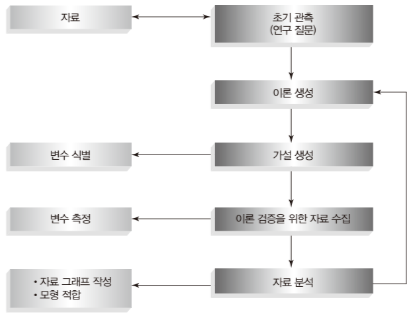
To answer an interesting question, you need to take the following steps:
- Observation: The first step begins with observation. Observations can be stories that can be captured between actual events or people in everyday life.
- Theory: Initially create a theory that explains the observations.
- Hypothesis: Create a hypothesis to make a guess or inference from a theory. At this time, variables are defined and relationships between variables are established.
- Data collection: Collect relevant data to logically verify the theory. The form of data may vary depending on the type of information that matches the variable.
- Data analysis: Analyze collected data to verify or revise the theory.
Ⅱ. What is a meaningful hypothesis?
A good theory should be able to make statements (propositions) about the state of the world. In this case, the statement means something good. We make sense of the world through statements and make decisions that affect our future. Some statements can be verified through scientific activities, while others cannot be scientifically verified. Scientific statements can be confirmed or disproved by experiments. ‘IU is a popular singer’ – unscientific statement ‘IU is the singer with the highest album sales in Korea. ‘ – Scientific statement So, a meaningful hypothesis is one that creates a hypothesis that corresponds to a scientific statement with a good theory.
Ⅲ. Verification and disproof
In scientific research, verification and falsification play a key role in the process of evaluating the validity of scientific theories and accumulating scientific knowledge. Both verification and falsification are important in scientific research, but their roles are different.
- Verification: The process of finding data that supports a hypothesis or theory and thereby increasing reliability.
- Counterevidence: The process of proving a hypothesis or theory wrong due to a single counterexample.
Ⅱ – 1. Verification
Verification is the process of confirming whether a particular theory or hypothesis is actually correct. If the data obtained through verification supports a hypothesis or theory, the reliability of that theory is strengthened. However, verification alone cannot prove that the theory is absolutely true, because other possible explanations may exist.
[Example] Law of universal gravitation: Isaac Newton’s law of universal gravitation explains the magnitude of gravitational force acting between two objects. To verify this, various experiments and observations were conducted. For example, by observing the orbital motion of planets or experimenting with objects falling on Earth, the results predicted by Newton’s laws were compared with the actual results. Through these numerous successful verification cases, it is accepted that the law of universal gravitation exists.
Ⅲ – 2. Falsification
Falsification is the process of proving that a specific theory or hypothesis is wrong. Philosopher Karl Popper argued that falsifiability is important in scientific methodology. This is because no hypothesis can be proven completely true by an infinite number of test cases, but it can be proven wrong by a single counterexample.
[Example] Ether theory: Until the end of the 19th century, it was believed that light propagated through a medium called ‘ether.’ However, the Michelson-Morley experiment proved that light can propagate in a vacuum without ether. Ultimately, the ether theory was disproved. Accordingly, a new understanding of light became necessary, which led to Einstein’s theory of relativity.
Good article to read together
- str_squish function to remove unnecessary spaces
- Creative thinking has become more important in the AI era, and the power of questions and perspectives spoken of by Dr. Jeongwoon Kim
- Human Values in the AI Era: What should people who cannot be replaced prepare?
Key Checklist
- Is the research question clear?
- Are the research object and scope determined?
- Does the data collection method connect to the research question?
- Have you decided on what criteria to interpret the analysis results?
Good R statistics articles to read together
- Research Method Introduction to R Statistics: Understanding research design and analysis methods at a glance
- Variables and Measurement R Statistics: Understanding independent variables, dependent variables and measurement levels
- Measurement Error R Statistics: Easily Understand Random Error and Systematic Error
- Validity/Reliability R Statistics: Criteria for judging a good measurement tool
Related Reading
Continue with these related Thinknote English articles in the Data Analysis cluster.
- Research Method Introduction to R Statistics: Understanding research design and analysis methods at a glance
- Validity/Reliability R Statistics: Criteria for judging a good measurement tool
- Measurement Error R Statistics: Easily Understand Random Error and Systematic Error
- Variables and Measurement R Statistics: Understanding independent variables, dependent variables and measurement levels
- How to connect PHP to R: How to call an R script on the web and receive the result
- How to use unnest_tokens function: How to split by words in R text miningng
FAQ
What is this article about?
This article is part of Thinknote’s English R statistics and data-analysis archive. It explains research, measurement, text processing, or tidyverse-style workflow concepts in practical language.
How should I use this guide?
Use it as a learning note and starter reference. When applying code, adjust package versions, object names, and dataset structure to your own R environment.
Where can I read the original Korean article?
The original Korean article is available here: Original Korean article.