[태그:] PEST Analysis

  • Korea Ecommerce Outlook 2024–2025: PEST Analysis of Market Change

    Korea Ecommerce Outlook 2024–2025: PEST Analysis of Market Change

    This English article is a fuller global adaptation of the original Korean analysis. The original post is not only a short market note; it is a PEST-based industry outlook that connects regulation, platform trust, consumer behavior, logistics cost, and technology adoption in Korea’s ecommerce market. The purpose here is to preserve that level of detail while making the article readable for international readers who search for Korea ecommerce trends, platform regulation, C-commerce, and digital retail strategy.

    Korea ecommerce outlook 2024 2025 PEST analysis
    Korea ecommerce outlook 2024 2025 PEST analysis.

    Original Korean article: 이커머스 산업 전망 2024-2025: 시장 변화와 PEST 분석

    Why Korea Ecommerce Is Entering a New Phase

    Korea’s ecommerce market is no longer in the simple “sell more online” phase. For many years, gross merchandise volume and fast user acquisition were treated as signs of strength. The original Korean article argues that this era is ending. The market is now shaped by settlement risk, trust, cross-border price competition, consumer polarization, logistics pressure, and platform regulation.

    The TMON and WeMakePrice settlement delay crisis damaged confidence in marketplace platforms. At the same time, Chinese C-commerce platforms such as AliExpress and Temu pressured domestic players with ultra-low prices. High inflation weakened mid-market consumption. These changes mean that ecommerce strategy must be understood through market structure, not only sales growth.

    The core message is clear: survival and profitability matter more than raw scale. The companies that survive will not simply be the ones with the largest app downloads. They will be the companies that manage trust, cash flow, logistics, customer experience, and regulatory risk better than competitors.

    Political Factors: Platform Regulation, Settlement Rules, and C-Commerce

    Platform fair competition rules are becoming stricter

    Korea’s policy direction is moving from voluntary self-regulation toward legally binding platform regulation. The Fair Trade Commission has been concerned about monopoly power, self-preferencing, bundled services, and restrictions that prevent sellers or users from using competing platforms. Even if the final regulatory form changes, the pressure on dominant platforms remains significant.

    For large players such as Naver and Coupang, this may limit aggressive membership expansion, private-label exposure, or platform-lock-in strategies. For smaller competitors, regulation can create opportunity. However, the overall market may also become less efficient if rules slow down experimentation or increase compliance costs.

    The TMON-WeMakePrice crisis changed settlement expectations

    The settlement delay crisis triggered a strong policy response. The article highlights shorter settlement cycles and separate management of seller payments, similar to escrow-style protection. This is especially important because many sellers depend on timely settlement to pay suppliers, employees, and logistics partners.

    The impact can be double-edged. Stronger settlement rules protect sellers and consumers, but they can also weaken smaller platforms that previously relied on cash-flow timing to expand. As liquidity requirements rise, the market may consolidate around platforms with stronger capital structures.

    C-commerce regulation and customs barriers are becoming strategic issues

    Chinese platforms compete with extremely low prices and increasingly fast delivery. Korea’s policy response includes safety inspections, customs scrutiny, and potential adjustment of duty-free thresholds for small parcels. These measures are partly about consumer safety and partly about reducing reverse discrimination against domestic sellers.

    If customs and safety rules become stricter, C-commerce may lose part of its speed and price advantage. Domestic platforms should not assume that regulation alone will protect them, but regulation can change the competitive balance.

    Economic Factors: Polarized Consumption and Profitability Pressure

    The disappearance of the average consumer

    High inflation and high interest rates are changing the way Koreans shop. The original article describes a “disappearance of the average.” Consumers are moving toward either ultra-low-price options or clear premium value. Products in the middle price range can become difficult to defend unless they offer strong trust, brand identity, or convenience.

    This explains why discount stores, low-cost imported goods, and premium categories can grow at the same time. The strategic problem for ecommerce operators is that a vague middle-market position is becoming dangerous.

    The market is maturing into a zero-sum game

    As ecommerce penetration is already high, growth rates naturally slow. The market becomes less about bringing people online for the first time and more about taking share from other platforms. In this environment, marketing cost, delivery subsidy, membership benefits, and seller incentives can easily turn into a zero-sum competition.

    The article stresses that operating profit matters more than GMV. Platforms that cannot convert scale into margin may face restructuring, acquisition, or decline.

    Logistics and labor costs widen the gap

    Rising minimum wages, warehouse expenses, last-mile delivery costs, and returns management all create pressure. Companies with their own fulfillment networks may gain an advantage, but only if utilization and operational efficiency are high enough. For smaller sellers and platforms, logistics can become a structural disadvantage.

    Social Factors: Time Efficiency, Short-Form Commerce, and Senior Shoppers

    One-person households and time-efficient lifestyles are expanding demand for quick commerce, small packages, scheduled delivery, and easy returns. Fast delivery is no longer a luxury feature; it is becoming a hygiene factor that customers expect by default.

    The original article also highlights “Ditto consumption,” where shoppers follow influencers, algorithms, and social proof rather than searching only by product category. Short-form video, TikTok-style discovery, Instagram Reels, and creator recommendations are now part of the ecommerce funnel. Marketing must combine content and commerce.

    Another important social shift is the rise of active seniors in their 50s and 60s. These customers have purchasing power and are increasingly comfortable with online shopping. However, they need better user interfaces, trustworthy product information, clear payment flows, and sometimes vertical platforms that match their interests.

    Technological Factors: Generative AI, Retail Tech, and Cross-Border Logistics

    Generative AI can improve personalization, review summaries, customer service chatbots, product copy, virtual fitting, and product recommendation. The value is not simply novelty. AI can reduce operational workload and increase conversion when it is connected to actual purchase decisions.

    Retail technology and fulfillment automation are also becoming important. Automated guided vehicles, demand forecasting, inventory optimization, and warehouse management systems can become barriers to entry. Logistics infrastructure becomes a moat when it improves both speed and margin.

    Cross-border logistics is another technological and operational force. If direct purchase delivery times fall to three to five days, national boundaries become weaker in consumer perception. Korean platforms compete not only with domestic rivals but with global price and supply-chain systems.

    Strategic Implications for Ecommerce Companies and Sellers

    The original article’s consultant-style insight is that stronger regulation may shrink some short-term activity but improve long-term market health. Sellers should evaluate platforms not only by traffic, but by settlement stability, financial soundness, customer trust, and operational support.

    For platforms, the strategic priorities are clear: protect seller trust, strengthen compliance, reduce logistics waste, use AI for practical efficiency, and avoid undifferentiated price wars. For brands, the challenge is to choose whether they will compete on price, premium value, community trust, or specialized category authority.

    Korea ecommerce in 2024–2025 is not a simple growth story. It is a restructuring story. The companies that understand this shift early can build resilient operating models before the next wave of regulation, competition, and technology change arrives.

    Related Reading

    FAQ

    What is the main message of this Korea ecommerce outlook?

    The main message is that Korea ecommerce is shifting from growth-at-all-costs to survival, trust, settlement stability, profitability, and operational efficiency.

    Why is C-commerce important in Korea?

    C-commerce platforms such as AliExpress and Temu pressure Korean ecommerce companies with low prices, cross-border supply chains, and improving delivery speed.

    What should sellers consider when choosing a platform?

    Sellers should consider traffic, but also settlement stability, platform financial health, logistics support, customer trust, and regulatory resilience.

  • Jeju Tourism Outlook 2026: PEST Analysis of Risks and Survival Strategy

    Jeju Tourism Outlook 2026: PEST Analysis of Risks and Survival Strategy

    This English version expands the original Korean PEST analysis for global readers. The source article is written from a practical field perspective: Jeju tourism is still attractive, but the industry can no longer rely only on visitor volume. Operators must understand regulation, cost pressure, changing travelers, sustainability expectations, and digital transformation.

    Jeju tourism outlook 2026 PEST analysis
    Jeju tourism outlook 2026 PEST analysis.

    Original Korean article: 제주 관광산업 전망 2026: 위기와 생존 전략 PEST 분석

    Why Jeju Tourism Needs a 2026 Strategy Reset

    Jeju remains one of Korea’s most recognizable destinations, but the mood inside the tourism industry is increasingly serious. The original article begins with the feeling that many operators now say, “It is not like before.” Accommodation businesses, restaurants, local tour operators, and experience providers face higher costs and more demanding travelers.

    A resort owner’s comment in the original article captures the situation: simply selling rooms is no longer enough to cover labor costs. This is why a 2026 outlook must look beyond visitor numbers. It must examine airfare, lodging prices, local spending, environmental regulation, platform-driven travel behavior, and digital service expectations.

    Political Factors: From Development to Regeneration and Local Balance

    Large-scale resort development is harder than before

    Jeju has long carried the identity of an international free city, but development rules are becoming stricter. Environmental impact assessments, local consent, water and sewage capacity, landscape protection, and resident concerns all make new large-scale projects difficult.

    The original article emphasizes that the era of building a large resort simply because the land has a beautiful view is ending. Over-tourism, waste, sewage, and community fatigue have made local opinion more cautious.

    ESG and regional distribution shape public support

    Government and local budgets increasingly support smart tourism, eco-friendly operations, ESG projects, and local community models. Projects that reduce carbon, distribute visitors beyond famous attractions, and collaborate with local creators have stronger policy alignment.

    For 2026, the practical advice is to consider remodeling, upcycling, and regeneration rather than only new construction. Old houses, unused buildings, and local spaces can become attractive tourism assets when they preserve Jeju’s identity and meet sustainability goals.

    Economic Factors: High Costs and the Search for Perceived Value

    The high-cost structure is becoming normal

    Tourism businesses face interest costs, labor costs, food costs, energy costs, and maintenance expenses. Businesses that survived the pandemic through loans still carry financial pressure. Hiring service workers in Jeju is also difficult, and the expansion of foreign worker programs does not fully solve the need for skilled service labor.

    From the traveler’s perspective, Jeju is no longer always perceived as a cheap destination. Airfare and accommodation can make a domestic Jeju trip feel expensive, especially when the weak yen makes Japan appear competitive.

    The middle position is the most dangerous

    The original article argues that businesses with an unclear middle position are the first to suffer. Travelers choose either strong value-for-money options or premium experiences that feel worth the price. “Average” lodging, average food, and average service are difficult to defend.

    This does not mean every business must become luxury. It means the value proposition must be clear. A business can be affordable, premium, local, healing-focused, family-friendly, pet-friendly, workation-oriented, or culture-driven. It cannot be vague.

    Social Factors: Experience, Workation, Seniors, and Value Consumption

    Jeju travelers increasingly seek more than sightseeing. They want local culture, food, wellness, nature, photography, short video moments, and meaningful experiences. The rise of MZ travelers emphasizes experience and shareability, while active seniors seek health, healing, comfort, and slower itineraries.

    Longer stays such as workation and one-month living also change demand. These travelers need reliable internet, workspace, local mobility, laundry, food options, and community information. Tourism products must connect accommodation, work, rest, and local life.

    Value consumption is another social factor. Travelers care about eco-friendly choices, fair travel, local coexistence, and authentic regional stories. Businesses that show how they support local communities can build deeper trust.

    Technological Factors: AI, CRM, Smart Mobility, and Global Access

    Digital transformation is no longer optional for tourism operators. AI consultation, non-face-to-face check-in, automated booking, multilingual support, mobile payment, QR-based services, and customer relationship management can reduce labor burden and improve traveler convenience.

    Data-based marketing is especially important. Businesses need to understand who their customers are, where they come from, what content brings them, and what experience leads to reviews or repeat visits. Personalized recommendation and CRM can turn one-time tourists into loyal customers.

    Smart mobility also matters. Electric rental cars, mobility-as-a-service, autonomous driving pilots, and transportation data can reshape how visitors move around the island. Tourism strategy must connect destination, mobility, and digital discovery.

    Survival Strategy for Jeju Tourism Businesses

    The original article’s survival logic can be summarized in four directions. First, avoid the unclear middle. Second, reduce operational waste with automation and digital systems. Third, build differentiated local experiences that justify price. Fourth, align with sustainability, ESG, and regional distribution so that the business fits Jeju’s future policy direction.

    Jeju tourism in 2026 will not disappear, but it will reward different capabilities. The winners will not simply be those with the largest buildings. They will be operators who design experiences, manage costs, use data, respect local communities, and make Jeju feel meaningful again.

    Related Reading

    FAQ

    What is the biggest challenge for Jeju tourism in 2026?

    The biggest challenge is the combination of high operating costs, stricter environmental expectations, changing traveler behavior, and the need for stronger differentiation.

    Why is PEST analysis useful for tourism?

    PEST analysis helps tourism operators see policy, economy, social change, and technology together instead of treating tourism demand as a simple visitor-count issue.

    What strategy should Jeju tourism businesses prepare?

    They should clarify their market position, improve digital operations, design local experiences, reduce cost pressure, and align with sustainable regional tourism.

  • HRD Consulting Industry PEST Analysis: From Training Delivery to Tech Solutions

    HRD Consulting Industry PEST Analysis: From Training Delivery to Tech Solutions

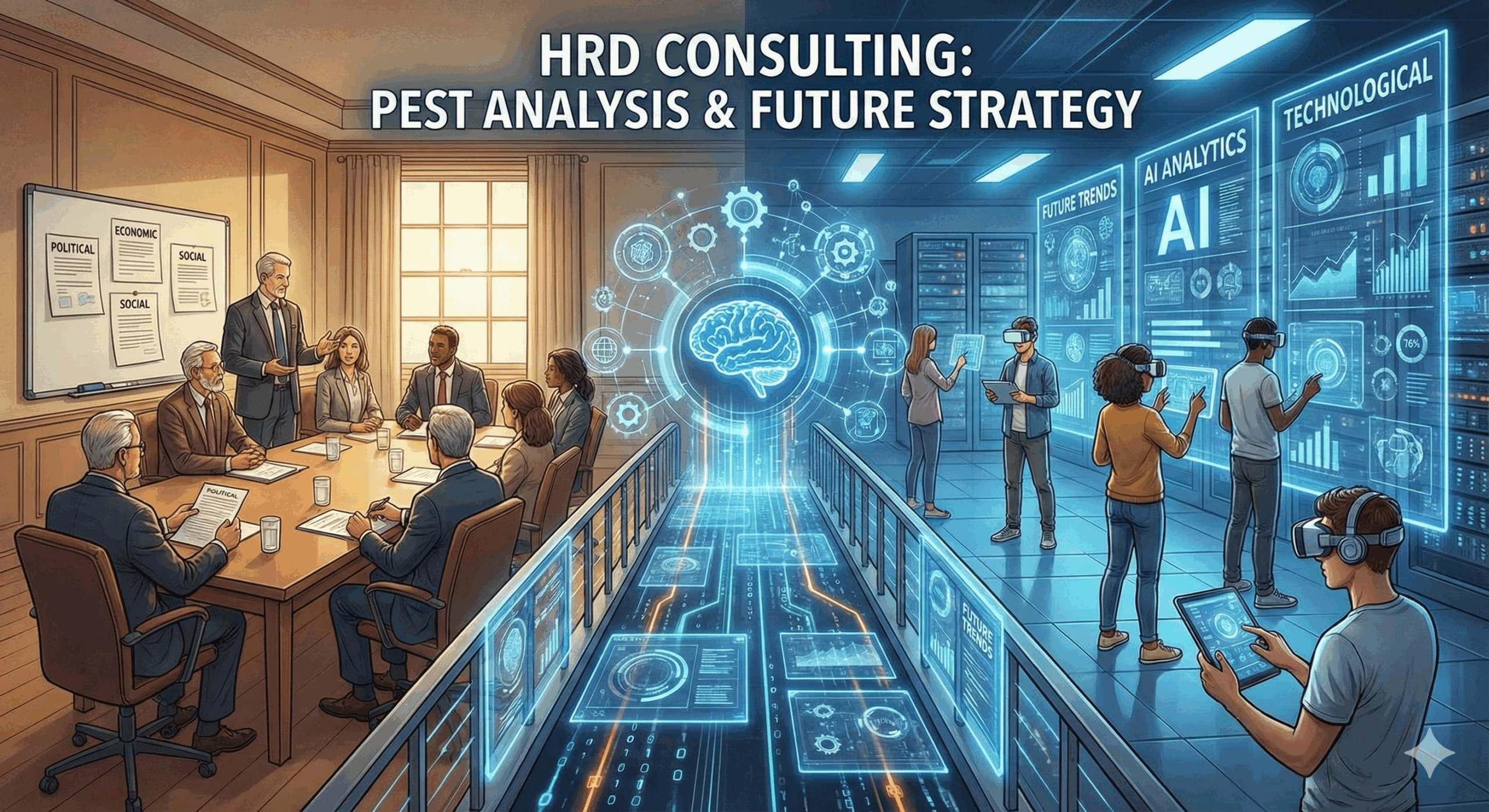
    This English version is a fuller translation and adaptation of the original Korean article, HRD 컨설팅 산업 PEST 분석: 교육에서 Tech 솔루션으로 가는 변화, for global readers. The HRD consulting industry and corporate education environment are undergoing rapid changes. Beyond simple job training, digital transformation and data-based performance management have become the core focus. The HRD consulting industry is shifting from traditional education operations to data, AI, and platform-based tech solutions. To understand the corporate education market, it’s essential to consider how policy, economic, social, and technological changes affect HRD demand and supply.

    HRD consulting PEST analysis and learning technology
    HRD consulting PEST analysis and learning technology.

    Original Korean article: HRD 컨설팅 산업 PEST 분석: 교육에서 Tech 솔루션으로 가는 변화

    HRD Consulting Industry – 1. Political (Political Environment)

    The government’s policies are the most significant variable in determining the flow of HRD budgets. Currently, the government’s focus is clearly on ‘digital’ and ‘safety’. The K-Digital Training policy aims to cultivate 1 million digital talents, with massive budgets invested in private training institutions. This presents a significant opportunity for consulting companies with digital job curricula. The Serious Accident Punishment Act has increased the demand for substantial safety education consulting, rather than formal legal mandatory education. The transition to a job-based pay system and fair hiring practices have also created a demand for consulting services based on job analysis and competency modeling.

    (IMAGE_1)

    HRD Consulting Industry – 2. Economic (Economic Environment)

    The economic downturn may lead to a reduction in education budgets. However, not all budgets are being cut. The polarization of education budgets means that general, universal education budgets are being reduced, while investments are being made in core talent development and digital transformation education. ROI (return on investment) proof has become more crucial than ever. Instead of hiring, companies are focusing on reskilling and upskilling their existing employees, as the cost of hiring has increased. This strategy has become more economically viable.

    (IMAGE_2)

    HRD Consulting Industry – 3. Social (Social and Cultural Environment)

    The learning subject has changed. The MZ generation no longer responds to collective education. Instead, they focus on education that enhances their market value and employability. Personalized career path proposals are essential. The issue of declining literacy and the rise of short-form content have led to a shift towards micro-learning and game-based content. The aging population has also created a new market for outplacement services and mid-career job transition support.

    (IMAGE_3)

    HRD Consulting Industry – 4. Technological (Technological Environment)

    Technology is no longer just a supporting tool for education. It has become the core engine driving the consulting process. Generative AI, such as ChatGPT, has significantly reduced the cost of creating educational content. Real-time AI tutors and ultra-personalized curation algorithms have become essential competitive advantages. HR analytics, which uses data to drive decision-making, has become a critical component of consulting services. By linking learning data and performance data, HR analytics can demonstrate the actual effectiveness of education.

    (IMAGE_4)

    Comprehensive Conclusion and Recommendations

    The paradigm of the HRD consulting industry has shifted from ‘simple education operation’ to ‘tech-based performance management solutions’. The traditional offline collective education market will shrink, but the HR tech market, combined with diagnostic-education-evaluation integrated platforms, is expected to grow continuously. To adapt to this change, HRD consulting companies should develop business models that utilize government digital training subsidies, focus on high-efficiency products, and secure AI-based personalized learning systems and data analysis capabilities.

    Related Reading

    For further insights into the HRD consulting industry and related topics, please refer to the following articles: – AI Agent Operating System: https://www.thinknote.co.kr/ai-agent-operating-system-blueprint/ – Six Habits for Smarter AI Use: https://www.thinknote.co.kr/six-habits-smarter-ai-use-cognitive-debt/ – Future Talent in the AI Era: https://www.thinknote.co.kr/future-talent-ai-era-thinking-power-ai-nation-strategy/ – 2024-2025 E-commerce Industry Outlook – (2026 Industry Outlook) Insurance Comparison Platform Market Future – (2026 Outlook) Pension Fund Era, ‘Return on Investment War’ Winner? – 2026, Jeju Tourism Industry Survival Strategy

    PEST Perspective Core Checklist

    When analyzing the HRD consulting industry from a PEST perspective, consider the following key points: – Does the government’s job training and lifelong education policy change drive HRD demand? – What is the direction of corporate education budgets and personnel reallocation? – Are learners’ expectations shifting from offline lectures to digital experiences? – How do AI tutors, LMS, and learning data analysis change the consulting model?

    Frequently Asked Questions

    Why is the HRD consulting industry moving towards tech solutions?

    Companies want to measure education effectiveness more quickly and provide personalized learning experiences. In this process, technologies like LMS, AI tutors, and learning data analysis are becoming essential tools for consulting services.

    What changes do AI and data bring to corporate education?

    AI and data can be used for education recommendations, learning diagnostics, performance measurement, and content automation. Education managers must interpret learning data and provide improvement suggestions, rather than simply operating the process.

    What capabilities should HRD consulting companies prepare?

    HRD consulting companies should develop capabilities beyond education design, including data analysis, platform operation, AI tool utilization, and performance indicator design. The ability to connect customers’ business problems with technical solutions will become a key differentiator.

    FAQ

    What is a PEST analysis for HRD consulting?

    It is a structured way to examine political, economic, social, and technological forces that shape the HRD consulting industry.

    Why is HRD consulting changing?

    The industry is moving from simple training delivery toward technology-enabled learning, data-based performance support, and organizational transformation.

    What should HRD firms prepare?

    They should strengthen digital learning capability, consulting methodology, data use, and solutions that connect education to business performance.