
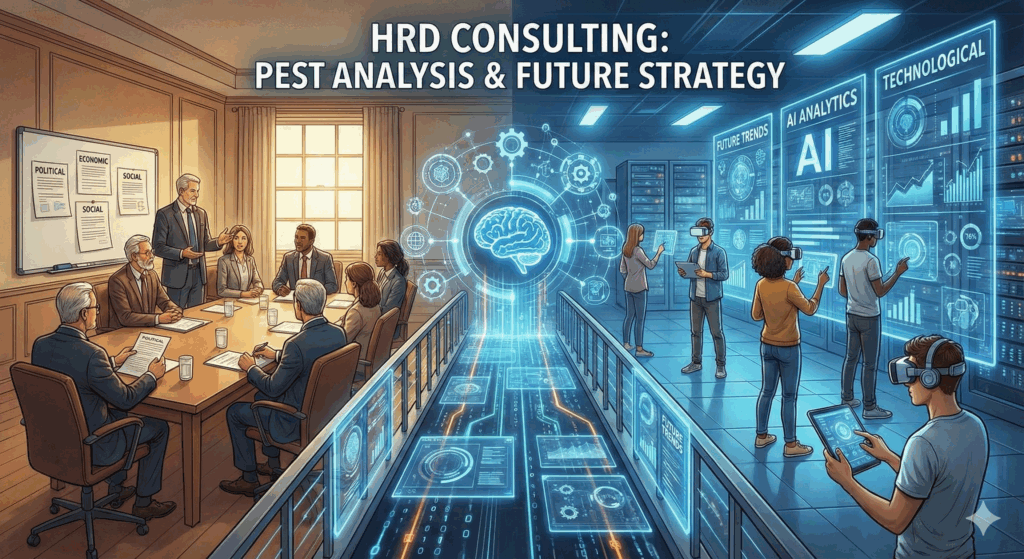
This English version is a fuller translation and adaptation of the original Korean article, HRD 컨설팅 산업 PEST 분석: 교육에서 Tech 솔루션으로 가는 변화, for global readers. The HRD consulting industry and corporate education environment are undergoing rapid changes. Beyond simple job training, digital transformation and data-based performance management have become the core focus. The HRD consulting industry is shifting from traditional education operations to data, AI, and platform-based tech solutions. To understand the corporate education market, it’s essential to consider how policy, economic, social, and technological changes affect HRD demand and supply.
Original Korean article: HRD 컨설팅 산업 PEST 분석: 교육에서 Tech 솔루션으로 가는 변화
HRD Consulting Industry – 1. Political (Political Environment)
The government’s policies are the most significant variable in determining the flow of HRD budgets. Currently, the government’s focus is clearly on ‘digital’ and ‘safety’. The K-Digital Training policy aims to cultivate 1 million digital talents, with massive budgets invested in private training institutions. This presents a significant opportunity for consulting companies with digital job curricula. The Serious Accident Punishment Act has increased the demand for substantial safety education consulting, rather than formal legal mandatory education. The transition to a job-based pay system and fair hiring practices have also created a demand for consulting services based on job analysis and competency modeling.
(IMAGE_1)HRD Consulting Industry – 2. Economic (Economic Environment)
The economic downturn may lead to a reduction in education budgets. However, not all budgets are being cut. The polarization of education budgets means that general, universal education budgets are being reduced, while investments are being made in core talent development and digital transformation education. ROI (return on investment) proof has become more crucial than ever. Instead of hiring, companies are focusing on reskilling and upskilling their existing employees, as the cost of hiring has increased. This strategy has become more economically viable.
(IMAGE_2)HRD Consulting Industry – 3. Social (Social and Cultural Environment)
The learning subject has changed. The MZ generation no longer responds to collective education. Instead, they focus on education that enhances their market value and employability. Personalized career path proposals are essential. The issue of declining literacy and the rise of short-form content have led to a shift towards micro-learning and game-based content. The aging population has also created a new market for outplacement services and mid-career job transition support.
(IMAGE_3)HRD Consulting Industry – 4. Technological (Technological Environment)
Technology is no longer just a supporting tool for education. It has become the core engine driving the consulting process. Generative AI, such as ChatGPT, has significantly reduced the cost of creating educational content. Real-time AI tutors and ultra-personalized curation algorithms have become essential competitive advantages. HR analytics, which uses data to drive decision-making, has become a critical component of consulting services. By linking learning data and performance data, HR analytics can demonstrate the actual effectiveness of education.
(IMAGE_4)Comprehensive Conclusion and Recommendations
The paradigm of the HRD consulting industry has shifted from ‘simple education operation’ to ‘tech-based performance management solutions’. The traditional offline collective education market will shrink, but the HR tech market, combined with diagnostic-education-evaluation integrated platforms, is expected to grow continuously. To adapt to this change, HRD consulting companies should develop business models that utilize government digital training subsidies, focus on high-efficiency products, and secure AI-based personalized learning systems and data analysis capabilities.
PEST Perspective Core Checklist
When analyzing the HRD consulting industry from a PEST perspective, consider the following key points: – Does the government’s job training and lifelong education policy change drive HRD demand? – What is the direction of corporate education budgets and personnel reallocation? – Are learners’ expectations shifting from offline lectures to digital experiences? – How do AI tutors, LMS, and learning data analysis change the consulting model?
Frequently Asked Questions
Why is the HRD consulting industry moving towards tech solutions?
Companies want to measure education effectiveness more quickly and provide personalized learning experiences. In this process, technologies like LMS, AI tutors, and learning data analysis are becoming essential tools for consulting services.
What changes do AI and data bring to corporate education?
AI and data can be used for education recommendations, learning diagnostics, performance measurement, and content automation. Education managers must interpret learning data and provide improvement suggestions, rather than simply operating the process.
What capabilities should HRD consulting companies prepare?
HRD consulting companies should develop capabilities beyond education design, including data analysis, platform operation, AI tool utilization, and performance indicator design. The ability to connect customers’ business problems with technical solutions will become a key differentiator.
Related Reading
Continue with these related Thinknote English articles in the Digital Transformation cluster.
- Thinknote English article
- Thinknote English article
- Thinknote English article
- Thinknote English article
- Thinknote English article
- Thinknote English article
FAQ
What is this article about?
This article explains a digital transformation, platform, market-structure, or technology-adoption topic with Korea-specific context and global implications.
How should I use this guide?
Use it to understand market signals and strategic patterns. Combine it with current market data before making business or investment decisions.
Where can I read the original Korean article?
The original Korean article is available here: HRD Consulting Industry PEST Analysis: From Training Delivery to Tech Solutions.