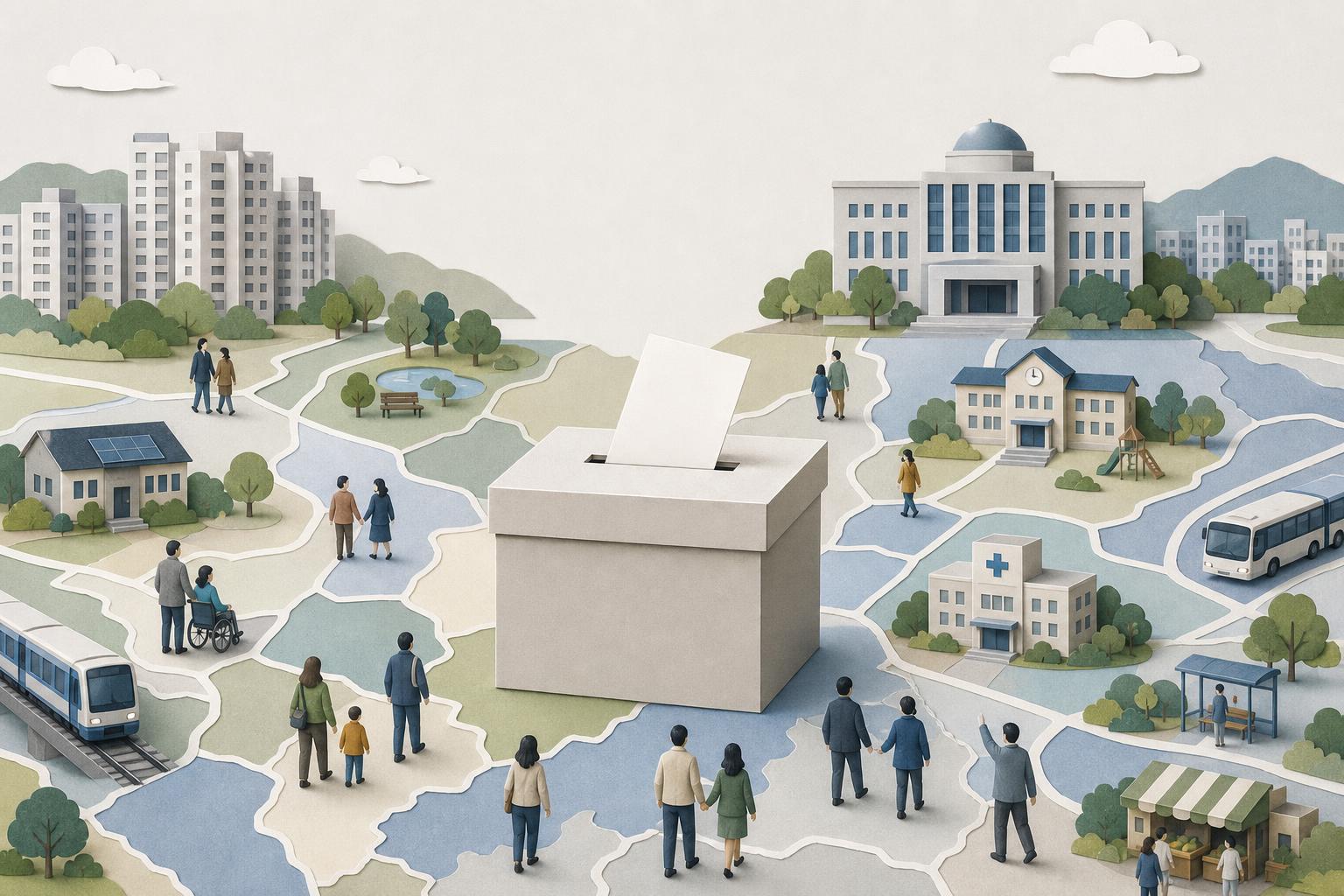
The June 2026 election cannot be viewed simply as a competition between political parties. Over the past five years, South Korea has experienced extensive changes in terms of economy, population, industry, political system, and social trust. Post-pandemic recovery, high inflation and interest rate burden, real estate and household debt have shaken Korean society. Low birth rates, aging populations, reorganization of the export industry, and political upheaval also occurred simultaneously.
Original Korean article: Original Korean article.
In particular, the 9th National Simultaneous Local Election to be held on June 3, 2026 is a nationwide election to newly form local powers according to the official election schedule guided by the National Election Commission. Local elections may seem smaller than presidential or general elections, but policies that meet the actual lives of people are often implemented through local governments. Transportation, housing, welfare, education, regional development, licensing, youth policy, welfare for the elderly, and regional industrial policy are all connected to the capabilities of local administration.
So the key question in this election is not only “who will win?” The more important question is, “By what standards should the Republic of Korea be operated in the future?” This should not be a politics that makes conflicts bigger, but an election that confirms whether politics that transparently exposes and fairly adjusts conflicts is possible.
What has changed in Korea in the past five years?
To understand the changes over the past five years, we must first look at the economy and population structure together. Based on the World Bank’s published indicators, Korea’s real GDP growth rate was 2.314% in 2019. It fell to -0.7% in 2020, then rebounded to 4.613% in 2021, and reached 2.004% in 2024. Although we have escaped the shock of the pandemic, it is difficult to say that we have returned to a high growth phase.
The price trend was more direct to the public’s perception. According to the same World Bank indicator, Korea’s consumer price inflation rate was 0.383% in 2019. It rose to 5.09% in 2022 and hit 2.322% in 2024. Looking at the numbers alone, it may seem stable, but the already high cost of living and loan burden remain for a long time in the perceived economy of households.
Demographic change is also an important background for elections. Korea’s total fertility rate decreased from 0.918 in 2019 to 0.748 in 2024. The proportion of the population aged 65 or older increased from 15.063% in 2019 to 19.274% in 2024. If we look at the birth and population data from Statistics Korea and e-National Index together, the trend is clear. Low birth rate and aging are no longer a long-term outlook, but are now becoming core conditions for local administration.
The export-oriented economic structure is also important. Based on the World Bank, Korea’s export/GDP ratio increased from 37.041% in 2019 to 44.358% in 2024. Semiconductor and manufacturing competitiveness remain the core of the Korean economy. At the same time, it also means that we have become more sensitive to external economic conditions, the US-China conflict, supply chain, exchange rates, and competition for technological hegemony. The Bank of Korea’s economic outlook and the KDI’s economic outlook are also reference materials that show that the semiconductor economy, prices, interest rates, and external conditions must be checked together when looking at the 2026 economy.
In the end, the past five years in Korea were a time of both recovery and anxiety. Although there was a recovery on the surface, the reality felt by the people was more complex due to issues of prices, housing, loans, jobs, old age, and regional disparities.
How are political changes connected to people’s lives?
Political changes were also very significant. After the 2022 presidential election, Korean politics moved amid strong opposition between the ruling and opposition parties. The 2024 general election reaffirmed the power structure of the National Assembly, and subsequent clashes between the executive and legislative branches increased political fatigue.
In particular, the martial law, impeachment, and early presidential election phase that lasted from the end of 2024 to 2025 simultaneously revealed the institutional resilience and vulnerability of South Korean democracy. Reuters reported the dismissal of former President Yoon Seok-yeol and the early presidential election, and AP News described the 2025 early presidential election as an election that will end political upheaval. The BBC covered the background of the presidential election held on June 3 following the impeachment situation. The Guardian also reported the Constitutional Court’s impeachment and presidential removal as major international news.
The common interest of overseas media was in how Korean democracy functioned in a crisis rather than the victory or defeat of one person or one party. This will also be an important standard when looking at the 2026 elections. Democracy is not a system that only works in times of crisis; it must also create trust in daily administration, budget execution, and policy-making processes.
Tasks remain even after the new government is launched in 2025. The great tasks of restoration of democracy, national unity, economic recovery, foreign relations, and stabilization of people’s livelihoods were faced simultaneously. In this trend, the June 2026 election will be an extension of central politics and a practical evaluation of local administration.
What the public feels is not political news, but the economy.
Politics is consumed as news, but people evaluate politics based on the economy. What is more direct than political party approval ratings or politicians’ statements are shopping cart prices, loan interest, housing prices, rent instability, jobs, retirement preparation, and children’s education expenses.
This is why the perceived economy does not improve immediately even if economic indicators improve. Even if the growth rate recovers, if the recovery is centered on specific industries and large corporations, the temperature felt by regions and households may be different. Even if the unemployment rate is low, the public’s evaluation is inevitably cold. This is because the quality jobs that young people want, stable employment for the middle-aged and the elderly, and recovery in sales for the self-employed must all be achieved.
Korea Research’s economic security indicators, national indicator survey, and Gallup Korea’s regular surveys are useful references when checking these differences in perception. In particular, economic awareness, evaluation of government management, political party support, and outlook for living conditions should be viewed in combination with trends and questions rather than single figures. When citing opinion polls in election reports, you should not only look at which political party is ahead. We must read together to understand why the people are anxious and what issues they see as priorities.
Household debt and real estate issues have particularly great political significance. The interests of those who have a home and those who do not, those who have received a loan and those who have not, those in the metropolitan area and those in non-metropolitan areas, and the youth and the older generation are different. If one side is solely responsible for this problem, the conflict will increase but resolution will be further away.
Therefore, the economic agenda in the 2026 election should not be limited to the abstract slogan of “growth.” It must come down to items such as price stability, housing stability, household debt management, and local jobs. Youth opportunities, retirement safety net, and local industrial base are also standards that people actually feel.
Articles to read together
- How to apply for high oil price subsidies: Target, period, and usage at a glance: You can refer to the connection between the burden of living expenses and policy support.
- In the 2026 retirement pension era of 400 trillion won, who will be the winner in the competition for returns? Preparation for retirement and changes in the financial market are in line with the 2026 economic agenda.
- Frame analysis of the Samsung Electronics union article: Between “Let’s talk” and “I refused”: You can see the connection between labor, corporate, and media frames and social conflict.
- The brain science of hate: Why can’t we understand each other to the end? Problems of conflict and fair coordination can be viewed from a social psychological perspective.
The criteria for the 2026 elections should be transparency and fairness rather than conflict.
Conflict does not easily disappear in Korean politics. As society becomes more complex, interests become more diverse, and differences in generations, regions, classes, and ideologies continue to appear. The important thing is not to say that we will eliminate the conflict itself. It’s how you deal with conflict.
The criterion for the 2026 election should not be “who fights stronger.” “Who explains more transparently, adjusts fairly, and takes responsibility for the results” should be the standard.
Transparency begins with the funding and schedule of the pledge. Even if a pledge is packaged in good words, it is difficult to regard it as a responsible promise if the budget, legal basis, implementation agent, and priorities are unclear. Local government development projects, permits, welfare expansion, youth support, and transportation network expansion are all policies that require money and time. Voters must look not only at the direction of the pledge but also at its feasibility.
Fairness is more important when there are conflicts of interest. Regional development may be beneficial to some, but it may alienate or burden others. Expanding welfare is necessary, but fiscal sustainability must also be considered. Expanding opportunities for young people is important, but we should not ignore the anxieties of middle-aged and old age. Fair politics does not mean satisfying everyone, but politics that discloses and explains the standards for coordination.
The questions voters ask when looking at candidates and political parties are clear.
- Are the financial resources and implementation schedule of the pledge disclosed?
- Are regional development and budget commitments explained in terms of publicness rather than the interests of specific groups?
- Is there a principle of coordination when the interests of young people, middle-aged people, old people, self-employed people, workers, and companies conflict?
- Are there any plans to persuade and compromise within the system rather than defining the opposing side only as the enemy?
- When talking about economic recovery, do we also address prices, housing, jobs, and regional disparities?
An election that fails to answer this question is likely to repeat conflict. Conversely, an election that answers this question could change South Korea’s political culture one step further.
Why this election is important for the future of Korea
The June 2026 election should not end with an election that confirms the anger of the past. This election should be one that answers the questions left by the changes of the past five years. Is the economy recovering? Are the people feeling the recovery? Is politics restoring institutional trust? Is the region preparing for the future? Are conflicts resolved fairly?
South Korea is already a country with a globally significant economy and democratic system. However, the more mature a country is, the more important it is to trust rather than speed. The direction of policy must be explained transparently. Budgets and authority must be administered fairly. When responsibility for results is clear, people can trust politics again.
This is why the 2026 election is important. This election is not just about which party wins or loses. We ask whether the future Republic of Korea will become a country that repeats conflicts or a country that adjusts issues based on transparency and fairness.
If voters look at the basis of policy rather than the color of the party, the criteria for elections change. If we look at feasibility over slogans, and accountability over anger, the 2026 elections could be a turning point that changes the next five years of our country.
Related Reading
Continue with these related Thinknote English articles in the Korea Policy & Economy cluster.
- What if an interest rate cut comes? Investment strategy for deposits, bonds, and dividend stocks
- ETF Investment Craze: Things Individual Investors Must Check Now
- Recruitment analysis on June 1, 2026: Recruitment flow centered on production/manufacturing and care/nursing
- What has changed in the expansion of support for youth leap account applicants and small and medium-sized business employees by 2026?
- 2026 Korea Local Election Media Headline Analysis: Reading Keywords and Frames
- 2026 driver’s license subsidy, what will be different by region? Key criteria to check before applying
FAQ
What is this article about?
This article explains a Korean policy, economy, finance, election, media, job-market, or industry trend for readers who need broader context on Korea.
How should I use this guide?
Use it as contextual analysis rather than personal financial, legal, or administrative advice. Check official notices and current data before making decisions.
Where can I read the original Korean article?
The original Korean article is available here: Original Korean article.