
AI writes the code, another AI reviews it, and they even submit a PR. Work appears faster. But what remains if a person cannot explain why the changes were made or what they affect? Cognitive debt in AI coding is the gap between code generation speed and human understanding.
Modu AI’s video reviewing Orca and Buzz addresses this problem. It does not conclude that either tool is bad. The creator acknowledges the potential of collaborative approaches but warns against expanding delegation before developing the ability to understand and control a single agent’s results. That makes it worth focusing on what developers should verify, rather than competition over tool features.
Orca and Buzz May Be Convenient, but Review Responsibility Remains
The video presents Orca as connecting multiple coding agents and models in one workspace. It presents Buzz as a channel-based setting where people and agents converse together. The creator describes having another model review work, assigning development roles, and receiving a PR.
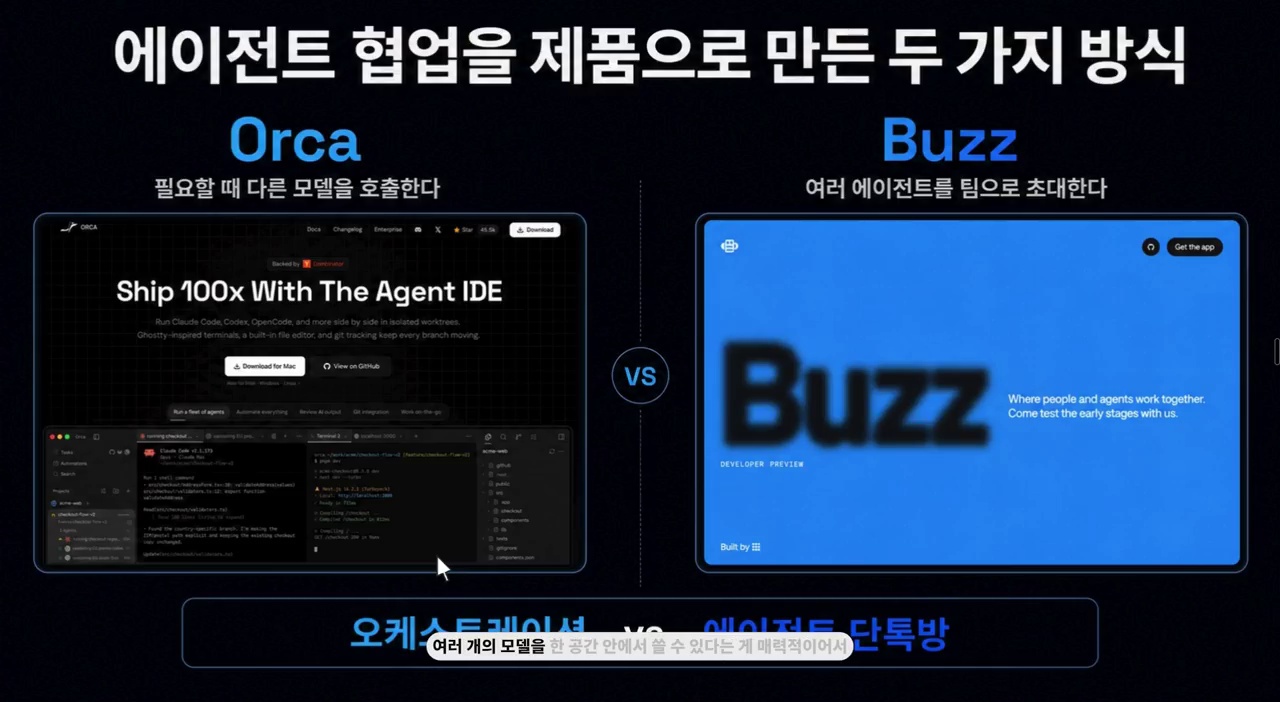
This is not an independent comparison of the two products’ latest specifications and performance. Promotional claims shown onscreen, such as productivity multipliers, are not cited as measured results. The focus is not the interface. It is who understands and approves results once delegation becomes easier.
Having one AI ask another AI for a review does not establish that the review was independent or sufficient. They may have accepted the same assumptions, missed the same materials, or failed to test important failure conditions. Switching models can provide a different perspective. It does not prove that errors have been eliminated.
The creator says the PR produced by several agents was satisfactory. Yet the creator also describes difficulty following the changed files and decisions. These observations are not contradictory. A plausible result and understanding it well enough to take responsibility for fixing it are different states.
Cognitive Debt Means Putting Off the Work of Understanding
In the video, cognitive debt is the burden that accumulates when understanding AI’s work is postponed. You may move on because the interface looks normal. But an incident or further development could force you to learn the structure from scratch later.
This is not a formal metric measured here or a diagnosis applying to every AI user. It is a perspective for examining gaps in understanding during development. Consider the following situations.
- A feature works, but you cannot readily explain which data and files it passes through.
- You read AI’s summary but did not check whether it matches the actual changes.
- Review comments were resolved, but you do not know which tests support those resolutions.
- You cannot readily identify what to roll back after a problem or whether the data can also be restored.
The point is not to memorize all the code. The creator does not argue that building a product requires reading every line. What matters is understanding enough to assess change scope and key connections as the system grows, and to recover from problems.
What Else Should You Check as Agent Numbers Grow?
The video shows a diagram of increasing possible relationships between agents. If every agent is paired with every other agent, without distinguishing direction, the number of possible relationships is n(n-1)/2. Under this assumption, 3 agents yield 3 pairs, 4 yield 6 pairs, and 6 yield 15 pairs.
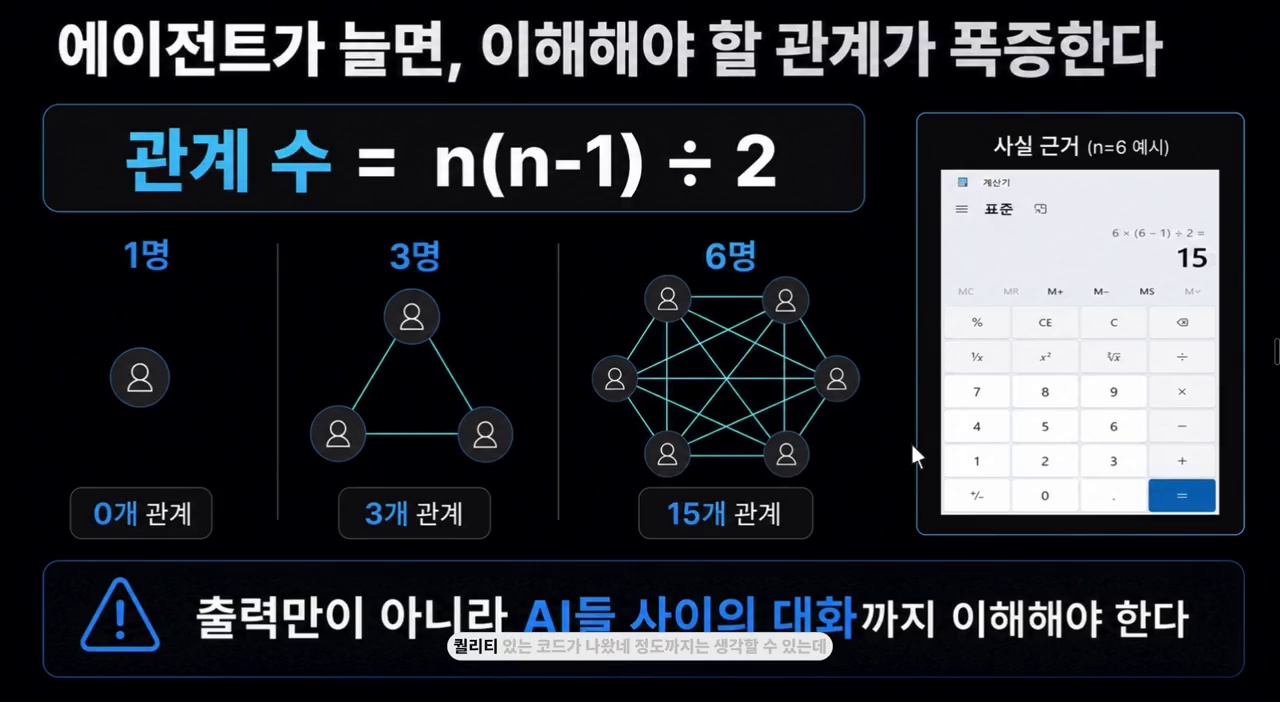
However, this formula counts possible connections. It does not mean actual message volume or review costs must reach those numbers. The relationship count is quadratic, not mathematical proof of exponential growth. Actual overhead depends on whether there is a central coordinator and who passes results to whom.
In practice, the following questions are more useful than asking how many agents were added.
- Do participants’ change scopes overlap?
- What supporting evidence accompanies one participant’s results when passed to the next?
- When opinions conflict, who decides, and by what criteria?
- Can the final PR’s actual changes be compared with what was agreed?
- Are test failures and uncertainties reported to a person?
Checking these points does not require reading every conversation or private internal reasoning. What you should request is the reasons for changes, reviewable evidence, impact scope, execution results, and unverified items. A short decision record linked to the actual diff and tests may help more than a lengthy discussion transcript.
A Visible Collaboration Interface Is Not the Same as Understood Results
The Buzz walkthrough shows creating a channel, inviting agents, and conversing with them. Seeing who is responding and in which role may help you follow the collaboration process.
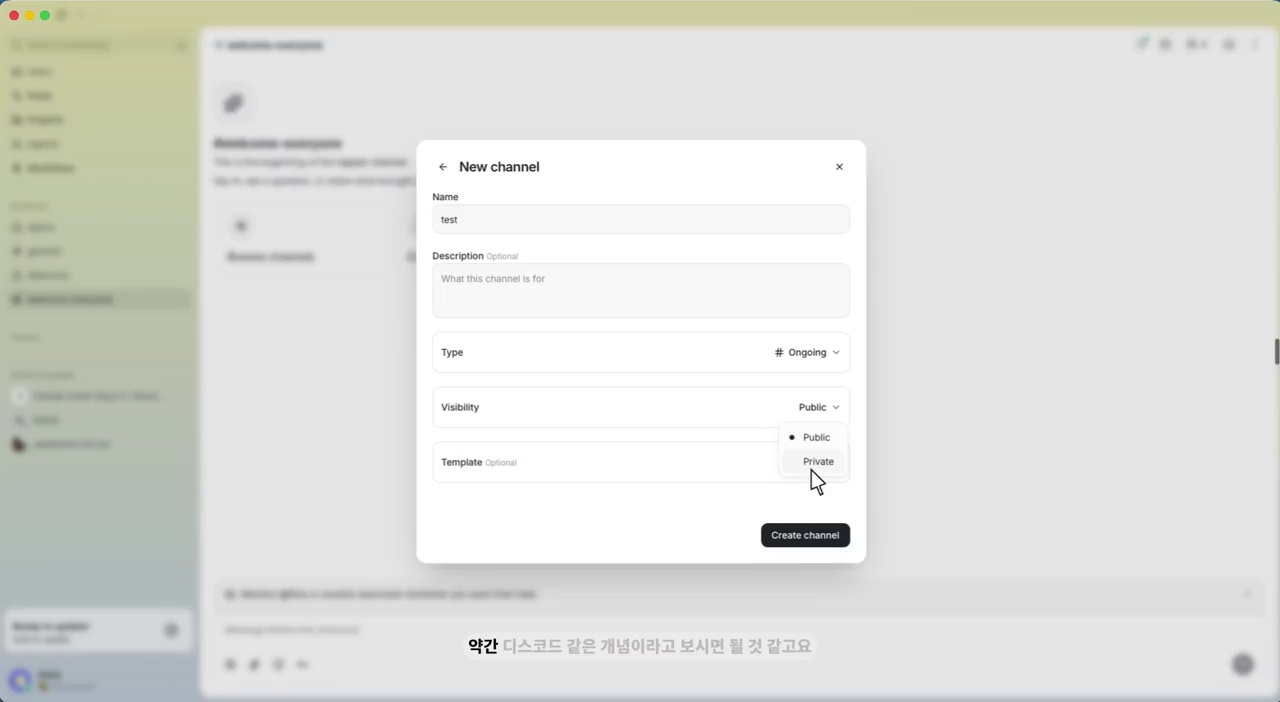
However, seeing a conversation differs from understanding the effects of actual code. Several agents may respond positively while collectively missing an important failure condition. A generated PR does not mean the work is ready for deployment.
A final report should go beyond summarizing the conversation and cover the following items.
- What changed: Features and major changed files.
- Why it changed: Requirements and the rationale for the choices.
- What it affects: Called functionality, data, permissions, and external integrations.
- What was verified: Tests executed and their actual results.
- What remains: Unverified conditions and items requiring approval.
This list does not reproduce the video’s implementation. It is a suggestion for applying its concerns to practical review.
A Teach-Back Hook: Asking What You Understand Before a Commit
The creator describes building a hook that checks understanding before commits to reduce cognitive debt. Initially, users had to explain the changes themselves. Later, the process allowed commits after passing multiple-choice questions. The video also introduces an HTML walkthrough that explains incorrect answers and checks understanding again.
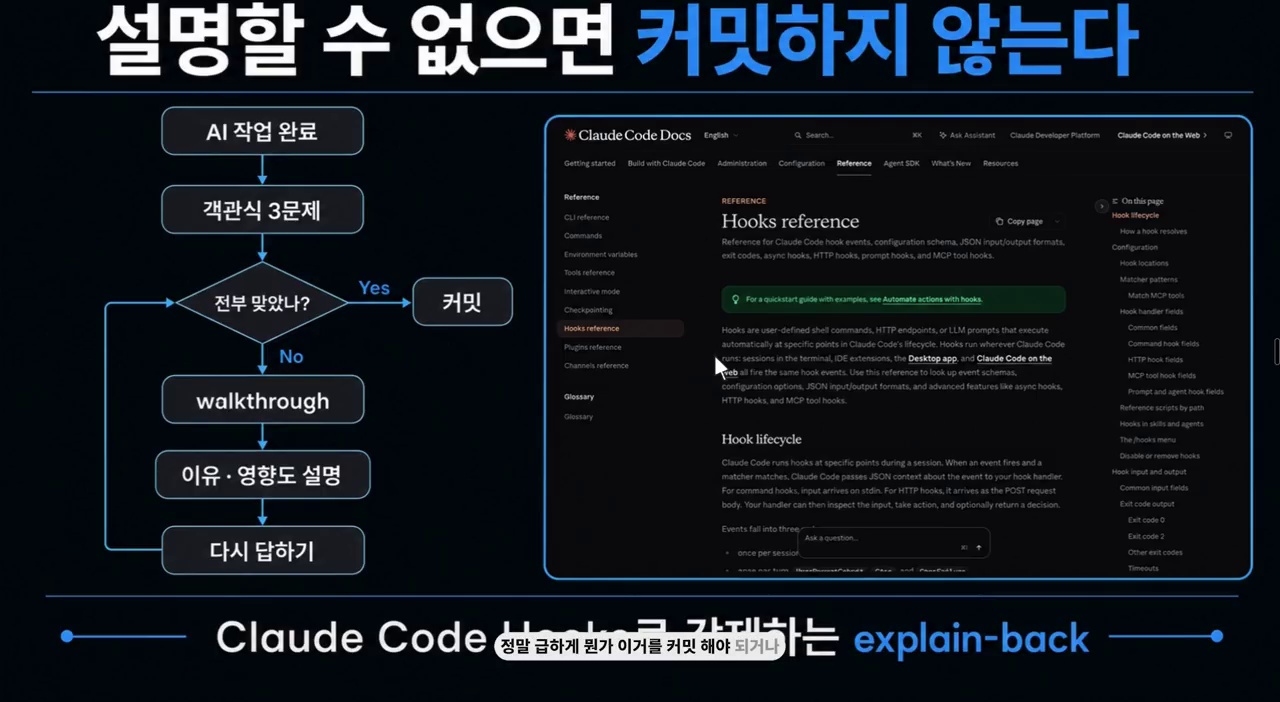
The useful idea is incorporating the intention to understand into the work process, rather than postponing it. However, the video’s description does not verify implementation code, check coverage, bypass prevention, or control over every commit path. Do not interpret the quiz as a built-in Claude Code feature.
According to the official documentation, Claude Code hooks and Git pre-commit hooks are different systems. Claude Code hooks automate actions at particular events, such as session events or tool calls. Git hooks are separate mechanisms triggered by Git operations. Coverage depends on which conditions are connected to which system.
Rather than assuming a hook completely blocks commits, check which execution paths it inspects and when it fails or permits execution. Do not treat a single local hook as equivalent to server-side approval rules or a security boundary.
Correct Quiz Answers Do Not Guarantee Code Safety
Comprehension questions can prompt a review. But their value weakens if AI-generated questions and answers are wrong, users merely memorize answers, or code changes after the questions.
If applying this approach yourself, consider the following design choices. These are suggestions for improvement, not code reproducing the creator’s hook.
- Tie questions to the changes under review. If those changes differ, reassess the previous pass status.
- Ask about impact scope, failure conditions, and recovery methods, not just recall of code content.
- When explaining correct answers, check the actual changes and test evidence together.
- Even after a comprehension check passes, review tests, permissions, and data protection separately.
- If an urgent exception is needed, record what was skipped and who is responsible for follow-up verification.
For example, asking only for the name of a modified function may be less useful than asking about failure consequences. Having users explain which user flows would be affected and how to verify them may better serve a real review.
What Coding-Learning Research Supports—and What It Does Not
In research released in January 2026, Anthropic tested 52 software developers, mostly juniors, learning a new Python library, Trio. Its official overview reports average quiz scores of 50% for the AI group and 67% for those coding themselves. The difference in task completion time was not statistically significant.
The researchers also discuss differences between simply receiving generated code and building understanding through follow-up questions, explanations, and conceptual checks. However, qualitative analysis of interaction types must not be treated as proof of a particular learning method’s causal effects.
These results concern a specific task involving learning a new library. The experiment did not compare Orca with Buzz or measure multi-agent performance. It cannot support broader conclusions that AI reduces every developer’s understanding or that multiple agents lower productivity.
The connection to the video’s concerns is narrow and clear. Completing a task and developing understanding during it need to be checked separately.
Five Checks Before Adding More Agents
You do not need perfect control over one agent before taking the next step. But before expanding delegation, check whether you can answer the following questions about your current work.
- Purpose: Can you explain the user problem this change is intended to solve?
- Scope: Can you identify the main changed files and connected features?
- Evidence: Can you compare key implementation and review decisions against actual changes and requirements?
- Verification: What was tested, and what remains unverified?
- Recovery: If something goes wrong, which code, settings, and data must you inspect and restore?
If these questions are hard to answer, consider smaller tasks, narrower PRs, and clearer change explanations before adding agents. Conversely, if roles are clear and results can be independently checked, expand parallel work where needed.
This single video cannot determine the optimal number of agents. The important criterion is not how many are working, but whether a person can understand and approve the results, then fix them when necessary.
Related Reading
- How to Distinguish Delegation from Group Chat in Hermes Bot Mode
- Pixel Agents: The Difference Between Visible Work Status and Verifying Actual Completion
- Comparing AI Agent Frameworks and Choosing for Your Operating Conditions
FAQ
Must I Read All AI-Written Code to Resolve Cognitive Debt?
The point is not to memorize every line. It is to understand enough to judge key change rationales, impact scope, verification evidence, and recovery methods if something fails.
Does This Mean I Should Not Use Orca or Buzz?
No. The creator acknowledges both tools’ potential and strengths. It is better understood as experience-based advice against expanding collaboration while a single agent’s results remain difficult to understand.
Does Claude Code Require Passing a Comprehension Quiz Before Committing by Default?
The video describes a hook and walkthrough approach built by the creator. The quiz should not be considered a default feature. Its actual implementation and check coverage also require separate verification.
Can I Skip Human Review After Passing an AI Review?
Passing an AI review alone does not guarantee safety or compliance with requirements. Define the scope of human approval using actual changes, tests, permission and data impacts, and unverified items.
References
- Modu AI: Source Video Reviewing Orca, Buzz, and Cognitive Debt
- Official Claude Code Hooks Documentation
- Official Git githooks Documentation
- Anthropic: How AI Assistance Impacts the Formation of Coding Skills
The images are captures used to explain and critique the source video’s discussion. The creator’s personal experience, official technical documentation, a learning experiment under specific conditions, and this guide’s practical suggestions are distinguished. They do not indicate a completed product-performance comparison or independent execution and security verification of the hook.