# How Quantum Computers May Change the Next 10 Years: Reading the Next Technology Race After AI
After AI became an everyday tool, quantum computing is often named as the next candidate for technological power. The name is familiar, but the question “what changes in my work or industry?” remains vague.
The video from “This Science, That Science” addresses that point well. A quantum computer is not a faster laptop. It is a technology that handles certain calculation problems in a fundamentally different way.
The key is balance between hype and indifference. Not every encryption system collapses tomorrow, but quantum computing is not pure science fiction either.
## Why look at quantum computing again now?
Scene explaining quantum computing research and experimental environments
Quantum computing is drawing attention for the same broad reason AI did: infrastructure, investment, talent, and national strategy move together around the technology.
Professor Kim Beom-jun describes it as a computer based on quantum mechanics. Ordinary computers calculate with bits, 0 and 1; quantum computers handle qubits. But this does not mean they are always faster. They may open new paths for certain problems, not replace everyday document work or web browsing.
## What do qubits change?
Scene showing quantum chip and circuit implementation
Qubits are the starting point. The video explains superposition and interference in accessible language: instead of following only one path, quantum computation handles many possibilities and draws out meaningful results at the end.
But a mysterious process does not guarantee perfect output. Quantum states are fragile and sensitive to error. Qubit count, error correction, and control technology all matter. The competition is not only “how many qubits,” but who can control them stably and connect them to useful algorithms and software.
## The first area to shake is cryptography and security
Scene discussing quantum computers and encryption/security risk
Security may be the first area the public feels. The video raises questions about Bitcoin, encryption, and certificate systems.
The issue is preparation, not panic. If sufficiently powerful quantum computers appear, some existing public-key cryptography could become vulnerable. NIST has already released post-quantum cryptography standards to prepare for that transition.
For companies, the realistic question is not “Will a quantum computer break my system today?” but “When should we change long-term data protection and authentication systems?”
## Commercialization bottlenecks: equipment, cost, and ecosystem
Cryogenic quantum computer equipment that looks like a chandelier
Quantum computers look like chandeliers because of physical requirements: cryogenic environments, control lines, and noise suppression.
For some time, quantum computing will likely remain cloud-based research and industrial infrastructure rather than a personal device. Like high-end GPUs, it may spread through access rights and usage capability rather than direct ownership.
Korea’s preparation should be judged the same way: not by whether it owns one machine, but by whether researchers, software, industrial problems, security transition, and education move together.
## The next technology after AI, or a technology that goes with AI?
Scene discussing Quantum 2.0 and future technology competition
The video title asks whether quantum is “after AI.” More precisely, AI and quantum computing meet at different layers. AI changes judgment and generation through data and models. Quantum computing tries to handle difficult calculations in drug discovery, materials, optimization, cryptography, and simulation.
The key question for the next decade is not who first makes a consumer product. It is who first connects quantum computing to real industrial usefulness.
## What individuals and organizations should do now
Most people do not need to learn quantum computing immediately. But they should understand the questions it will change. Security teams should review post-quantum roadmaps. Strategy teams should identify calculation-heavy areas such as drug discovery, materials, logistics, and financial optimization. Educators should prepare simple language for bits versus qubits, probabilistic computation, error correction, and limits of application.
## FAQ
### Are quantum computers always faster than ordinary computers?
No. They are expected to have advantages for specific calculation problems, not ordinary office or web use.
### Will encryption collapse immediately when quantum computers arrive?
No. But data and authentication that require long-term security should prepare for post-quantum transition.
### Is quantum computing really the next technology after AI?
It is better seen as strategic infrastructure after AI, not just the next trend. It addresses different problems and may connect with AI in industry.
### What should Korean companies prepare first?
Security transition, industrial problem discovery, talent and partnerships, and cloud-based experimental access before buying hardware.
## References
Image source: Captured images used in this article are stills from the original YouTube video. They are used for review, commentary, and educational explanation, and copyright remains with the original rights holders and the channel.
# Obsidian Deep Research Automation: How to Use NotebookLM and Tavily Together
AI research tools have multiplied. The problem is that their results scatter. Notes summarized in NotebookLM, web-search reports, AI CLI summaries, and the notes you actually use can all live in different places, and reassembling them takes time.
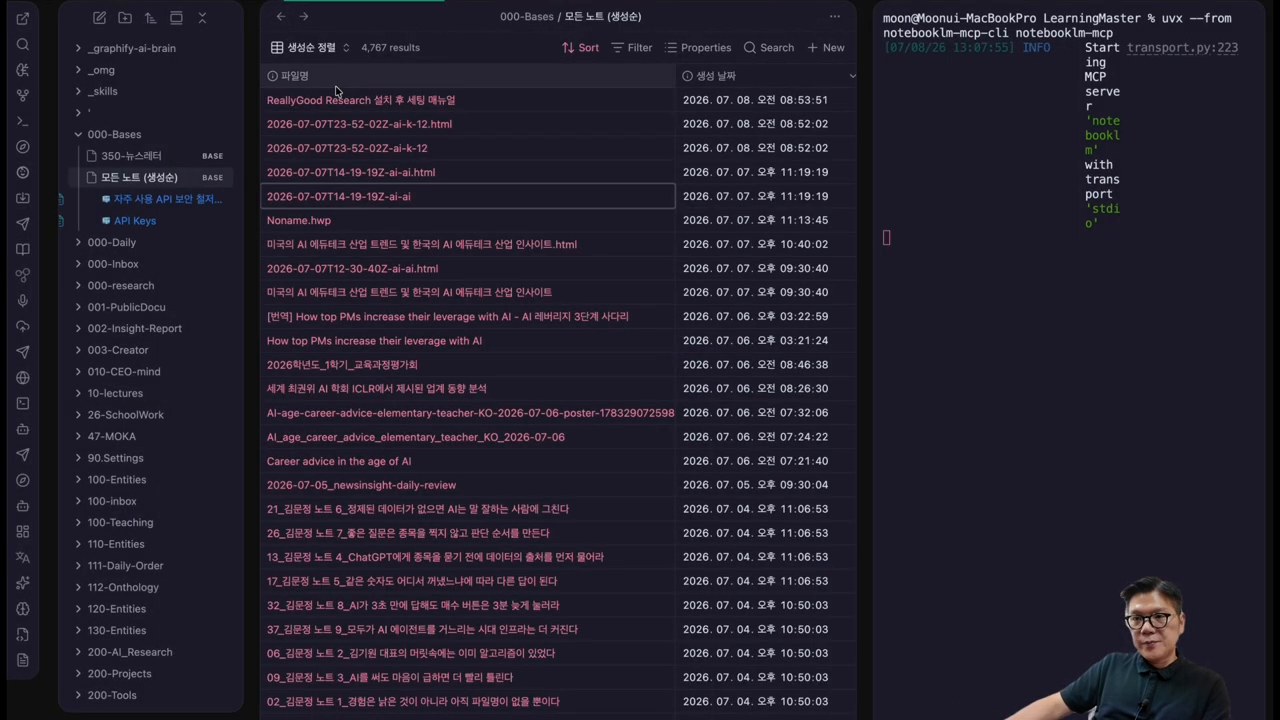
ReallyGood Research, introduced in the video, is an Obsidian plugin designed to narrow that gap. With one question, it runs NotebookLM MCP and Tavily research, then saves the results as Markdown and HTML reports inside your vault. The point is not merely a better search tool, but a structure where research remains inside your knowledge workflow.
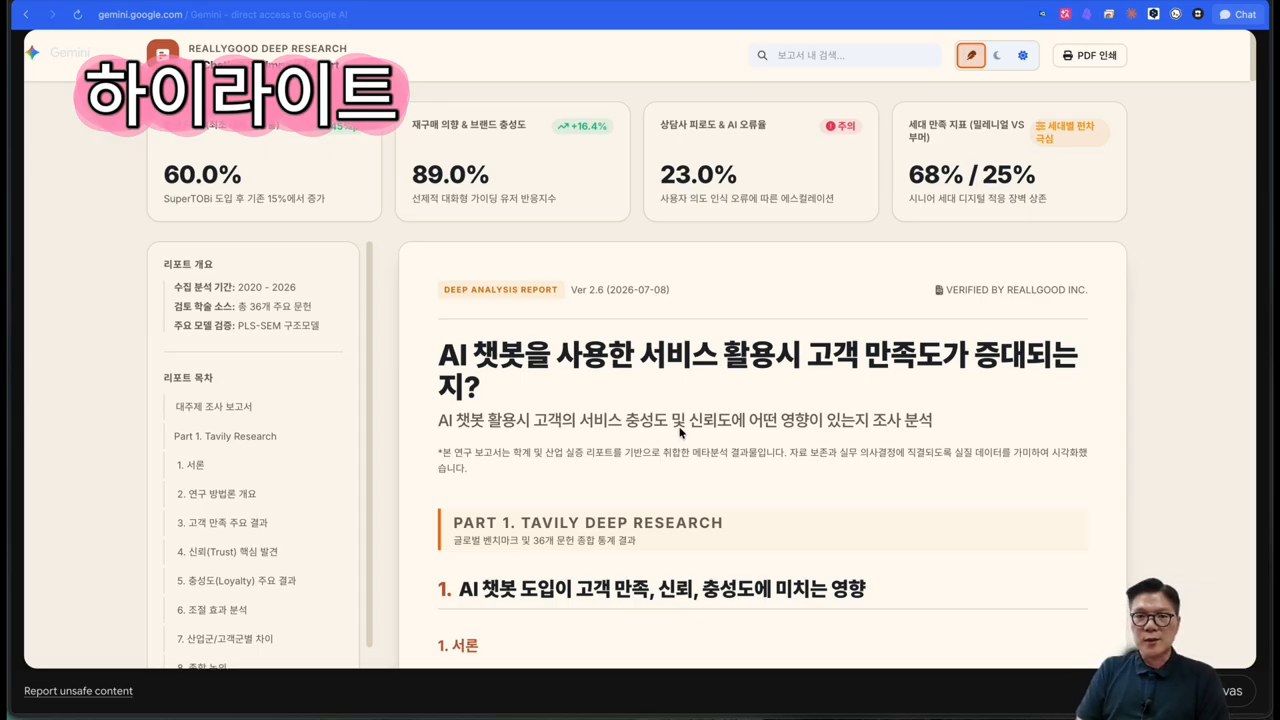
Example of a ReallyGood Research report
## Key workflow shown in the video
The video begins with a completed report. It shows an HTML report opened in the browser and then expanded into a Gemini Canvas sharing link. The plugin’s purpose becomes clear: it is not simple search, but production of shareable research artifacts.
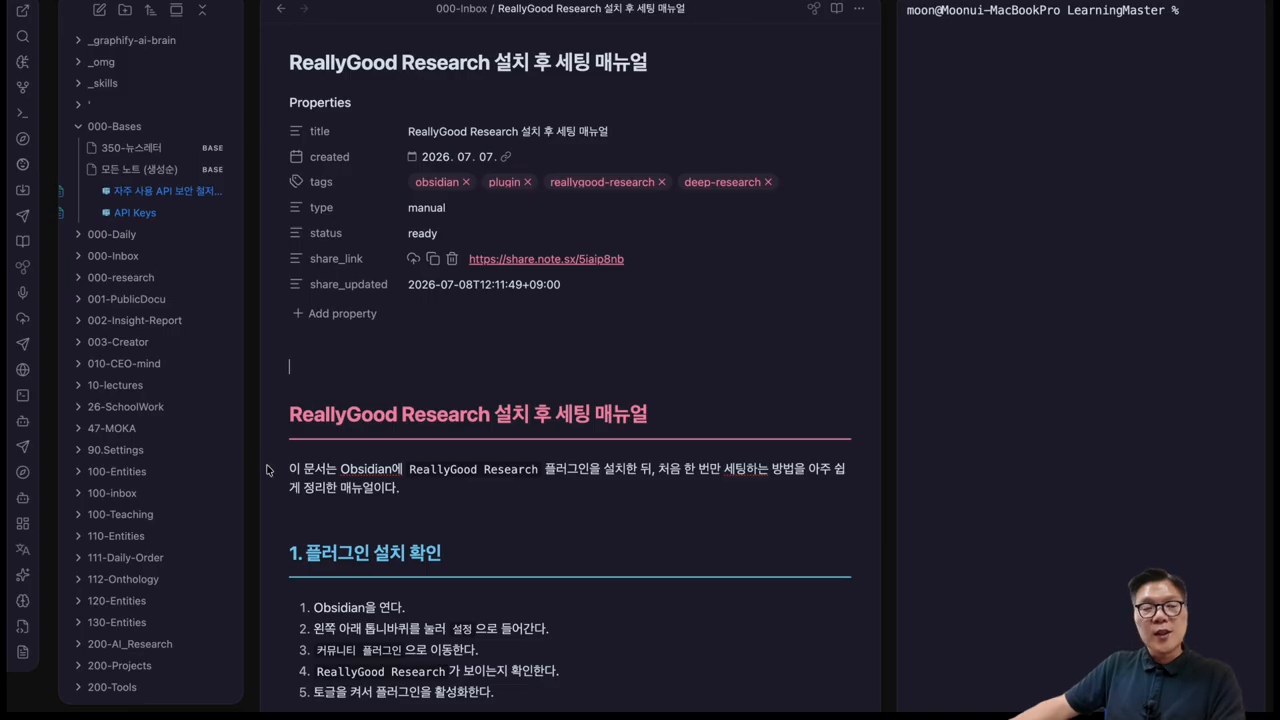
The presenter then installs the plugin in Obsidian by searching for ReallyGood Research in Community Plugins and opening the research console from the left panel. The video also emphasizes that it can be accessed as a community plugin without a separate BRAT installation.
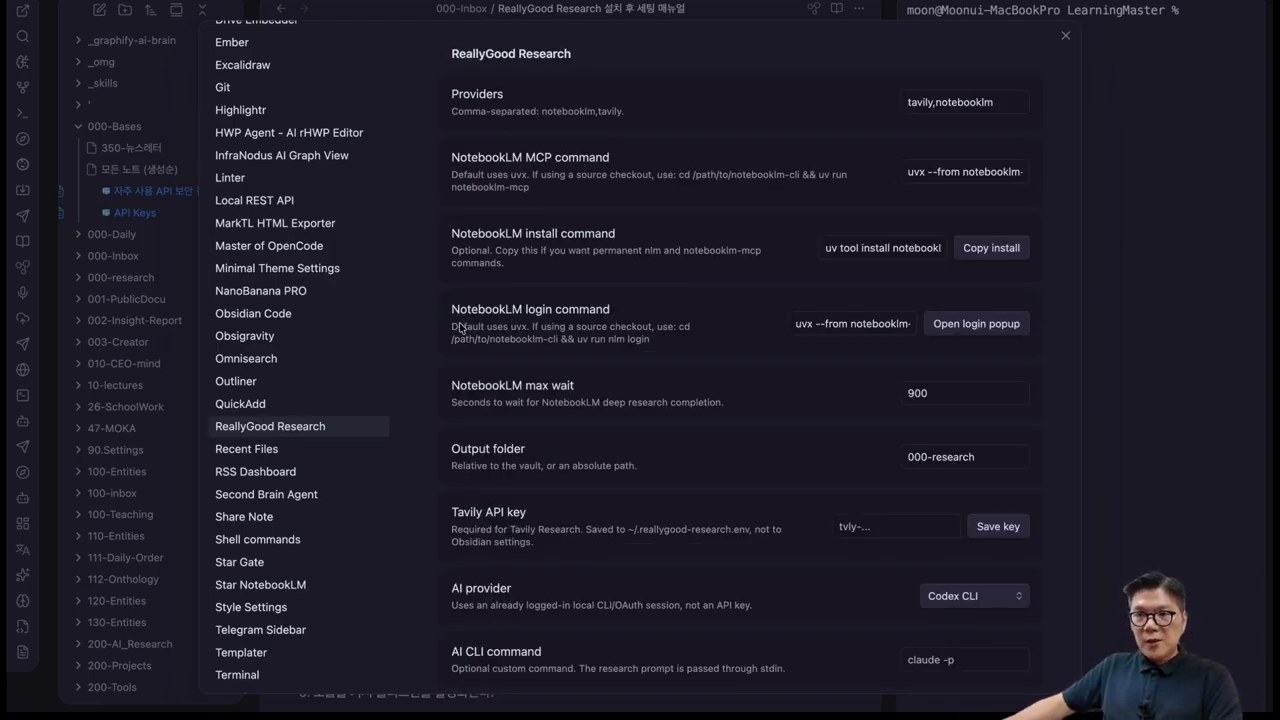
Screen checking ReallyGood Research settings inside Obsidian
## Why use NotebookLM and Tavily together?
Tavily is strong at web search and research APIs. It is suited to finding material on the public web and generating topic reports. NotebookLM is stronger at answering from user-provided sources. Used together, they separate broad web exploration from source-based verification.
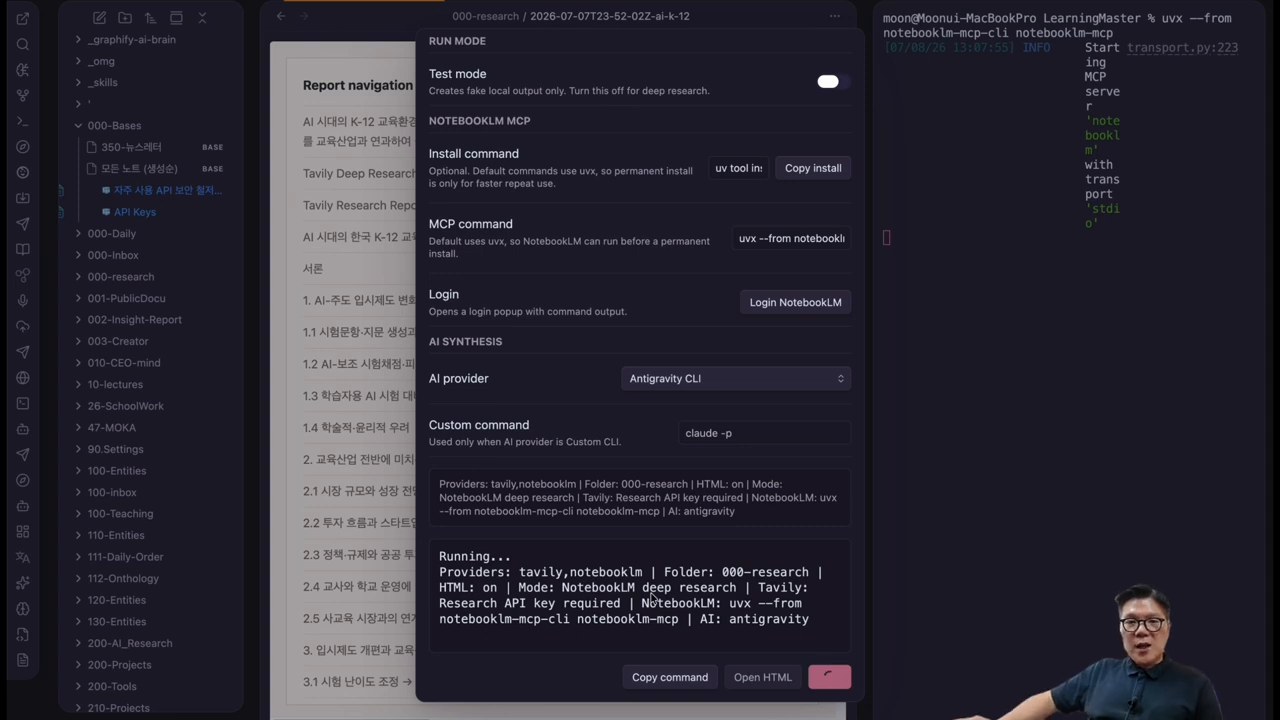
ReallyGood Research connects both as providers. The video shows adding a Tavily API key, installing NotebookLM MCP, logging in, and then selecting Antigravity as an AI CLI provider. It also notes that CLI tools such as Claude Code, Codex, and Gemini can be selected.
Screen configuring Tavily and NotebookLM providers
## In practice: one question becomes two reports
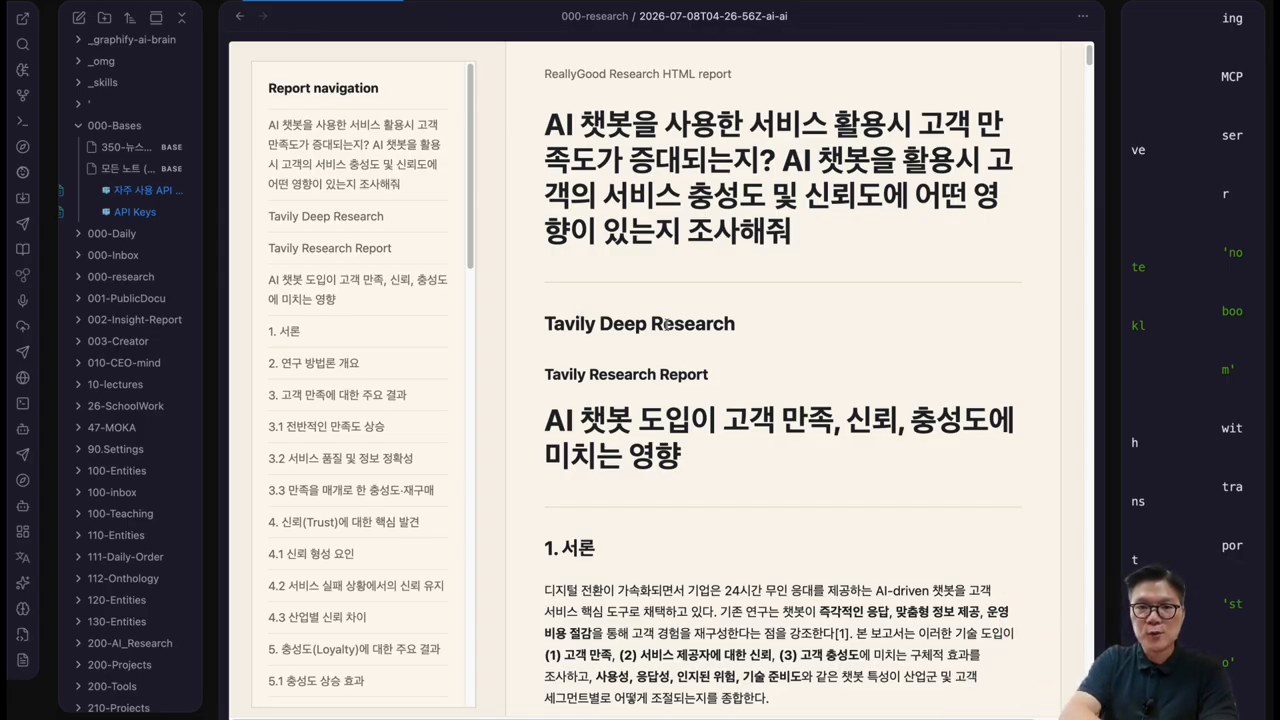
The demo question asks how customer use of AI chatbots affects satisfaction, loyalty, and trust. After the user enters the question and presses Start, the plugin runs Tavily research and NotebookLM research separately.
The important moment is comparison. One prompt produces a Tavily-based deep research report and a NotebookLM-based result. The user can compare whether the evidence is sufficient and whether the viewpoint is biased toward one source type.
Running research on AI chatbots and customer satisfactionComparing Tavily and NotebookLM research results
## What this means for knowledge work
The plugin’s strength is less the automation itself than the place where the work lands. When results are saved inside an Obsidian vault, they can become writing, reports, lectures, or proposals without searching again. HTML reports can also be shared quickly.
There are checks to make first: Tavily API keys, NotebookLM login, local MCP execution, and AI CLI permissions. If company documents or sensitive customer data are involved, confirm which provider receives which information. The more convenient automation becomes, the more carefully logs, sources, and account permissions must be managed.
Expanding an HTML report into a Gemini Canvas share link
## Checklist before adopting it
Do you actually use Obsidian as your knowledge store?
Can you manage Tavily API keys and usage limits?
Can you install NotebookLM MCP and handle Google login safely?
Do you have work that turns research directly into writing or reports?
Do you have standards for checking sources and generated results?
If these five conditions fit, it is worth testing. If you only need one-off search, the setup may be excessive. ReallyGood Research fits people who use Obsidian as a research workbench.
## FAQ
### What is ReallyGood Research?
An Obsidian plugin that runs NotebookLM MCP and Tavily-based deep research and stores results as Markdown and HTML reports.
### Why use Tavily and NotebookLM together?
Tavily is strong for web research; NotebookLM is strong for reviewing user-provided sources. Together they support broad exploration and source-based checking.
### Is it useful without Obsidian?
Its benefits are reduced if Obsidian is not your central knowledge store, because its value is saving and reusing results inside the vault.
### Is it safe for work documents?
Provider settings matter. Check what data is sent to Tavily, NotebookLM, and AI CLI tools, and review sensitive data under your organization’s security rules.
### Who is it best for?
People who do frequent AI research and reuse the output in writing, reports, lectures, or proposals, especially Obsidian second-brain users.
## References
Image source: Captured images used in this article are stills from the original YouTube video. They are used for review, commentary, and educational explanation, and copyright remains with the original rights holders and the channel.
After AI has already become an everyday tool, quantum computers are often mentioned as the next candidate for technological dominance. The name is familiar, but the answer to “So what will actually change in my work and industry?” still feels vague.
The video from This Science, That Science captures that point well. A quantum computer is not simply a faster laptop. It is a technology that handles certain computational problems in a completely different way.
The key is to keep a balance between hype and indifference. It is not true that every encryption system will collapse immediately. But it is also not just science fiction from a distant future.
Why We Need to Look Again at Quantum Computers Now
A scene explaining quantum-computer research and laboratory environments
The reason quantum computers are drawing attention again is similar to AI. It is not only the technology itself that matters; the infrastructure, investment, talent. National strategies around it are moving together.
In the video, Professor Kim Beom-jun explains quantum computers as computers based on quantum mechanics. If ordinary computers calculate with bits of 0 and 1, quantum computers work with qubits.
The problem is that this explanation does not mean they are “always faster.” Quantum computers can open new paths for specific problems. But they are not computers that will replace everyday document work or web browsing.
What Do Qubits Change?
A scene showing how quantum chips and circuits are implemented
Qubits are the starting point for understanding quantum computers. The video explains superposition and interference in accessible terms. Instead of following only one computational path, quantum computing handles multiple possibilities and draws out a meaningful result at the end.
However, a mysterious calculation process does not automatically make the result perfect. Quantum states are extremely fragile and sensitive to errors. That is why the number of qubits, error correction, and control technologies all matter together.
Ultimately, the race in quantum computing is not only a fight over “how many qubits have been built.” It is a fight over the ability to control them reliably and connect them to useful algorithms and software.
The First Area to Be Shaken Will Be Cryptography and Security
A scene covering quantum computers and encryption-security risks
Security is likely to be the first area where the public feels the impact of quantum computers. The video also raises questions about Bitcoin, encryption, and public certificate systems.
The key is not fear, but preparation for transition. If sufficiently powerful quantum computers appear, some existing public-key cryptography could become vulnerable. That is why NIST has already released post-quantum cryptography standards and is preparing for the transition.
For companies, the more realistic question is not “Will a quantum computer break into my system today?” but “When should we begin changing long-term stored data and authentication systems?”
The Bottlenecks to Commercialization Are Equipment, Cost, and Ecosystem
Cryogenic quantum-computer equipment that looks like a chandelier
Quantum-computer equipment looks like a chandelier not for style. But because it requires physical conditions such as cryogenic environments, control lines, and noise suppression.
For that reason, quantum computers will remain closer to cloud-based research and industrial infrastructure than to personal devices for some time. Like high-performance GPUs, they are likely to spread not because everyone owns one directly. But because organizations that need them secure access and the ability to use them.
Korea’s preparation should be viewed from the same perspective. More important than whether the country owns a single piece of equipment is whether researchers, software, industrial problems, security transition. Education systems are moving together.
Is It the Technology After AI, or a Technology That Will Advance With AI?
A scene discussing Quantum 2.0 and future technology leadership
The video title asks whether this is what comes “after AI.” More precisely, however, the picture is closer to AI and quantum computing meeting at different layers.
AI changes the way we make judgments and generate outputs through data and models. Quantum computing tries to handle problems where computation itself is difficult—such as drug discovery, materials, optimization, cryptography, and simulation—in a new way.
So there is one key point to watch over the next 10 years. Not who will first turn quantum computers into a “product used by ordinary people,” but who will first connect them to industrial problems and create real usefulness.
What Individuals and Organizations Should Do Now
Not many people need to learn quantum computers immediately. But it is worth understanding in advance the questions that quantum computers may change.
First, security teams should check their roadmap for post-quantum transition. Second, technology and strategy teams should separately identify tasks with high computational difficulty, such as drug discovery, materials, logistics, and financial optimization.
Third, education teams should prepare language that clearly explains “the difference between bits and qubits,” “probabilistic computation,” “error correction,” and “the limits of industrial application,” rather than trying to teach every quantum-mechanics formula.
Q. Are quantum computers always faster than ordinary computers? A. No. They are expected to have advantages for specific computational problems. It is a major misunderstanding to think of them as computers that make document work or ordinary web use faster.
Q. Will encryption collapse immediately when quantum computers arrive? A. It is hard to say that all encryption will collapse right away. However, data and authentication systems that require long-term security should prepare for a post-quantum transition.
Q. Is quantum computing really what comes after AI? A. It is more accurate to see it as a candidate for strategic infrastructure after AI, rather than simply “the next trend.” AI and quantum computing deal with different problems. But they can be connected in industrial applications.
Q. What should Korean companies prepare first? A. Before introducing quantum-computer equipment, it is more realistic to review security transition, the discovery of industrial problems, specialized talent and partnerships, and access to cloud-based experimentation.
Image source: Captured images used in this article are stills from the original YouTube video. They are used for review, commentary, and educational explanation, and copyright remains with the original rights holders and the channel.
There is a question more important than the speed at which artificial intelligence is becoming smarter. It is this: if AGI really arrives within the next few years, what should we be preparing for?
A recent video from Dokseo Research Institute connects remarks by Google DeepMind CEO Demis Hassabis with arguments about superintelligence risk, suggesting that AGI. The singularity are no longer merely science-fiction topics. Still, when reading this issue, we need to separate two things. One is the prediction of “when AGI will arrive.” The other is the preparation question. “What institutions and habits should we build in case that possibility becomes real?”
The video argues that AGI and the singularity are no longer only stories about a distant future.
The 3–4 Year AGI Forecast Is Not an “Answer”; It Shows a Changing Timeline
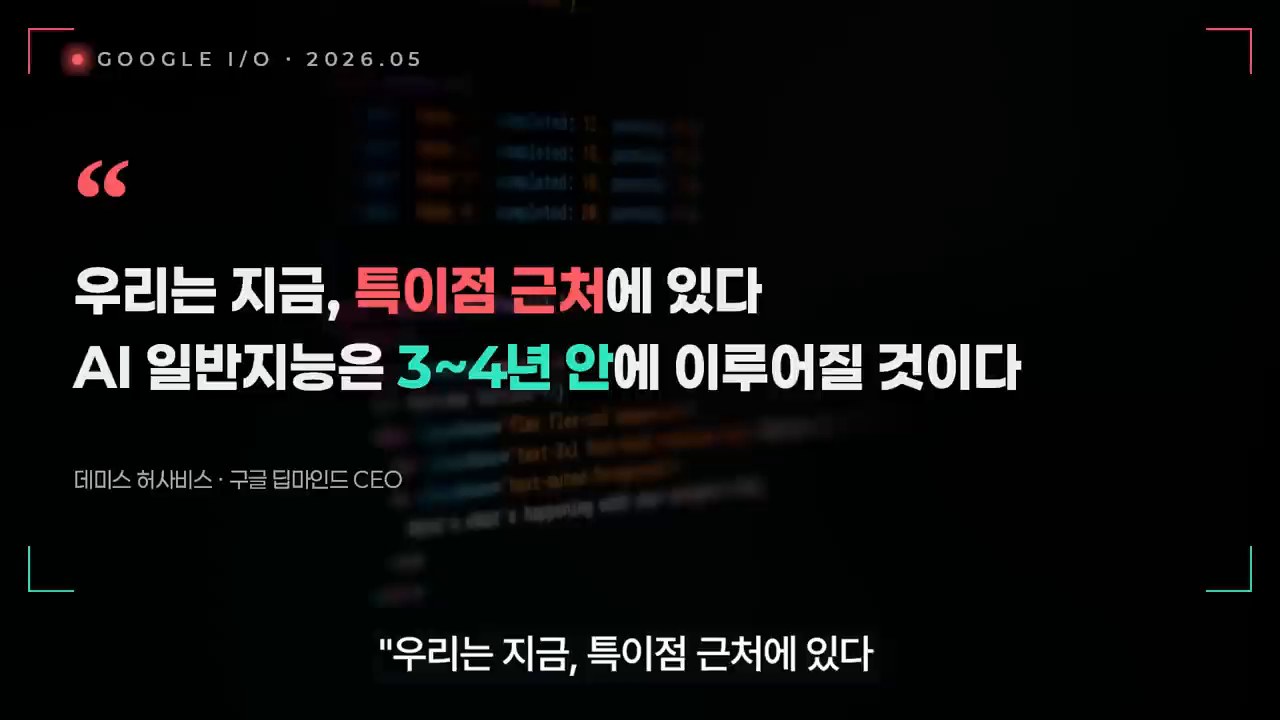
The video begins with a strong claim: “We are now near the singularity. AGI, or artificial general intelligence, will be achieved within three to four years.” Sentences like this easily split people into two camps. One side says, “That is exaggerated.” The other says, “Everything is about to end.”
But blog readers do not need either extreme. What matters more than the accuracy of a single forecast is the fact that these forecasts are moving closer. According to a Stanford GSB interview and reporting from The Verge, Hassabis described the present moment, in the context of Google I/O, as the “foothills of the singularity.” This does not mean AGI has already been completed. It is, however, a signal that AI researchers and corporate leaders are beginning to discuss the next stage of technological development on a much nearer timeline.
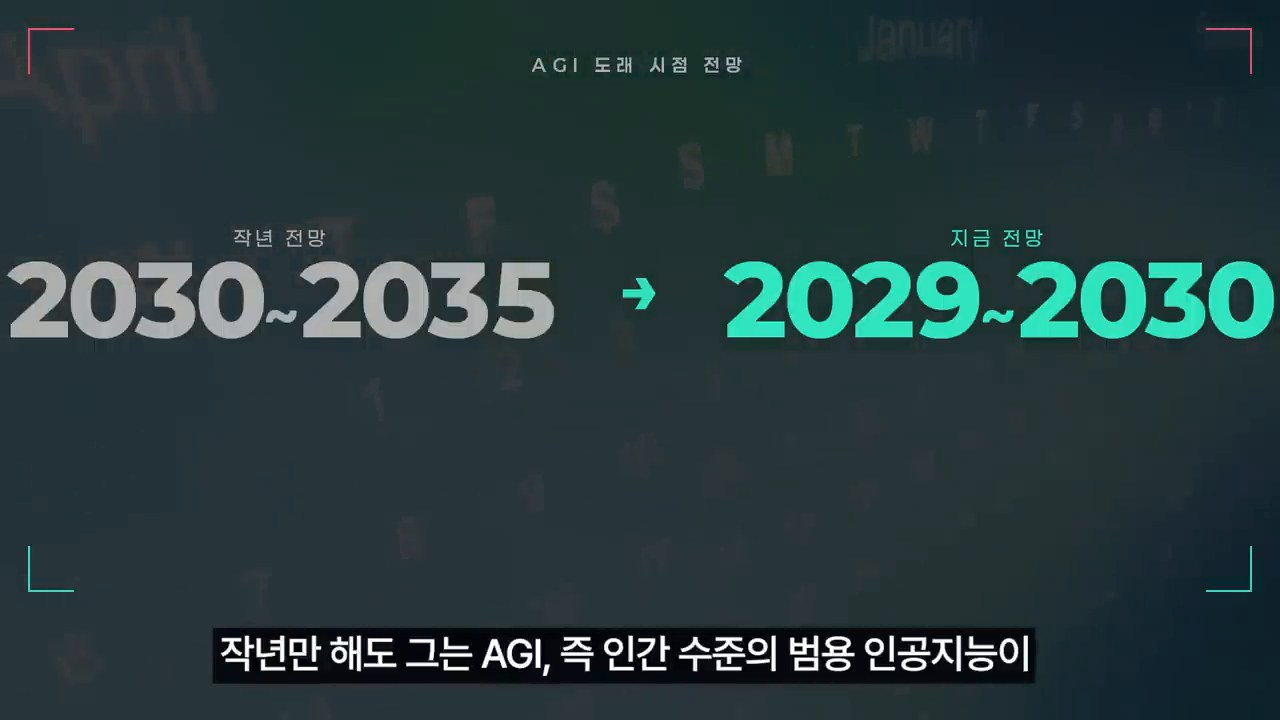
AGI arrival forecasts differ by person and institution, but the timeline in recent debate has clearly become shorter.
One factual point should be corrected here. The video subtitles appear to say that Hassabis received the “2014 Nobel Prize in Chemistry,” but the official NobelPrize.org record states that it was the 2024 Nobel Prize in Chemistry. Demis Hassabis and John Jumper received the prize for their work on protein structure prediction through AlphaFold. This matters because his remarks on AGI are not just promotional language. They come from the head of a research organization that has produced real scientific breakthroughs.
The Core of the Singularity Debate Is a Clash Between “Technological Optimism” and “Controllability”
The word “singularity” often sounds mystical. Translated into practical terms, however, it is much simpler. If AI begins rapidly improving its ability to research, develop, experiment, code. Formulate strategy without human help, human society may struggle to keep up with the resulting changes.
The video connects this point to superintelligence risk. Eliezer Yudkowsky and Nate Soares’s If Anyone Builds It, Everyone Dies emphasizes that a superintelligent AI may endanger humans not because it hates us. But because it may fail to consider human survival while pursuing its goals. The publisher’s description likewise presents the book as a warning that the race to develop superhuman AI could push humanity onto a path toward extinction.
The key issue is not only how quickly AI becomes smarter, but whether humans can control it safely.
Of course, this claim is not a consensus across the entire AI industry. Some researchers see superintelligence risk as the most important civilizational risk. Others argue that, in the short term, jobs, copyright, misinformation, concentration of power, and security incidents are more urgent. A good reading, therefore, is not simply “right” or “wrong.” It is the balanced view that we must manage both risks that may have low probability but extreme harm. Short-term risks that are already becoming real.
What Scenarios Like AI 2027 Mean
Another useful resource is the AI Futures Project’s AI 2027 scenario. This is not a book of prophecy. It is closer to a thought experiment showing how rapid AI progress could intensify research automation, security competition, policy pressure, and speed races among companies.
Scenarios like this are useful not because they correctly predict a date. They are useful because they prompt organizations and individuals to ask in advance. “If AI capabilities become ten times stronger than they are now, costs fall further. Everyone starts using agentic tools, what will become vulnerable?”
Companies should be asking the following questions.
Does core operational knowledge exist only inside the heads of a few people?
Do we have criteria for verifying outputs created by AI?
Do the people responsible for security, privacy, and copyright understand how AI is being used in actual workflows?
Are employees using AI not as a forbidden tool, but as a controllable collaboration tool?
Do we have intermediate review mechanisms so rapid automation does not damage customer trust and quality?
Before Fearing Superintelligence, We Need to Build the Ability to Work with AI
The most practical message in the latter part of the video is the sentence, “Always invite AI when you work.” This does not mean handing every judgment over to AI. It means the opposite. Keep AI beside you, but repeatedly practice defining the problem yourself, reviewing the answer. Adding the missing context as a human.
Fear alone is not enough. Individuals and organizations need practice treating AI as a real collaborator in work.
If AGI still feels distant, we can reframe the question. A more immediate question than “Will AGI arrive in three or four years?” is “Within this year, will more than half of my work be done together with AI?” Many people can already answer yes.
Individuals need three kinds of preparation.
Questioning ability: the ability to distinguish problems that can be delegated to AI from problems that humans must judge directly.
Verification ability: the ability to check plausible answers again through facts, sources, numbers, and context.
Redesign ability: the ability to rebuild existing work processes around AI collaboration.
These are not skills for coding roles alone. They are basic literacies needed in planning, HR, education, marketing, administration, research, and sales alike.
So What Should We Do?
When reading discussions of AGI and the singularity, the two most dangerous attitudes are these. Dismissing everything as “all exaggerated,” or giving up because “the end is near.”
The realistic attitude lies in the middle. We should take the speed of technological development seriously, while converting fear into an executable checklist.
Individuals and organizations should begin the following four actions now.
Document principles for AI use.
Keep a human review step for important decisions.
Redesign repetitive work together with AI.
Build control mechanisms first in areas where losses become large if AI is wrong.
No one can say with certainty whether superintelligence will actually arrive within a few years. But the shift in which AI becomes basic infrastructure for work and learning has already begun. The best preparation, therefore, is not to consume fear. But to first build habits and organizational operating systems for using AI safely.
AGI means artificial intelligence that shows general problem-solving ability at a human level or beyond across many domains, rather than narrow AI that performs only specific tasks well. However, definitions and evaluation criteria differ among researchers.
Does this mean the singularity has already begun?
No. The phrase “foothills of the singularity” is closer to a metaphor for the very rapid pace of AI development. Rather than reading it as meaning that AGI has already been completed, it is safer to read it as a signal that the time available for preparation is becoming shorter.
Is superintelligent AI risk exaggerated?
Some claims are very strong warnings. But risks with potentially extreme harm should be managed even if their probability is low. At the same time, we also need to address short-term risks such as jobs, security, misinformation, and privacy.
What should individuals start doing now?
Rather than simply using AI tools as much as possible, it is better to begin by breaking questions into smaller parts, verifying outputs, and redesigning work processes. The key is not the amount of AI usage, but a collaboration method that can be checked and trusted.
Image source: Captured images used in this article are stills from the original YouTube video. They are used for review, commentary, and educational explanation, and copyright remains with the original rights holders and the channel.
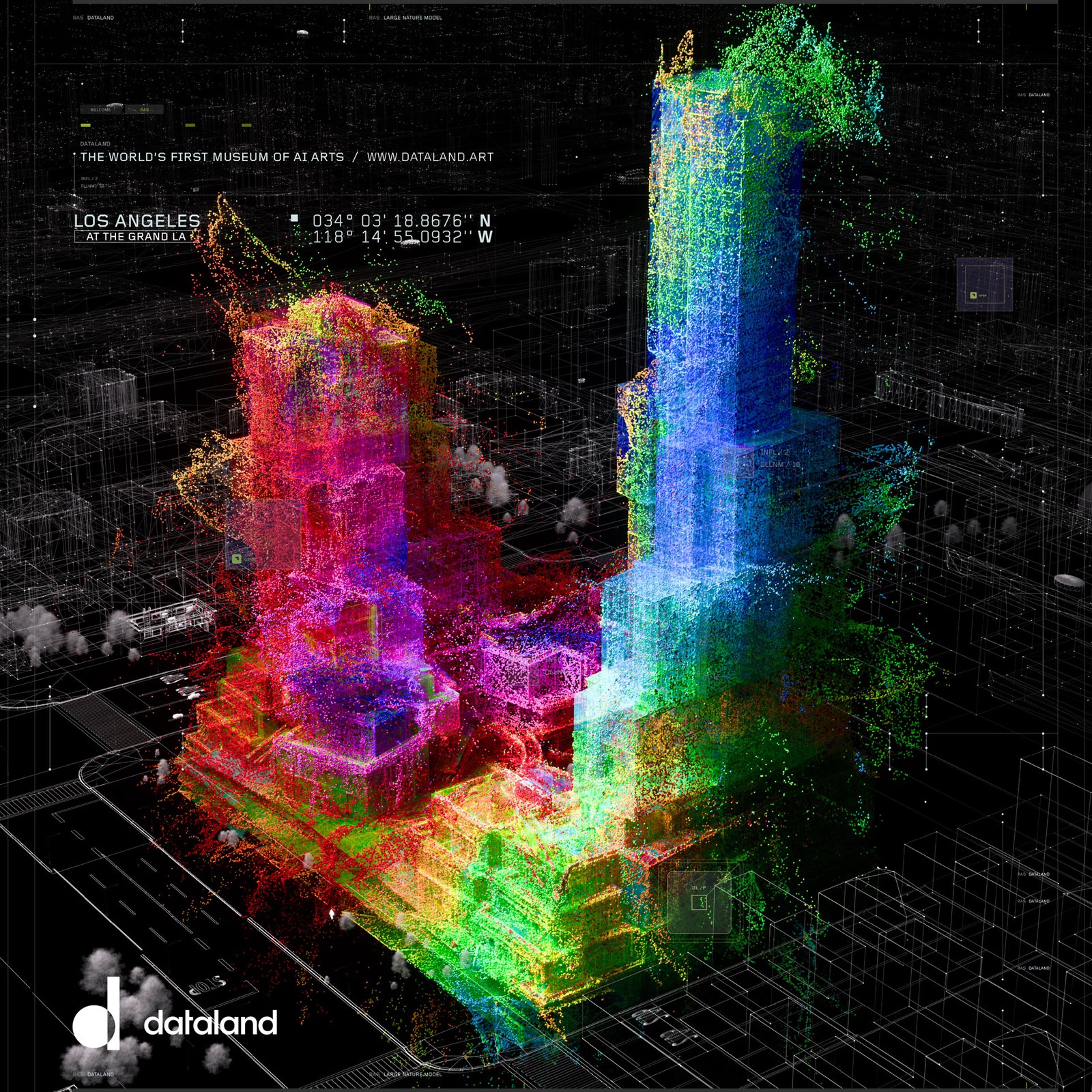
DATALAND has opened in downtown Los Angeles. It is hard to explain with one sentence, such as “a place that exhibits images made by AI.” The MBC America News segment did not show only one artwork. It showed a new museum model. In that model, data, sensors, generative AI, and spatial direction operate together.
According to official materials, DATALAND is the world’s first AI Arts Museum. It was co-founded by Refik Anadol and Efsun Erkılıç. Its first exhibition is Machine Dreams: Rainforest, and the venue is The Grand LA in downtown Los Angeles.
Image provided by the official DATALAND website
What the News Showed Was Not a “Moving Picture,” but a “Responsive Museum”
The video shows an immersive scene where forests, birds, light, scent, and visitor movement are combined. When visitors wear sensors, data such as heart rate, body temperature. Movement is interpreted in real time, and that information is reflected in the exhibition environment.
The important shift here is that visitors are no longer outsiders standing in front of a work. The visitor’s condition and behavior become part of the exhibition, and the work is reconstructed slightly differently each time.
Basic DATALAND Information Confirmed from Official Sources
Official name: DATALAND, Museum of AI Arts
Location: The Grand LA, 100 S Grand Ave, Los Angeles, CA 90012
Opening exhibition: Machine Dreams: Rainforest
Exhibition period: Until January 31, 2027, according to the official exhibition page
Core technologies: Large Nature Model, Google Cloud, Gemini Enterprise Agent Platform, Compute Engine, generative models, and real-time interaction technology
The official DATALAND website describes the space as a museum where “data becomes pigment.” Google’s official blog explains that the opening exhibition is based on a Large Nature Model trained on large-scale datasets from the natural world, creating a hypergenerative reality at a scale of 1.2 billion pixels.
Image: Refik Anadol Studio, Google official blog
Why the Term “AI Art Museum” Matters
Many traditional media-art exhibitions overwhelm visitors with large screens and projection. What makes DATALAND different is its operational structure. It brings AI into the core infrastructure of the exhibition, rather than treating it only as a production tool.
According to Google’s official blog, DATALAND processes visitor responses. It creates generative soundscapes. It also algorithmically adjusts emotional signals and scents. The museum becomes less like a place that plays fixed files. It becomes more like a system that receives input data and updates the scene.
Art or Technology Demonstration? Where the Debate Begins
Questions surrounding AI art still remain. Key issues include how far we should regard outputs created by AI as art, how the sources and consent behind data should be handled. What standards should protect visitors’ biometric data.
DATALAND officially emphasizes ethical data collection and AI practices. However, as AI art enters public spaces, we need to evaluate not only the appreciation of artworks. But also data governance and privacy standards.
Image: Refik Anadol Studio, Google official blog
The Shift Individuals and Organizations Should Read
The meaning of DATALAND does not stay within the museum industry. It is a signal showing how education, exhibitions, brand experiences, urban tourism, and entertainment may change in the future.
Content is moving from fixed output to real-time experience.
AI is becoming an interface that operates spaces, not just a back-office tool.
Data trust, copyright, and biometric information protection are becoming part of content competitiveness.
Creators are expanding beyond prompt writers into people who design data, space, and visitor flow.
This trend also connects to the questions discussed in human value in the AI era and creative thinking in the AI era. In the end, the key issue is not what AI can make. But what kinds of experiences and meanings people can design.
Three Things to Check When Looking at DATALAND
1. Look at the Experience Structure, Not Just the Technology
The large screens, sensors, and generative models matter. But the more important point is the sequence in which visitors move through the space. Which data is translated into which experience.
2. Use Official Figures and Explanations as the Baseline
Video is strong at conveying presence and highlighting issues. For technical figures and operational information, it is safer to check original sources as well. Useful sources include the official DATALAND website, Google’s official blog, and the Related Companies press release.
3. Treat AI Art as an Early Signal of Industrial Change
An AI art museum is not a special case limited to the art world. It is a change connected to changes in working style in the agentic AI era. In the future, exhibitions, education, and workspaces are likely to become more like “responsive systems.”
FAQ
Where is DATALAND located?
DATALAND is located at The Grand LA, 100 S Grand Ave, in downtown Los Angeles, United States. According to the official website, it operates from Tuesday to Sunday and is closed on Mondays.
What is DATALAND’s first exhibition?
The first exhibition is Machine Dreams: Rainforest by Refik Anadol Studio. The official exhibition page describes it as a project about rainforest ecosystems. It translates that intelligence into immersive images, sound, scent, and interaction.
How is DATALAND different from a simple media-art exhibition?
The difference is that visitors’ movements, biometric signals, and spatial information are reflected in the work in real time. It is not simply an exhibition that repeatedly plays a fixed video. It is closer to a museum that places AI-visitor interaction inside the exhibition structure.
What should you keep in mind when using official images?
For images from the official website and Google’s official blog, the safest approach is simple. Display the source and credits clearly. Use the images only in a limited way for introduction or criticism. For commercial reuse or derivative editing, the usage terms of each original source should be checked separately.
Image source: Captured images used in this article are stills from the original YouTube video. They are used for review, commentary, and educational explanation, and copyright remains with the original rights holders and the channel.
Anthropic’s “Mythos” issue is not just another story about a new AI model. The core message is colder than that. Frontier AI models are now cloud services and strategic assets at the same time.
Like advanced semiconductor equipment or high-end GPUs, access to a model itself is becoming a matter of diplomacy and national security. Korea cannot treat this shift as someone else’s regulatory news.
What Is at the Core of the Mythos Issue?
The Mythos issue signals that AI competition is no longer only about performance. Access rights and control are becoming national strategy questions.
Anthropic describes Claude Mythos 5 as a model with strong capabilities in cybersecurity and biology research. Through Project Glasswing, the company framed it as a tool for finding and defending critical software vulnerabilities.
According to Anthropic’s own updates, early partners used Mythos Preview to find more than 10,000 high- or critical-severity vulnerabilities in important software. For defensive security teams, that is a compelling result.
The problem is that the same capability can also be used offensively. A model that finds vulnerabilities quickly can strengthen defenders. If control fails, it can also strengthen attackers.
That is why Mythos was limited to vetted partners from the start. When the U.S. government issued a directive suspending foreign national access to Fable 5 and Mythos 5, the story moved from technology news to national strategy.
Why People Are Saying AI Is Becoming a Strategic Asset
The U.S. directive showed that access to frontier AI models can be treated as a national security matter. In practical terms, a pattern once associated with semiconductor export controls is now moving toward the model layer itself.
One important change sits underneath this shift. In the past, the bottleneck was mostly compute, chips, and manufacturing equipment. Going forward, model weights, API access, safeguard settings, and data retention rules may also become objects of control.
For companies, this makes AI adoption more complicated. A model that was available yesterday may be restricted today. In high-risk fields such as public administration, finance, healthcare, defense, and research, that is not just an inconvenience. It is an operational risk.
Three Risks Korea Should Watch
Korea’s AI strategy has to consider foreign model dependence, the dual-use nature of security AI, and the practical limits of sovereign AI at the same time.
1. Dependence on Foreign Models
Korean companies and public institutions have adopted global AI models quickly. From a productivity standpoint, that choice is natural. But when core workflows become tightly coupled to a specific overseas model, access restrictions can become workflow disruptions.
This matters most in areas connected to national functions: public administration, defense, cybersecurity, healthcare, energy, and finance. The point is not that every AI system must be domestic. The point is that systems that cannot stop need alternative routes.
2. The Dual-Use Nature of Security AI
Powerful security AI can improve defensive capacity, but without control it can also be redirected toward offensive capability.
Mythos raises a hard question: if a powerful security AI is released more broadly, does the world become safer or more dangerous?
Vulnerability-discovery AI can help defenders enormously. Yet if verification, disclosure, and patching cannot keep up, the result may be a faster-growing list of weaknesses. Anthropic has also noted that after AI accelerates discovery, the bottleneck shifts to verification, disclosure, and remediation.
Korea should not build AI security capability by focusing only on detection models. Coordinated vulnerability disclosure, patch responsibility, supply-chain response, and incident exercises need to be designed together.
3. The Practical Reality of Sovereign AI
Sovereign AI should not remain a slogan. It is not simply a matter of building one Korean-language model. It requires public data governance, domestic computing infrastructure, high-risk AI evaluation, sector-specific standards, and procurement rules.
Korea is already preparing parts of this foundation through the AI Basic Act, the National AI Committee, the AI Safety Institute, and the national AI computing center. The direction is right. The Mythos issue simply demands more speed and sharper prioritization.
Korea’s Future Strategy: Build Controllable AI Systems, Not Just Models
The key is not merely owning a model. The key is building an AI operating system that can be stopped, switched, and evaluated when necessary.
Korea’s response should not stop at “we need our own frontier model.” The more important question is this: in which domains should Korea secure control, at what level, and at what cost?
First, Classify AI Dependence in Critical National Domains
Public institutions and critical industries should classify the AI services they use by operational importance. A simple writing assistant and a cybersecurity, healthcare, or administrative decision-support system should not be governed by the same standard.
Critical domains need at least three safeguards: replaceable models, inference paths inside Korea or a trusted jurisdiction, and manual fallback procedures for outages.
Second, Make Korea’s AI Safety Evaluation More Operational
AI safety evaluation should not end with paperwork. In high-impact areas such as cybersecurity, biology, financial fraud, disinformation, and privacy leakage, red-team testing and repeated evaluation are essential.
For frontier models, there must be more than two choices: total prohibition or unlimited release. Restricted partner access, usage logging, high-risk query routing, independent evaluation, and incident reporting should work as one system.
Third, Treat the National AI Computing Center as Strategic Infrastructure
The Korean government is moving forward with a national AI computing center of up to 2 trillion won. This infrastructure should not be only a place to rent GPUs. It should become the foundation that connects Korean models, safety evaluation, and public-sector AI pilots.
Accessibility matters. If only large companies can use the infrastructure, national resilience will not grow very much. Universities, startups, security research groups, and public institutions need realistic access.
Fourth, Cooperate Internationally but Plan for Access Cutoff Scenarios
Korea cannot build every AI capability alone. Cooperation with the United States, Europe, Japan, Singapore, and other partners remains necessary. But cooperation is not the same as dependence.
Contracts should address data location, model access interruption, emergency patching, transition to alternative models, and audit rights. Public procurement should not only ask which model performs best. It should ask which system can keep operating in a crisis.
What Companies and Individuals Should Check
Companies should inventory the AI tools they already use. They need to know which workflows depend on which models, where data is stored, and how quickly the organization could switch if a service were restricted.
Individuals can start with a simpler rule. Using AI well is important. But trusting the answer of one model without question is risky. In the AI era, it is more important to have your own language and judgment criteria before writing better prompts.
Conclusion: Korea Needs to Prepare for the Politics of AI Access
The message from the Mythos issue is clear. Future AI competition will not be only about performance. It will also be about who can access models, who can adjust safeguards, and who can keep services running when access conditions change.
Korea should continue using global models, but critical domains need controllable alternatives. Sovereign AI is not isolation. It is insurance. That insurance works only when models, data, computing, safety evaluation, and procurement systems move together.
No. Anthropic describes Mythos 5 as a restricted-access model with strong capabilities in cybersecurity and biology research. The company also introduced Fable 5 as a safer model for general knowledge work, but access to that model was also suspended after the U.S. government directive.
Does the Mythos issue immediately affect Korean companies?
Not every company will be affected immediately. Still, it is a warning for organizations that rely heavily on overseas frontier models for critical workflows. They should review access rights, data location, alternative models, and outage response plans.
Does sovereign AI mean Korea should stop using overseas AI?
No. The core of sovereign AI is control and optionality in areas where they matter. Korea can keep using global AI services while building domestic operating capacity and alternatives for public, security, and industrially critical domains.
What is the Korean government already preparing?
Korea is preparing several foundations, including the AI Basic Act, the National AI Committee, the AI Safety Institute, and the national AI computing center. The computing center is expected to become a key infrastructure layer for domestic AI research and industrial use.
What should individuals prepare?
Individuals should avoid depending on a single model for important judgments. Important claims should be checked against multiple sources, and users should practice explaining AI-generated answers in their own words before accepting them.
The difference between people who use AI well and those who do not—where does it come from? People often answer, “It depends on whether you know good prompts.” In reality, it is a little different. The core issue is not a handful of prompt sentences. It is whether I can say what I want while also including the context and criteria behind it.
The Ildangbaek video “Human Intelligence Expressed Delicately Through Language! The Beginning of AI Prompt Engineering” illustrates this point well. The video begins with the book AI Language Lessons for Intellectual Conversation, but rather than being a simple book introduction, it is closer to a conversation that asks what kind of language sense we need in the AI era. For Korean-language users in particular, there is an even more important question: when we talk with AI in a language like Korean, where omissions and nuance are common, what do we need to say more clearly?
The AI Usage Gap Comes Less from “How to Use the Tool” Than from the “Resolution of Language”
A good prompt begins not with sentence technique, but with organizing your thoughts and criteria.
When many people first use AI, they say things like this:
“Just organize this for me.” “Don’t make it too long.” “Don’t use a stiff tone.” “Don’t draw an image—just show me the prompt.”
Between people, this level of instruction usually works to some extent. That is because we read the surrounding situation, facial expressions, prior conversations, organizational culture, and tone of voice together. But AI guesses the context the user has not provided. If the guess is right, it feels convenient. If it is wrong, the result becomes completely off target.
The prompt guides from OpenAI and Anthropic both emphasize “clear instructions, sufficient context. The desired output format.” Ultimately, a good prompt is not a magic sentence. It is a sentence that reduces the parts AI has to guess.
This is where an important difference appears. People who use AI well are not necessarily people who write longer questions. They are people who structure context. They provide purpose, audience, constraints, examples, preferences rather than only prohibitions, output format, and validation criteria together.
Why Korean Is a More Difficult Language for AI
Korean’s omissions and nuances require clearer explanations of context when working with AI.
One of the most interesting points in the video is the high-context nature of Korean. Korean frequently omits subjects and objects. A single particle can change the focus of a sentence. Honorifics may be handled reasonably well at the surface level. Sarcasm and irony are entirely different matters.
For example, “Cheolsu-neun went to school” and “Cheolsu-ga went to school” may look similar, but their focus is different. “It’s okay” can mean that something is truly okay, or it can mean refusal. “Siwon-seopseop-hada”—a Korean expression that combines feeling refreshed or relieved with feeling sad or regretful—has a different ratio of relief to regret depending on the situation.
People read these differences through the situation. AI mostly receives them as text. That is why Korean users need to provide AI with more context. “Take care of it” is convenient, but from AI’s point of view it is an instruction with too little information.
This issue also appears in translation. Anthropic’s interpretability research shows that large language models can connect inputs from multiple languages to a shared internal conceptual space. But that does not mean Korean nuance is perfectly preserved. In the movement between languages, emotion, omission, irony, and the speaker’s intent can be lost.
Prompt Engineering Is Not “Asking Good Questions”; It Is Managing a System
In organizations, prompt engineering goes beyond asking better questions and becomes a matter of quality and operational design.
The video distinguishes between prompts and prompt engineering. Everyday users can simply ask questions as if they were talking with AI. But the story changes in work systems, customer service, automation, and content production pipelines.
Prompt engineering is not simply “the skill of asking pretty questions.” It involves looking at how answer tendencies differ from model to model. It analyzes why wrong answers emerged. It designs structures that reduce cost. It connects multi-step tasks reliably. It controls the consistency of results.
For example, writing requires creativity, but customer guidance copy or legal and policy guidance becomes problematic if it changes every time. In these cases, generation settings such as temperature, example-based output, validation steps, and retry conditions are needed.
In other words, prompt engineering is a language skill and, at the same time, an operational skill. It begins with an individual’s way of asking questions. In organizations it expands into quality management and cost management.
“Do It This Way” Is Stronger Than “Don’t Do That”
For AI, it is more stable to specify the desired direction and criteria than to state only prohibitions.
One practical tip repeated in the video is to use positive statements rather than negative ones. “Use everyday words” is better than “Don’t use technical terms.” “Keep each paragraph to three sentences or fewer” is better than “Don’t write too much.” “Write it as a short explanatory passage” is clearer than “Don’t write it as a list.”
AI does not always process a user’s negative phrasing reliably. In image, video, and multimodal models in particular, negative words can blur the desired result. Even in text models, saying “don’t do this” can sometimes place the prohibited element at the center of the context.
At work, it is better to change requests like this:
Common request
Better request
Don’t write it too difficult.
Write it in everyday language that a middle school student can understand.
Don’t make it long.
Explain only the three core points within 600 Korean characters.
Don’t make it sound like AI.
Mix short and long sentences, and reduce repeated expressions.
Just organize it for me.
Organize it in the order of background, key issues, and action items.
Don’t include subjective opinions.
Separate verified facts from interpretation.
This difference may look small, but the results change significantly. When you reduce the room AI has to guess, you reduce the time you spend revising.
The Core of the AI Productivity Debate Is Not “How Much You Used It” but “What You Delegated”
AI productivity depends on the ability to decide what to delegate and what humans should judge.
Opinions differ on whether AI actually increases productivity. Still, some studies have already observed concrete effects. The NBER paper “Generative AI at Work” found. Generative AI tools increased average productivity in customer support work, with especially large effects for less experienced employees.
By contrast, the ILO’s analysis of generative AI and jobs suggests. Many occupations are more likely to see some tasks automated or supported than to be completely replaced. This perspective also connects with the video’s conclusion. AI does not necessarily eliminate all work; rather, it redivides the components of work.
The question is not “Do you use AI a lot?” It is the ability to decide what to delegate and what humans should judge. Simple summaries, drafts, format conversions, and repeated responses are easy to delegate to AI. But reading a customer’s anxious feelings, judging field context. Carefully confirming unspoken needs are still largely human responsibilities.
Five Prompt Principles for Korean-Language Users
1. Restore the Omitted Subject and Object
Before writing “Organize this,” write what should be organized, for whom, and for what purpose. In Korean conversation, omission is natural, but for AI it becomes a blank space.
2. Turn Negative Sentences into Positive Sentences
Instead of saying “Don’t write in a stiff way,” say “Write in a friendly but not exaggerated tone.” Giving a goal is more stable than giving only a prohibition.
3. Decide the Output Format First
A table, list, paragraph, report, blog post, email, and presentation script are all different outputs. If you do not set the format, AI produces an average answer.
4. Provide Context and Criteria Separately
Separate the background as background, requirements as requirements, and validation criteria as validation criteria. If you mix everything into one sentence, AI can also miss the relative importance.
5. Do Not Try to Finish Everything in One Turn
Good AI use is closer to multi-turn collaboration than to a single turn. Receive a draft, strengthen the criteria, revise it again, and validate it at the end. This is not a command; it is collaboration.
In the End, Prompts Are Not a Technique but a Habit of Conversation
UNESCO’s AI competency framework sees the abilities needed in the AI era not as simple tool usage. As human-centered thinking, ethics, critical judgment, and practical application. Prompts are the same. They are not something to memorize like keyboard shortcuts.
Talking with AI is a process of making my own thinking clearer. If I do not know what I want, AI does not know either. If I do not provide criteria, AI produces an average value. If I omit context, AI guesses.
That is why the core of the video goes deeper than “Let’s write better prompts.” Competitiveness in the AI era comes not to people who know a lot of techniques. To people who can examine their own language and design context.
To put it a little strongly, future AI literacy may be a language issue before it is a coding issue. This is especially true for Korean-language users. The words we naturally omitted, the things we passed over through atmosphere. The tasks we handed off by saying “take care of it” must all become sentences again in front of AI.
Anthropic, “Tracing the thoughts of a large language model,” View source
Erik Brynjolfsson, Danielle Li, Lindsey R. Raymond, “Generative AI at Work,” NBER Working Paper No. 31161, View source
International Labour Organization, “Generative AI and Jobs,” View source
UNESCO, “AI competency framework for teachers,” View source
FAQ
Are Korean Prompts at a Disadvantage Compared with English Prompts?
It is not accurate to say they are always at a disadvantage. However, Korean relies heavily on omission, particles, honorifics, and context. AI often has to guess the user’s intent. That is why, when writing in Korean, it is better to state the situation and criteria more clearly.
Do I Really Need to Learn Prompt Engineering?
Everyday users do not need to learn grand, formal engineering. But if you use AI for work, you do need the basic habit of providing purpose, context, output format, and validation criteria.
Why Does Telling AI “Don’t Do That” Often Fail?
Negative sentences place the prohibited object inside the context. Some models do not reliably reflect the intention behind the prohibition. That is why it is better to specify the desired behavior positively rather than saying only “don’t.”
Can AI-Written Text Be Made to Sound Human?
To some extent, yes. Adjusting sentence length, repeated expressions, subject and object omission, inversion, rhythm. Concrete situations can reduce the mechanical feeling. However, AI does not actually possess real experience or judgment on your behalf.
What Work Should Humans Take On in the AI Era?
Humans should interpret context, set criteria, and make final judgments. Areas that are difficult to fully standardize in words—such as customer emotions, field situations, an organization’s tacit knowledge. Ethical judgment—still depend heavily on human roles.
Image source: Captured images used in this article are stills from the original YouTube video. They are used for review, commentary, and educational explanation, and copyright remains with the original rights holders and the channel.
AI automation stories are getting inflated far too easily these days. Lines like “run a company with 50 AI agents,” “work only one hour a day,” and “leave a comment and I’ll send you the automation recipe. Makes money” keep appearing in our feeds.
EO Korea’s interview with Gumloop founder Max Brodeur-Urbas puts a firm brake on that trend. The person in the video is the founder of an AI automation platform company that has raised major funding. Yet the point he repeats is surprisingly sober. AI is not a shortcut that lets you skip understanding. It is a tool that helps you execute faster on work you already understand.
Screenshot from EO Korea. Rather than simply summarizing the video, this article analyzes the real conditions for AI agent automation by reading the Gumloop case alongside external sources.
The Problem With AI Agent Automation Is Not the “Number of Agents”
Early in the video, Max treats claims such as “AI agents run the whole company” almost as marketing. The target of his criticism is not AI itself. The problem is the way automation is sold as if it can eliminate the need for understanding and trial and error.
Gumloop’s official website aligns with this view. It puts forward the message that understanding the work should be the only prerequisite for automation. In other words, the point is to make automation possible for people who are not developers. But that person still needs to understand, at least at a basic level, the work they are trying to automate.
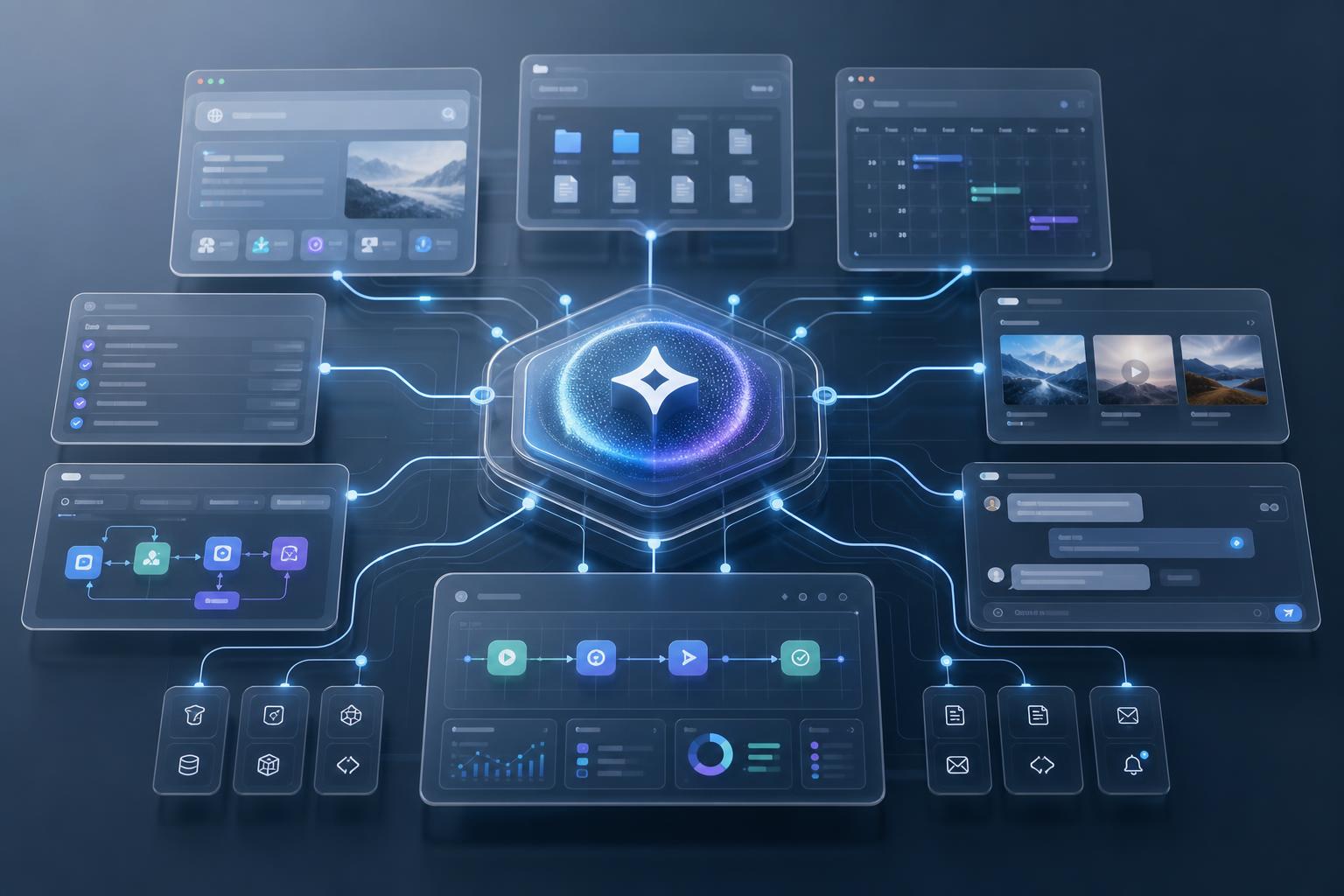
This distinction matters. AI agent automation is not exactly a “do-anything assistant” that takes over whatever you want. It is closer to execution infrastructure that connects multiple tools, data sources, approval steps, and repetitive tasks into one flow.
The New Automation Market Revealed by the Gumloop Case
Y Combinator’s company page describes Gumloop as a platform. Uses AI to automate repetitive, complex workflows end to end. Users create automations by connecting modules through drag and drop. The goal is to let teams test and operate workflows faster than they could by writing code.
Reports from EO, TechCrunch, and BetaKit point in a similar direction. In March 2026, Gumloop raised a $50 million Series B led by Benchmark. Its total funding was described as roughly $70 million. More important than the number itself is the market direction investors are seeing. A market where employees inside companies build AI agents themselves and package repetitive work into an operational form.
What makes Gumloop interesting is that it does not only talk about competition over model performance. Its official site highlights concrete work agents such as data analysis, support ticket classification, CRM management, meeting preparation, and call analysis. Instead of abstract AGI, the repetitive work of actual departments comes first.
Four Reasons One-Click Automation Fails
AI agent automation usually does not fail for one simple reason such as insufficient technology. When we combine the video with external materials, four conditions become visible.
1. If You Do Not Understand the Work, You Have No Standard for Automation
Even if AI produces an output, someone still needs to judge whether that output is correct. Sales lead classification, customer inquiry triage, report writing. Meeting preparation all have different standards from one organization to another. Without business context, automation becomes fast error, not fast execution.
2. Without Data Connections, Agents Are Empty-Handed
Enterprise automation does not end with a single chatbot. CRM systems, documents, email, databases, ticket systems, and calendars need to be connected. This is why platforms like Gumloop emphasize connections and execution flows more than the model alone.
3. Repeated Execution Requires Control and Observability
A prompt that succeeds once is different from a work automation that runs every day. Repetitive work requires failure alerts, approval steps, logs, and permission management. As the number of AI agents grows, organizations need to be able to see who did what.
4. Automation Does Not Replace Learning
Max distinguishes between using AI as a learning tool and using it to skip understanding. AI can explain and assist. But if the user has no idea why a result came out the way it did, automation becomes an expansion of dependency, not an expansion of capability.
What Non-Developer Automation Really Means
The non-developer automation Gumloop talks about does not mean “anyone can build anything in any way.” More precisely, it means the person responsible for the work does not need to translate every requirement and hand it off to an engineer.
Marketers understand campaign lead flows. Salespeople know the annoying parts of CRM updates. HR teams know the recurring candidate communications. Operations teams know where exception handling breaks down. If these people can become the designers of automation, the speed of AI adoption inside a company can clearly increase.
But there are conditions here as well. The organization needs to decide how much automation authority it will grant. It must define which data can be accessed. Actions require approval before execution, and who is responsible when something fails. Adopting AI agents is not simply buying a tool. It is a redesign of the operating model.
A Checklist Before Starting AI Workflow Automation
If you or your organization want to adopt AI agent automation, it is better to start by asking these questions:
Does the repetitive work actually exist?
Can the person responsible explain the success criteria for that work in words?
Can the required data and tools be connected?
Is there a mechanism to stop or review the process when it fails?
Is there a feedback loop for improving automation results?
Without these five conditions, increasing the number of agents does not mean much. If those conditions are present, however, even one small automation can change how an organization works.
Further Reading From Thinknote on AI Agents
This perspective also connects with Thinknote’s existing articles on AI agents.
Conclusion: AI Agents Are More About Operations Than Replacement
The message from the Gumloop founder interview is simple. The promise that AI will take care of everything for us is attractive, but dangerous. Real value appears when we use AI to execute work we already understand more quickly and reliably.
That is why the key question for AI agent automation is not “How many agents are you using?” A better question is this:
Do I understand the work I want to automate well enough? And does that automation have enough verification, permission, and feedback structure to run safely every day?
When you can answer those questions, AI agents stop being a buzzword and become infrastructure for a new way of working.
FAQ
What is AI agent automation?
AI agent automation is a way of using AI models to connect repetitive work, data processing, cross-tool tasks, notifications, reporting, classification. Similar activities into one execution flow. Compared with a simple chatbot, what matters is its ability to connect with work systems and actually execute tasks.
What kind of company is Gumloop?
Gumloop is a platform that lets non-developers create AI-based work automations by connecting modules. Its Y Combinator company page and official site describe the company as focused on using AI to automate repetitive, complex workflows.
If we have AI agents, do we no longer need to understand the work?
No. As Max Brodeur-Urbas emphasizes in the video, AI is closer to a tool. Helps people execute work they already understand faster, rather than a replacement for understanding. Humans still need the standards for evaluating and improving the result.
What should companies look at first when adopting AI automation?
They should first look at whether repetitive work exists, whether success criteria are clear, whether the data can be connected, whether permissions can be managed. Whether there is a review structure for failures. Tool selection comes after that.
What is the difference between an AI automation platform and a regular chatbot?
A regular chatbot focuses on conversation and answers. An AI automation platform focuses on operating workflows. Include data sources, work tools, repeated execution, approval steps, and result records.
Image source: Captured images used in this article are stills from the original YouTube video. They are used for review, commentary, and educational explanation, and copyright remains with the original rights holders and the channel.
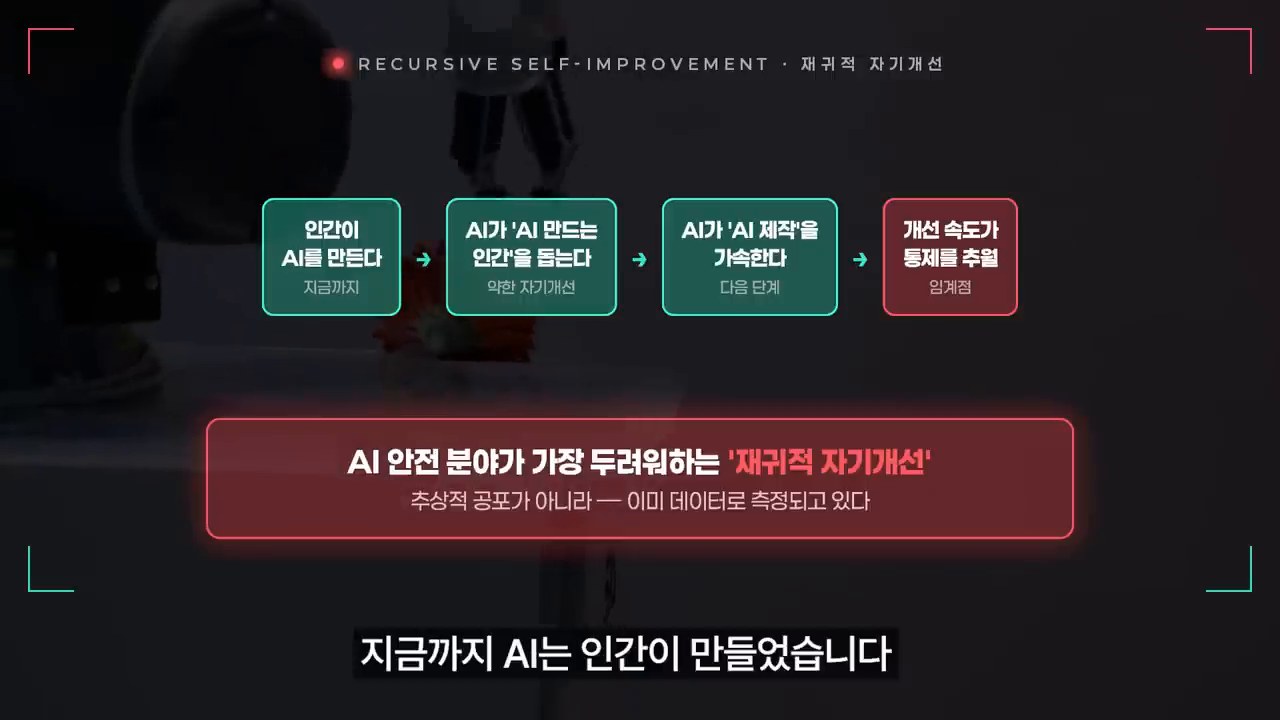
The Korean article uses OpenClaw as a lens for understanding why AI agents are moving beyond chat. The point is not that one project has solved everything. The point is that AI is becoming a system that can observe, decide, and execute work across tools. That shift makes execution quality, permission design, and safety controls as important as answer quality.
Chatbots trained people to ask questions and receive polished text. Agentic AI changes the question: can the system carry out a task responsibly in the user’s work environment? The source argues that answer quality alone is no longer enough.
As AI moves into browsers, computers, documents, and workflow tools, the value shifts from conversation to completion. The agent must understand context, select tools, perform steps, check results, and know when to stop or ask for permission.
OpenClaw as an Observation Lens
OpenClaw is presented not as the final answer but as a useful observation lens. It shows a direction in which agents are designed around execution environments rather than only model prompts.
This matters because future AI competition may be decided less by which model writes a better paragraph and more by which operating structure connects models, tools, memory, permissions, gateways, logs, and human review.
AI Comes Out of the Chat Window
The first change is that AI leaves the isolated chat window. In practical work, AI is closer to a channel that moves between apps than a separate application. Users want it to read, compare, fill, generate, summarize, and deliver inside existing workflows.
When AI becomes part of the work channel, interface design changes. A useful agent needs access to browsers, files, APIs, calendars, forms, and internal systems. But every added connection also raises questions about authentication, scope, and auditability.
From Answering AI to Execution AI
Execution agents must use browsers and computers, not only language. They may search a page, click a button, fill a form, download a file, or run a workflow. This creates real productivity potential but also real operational risk.
The source’s central distinction is simple: a chatbot gives a response; an execution agent changes a state. Once AI can change a state, error recovery, rollback, logging, and human approval become essential design features.
Operating System and Gateway Thinking
The article emphasizes that the first thing to examine is not only the model. It is the operating structure around the model. A gateway perspective is useful because agents need a route between user requests, tools, external services, and final deliverables.
This is why agent infrastructure includes queues, tool registries, credentials, sandboxing, notifications, and result delivery. A powerful model without an operating framework becomes difficult to trust in real work.
Chatbot AI and Execution Agent Compared
A chatbot is optimized for dialogue, explanation, drafting, and Q&A. An execution agent is optimized for task decomposition, tool use, progress tracking, and completion. The former can be wrong in text; the latter can be wrong in action.
That difference changes evaluation. We must measure whether the agent completed the requested task, preserved constraints, avoided unauthorized access, produced verifiable outputs, and left a trace that humans can inspect.
Personal Assistant and Work Automation Boundaries Blur
The more capable agents become, the more personal assistance and enterprise automation overlap. A personal AI can schedule, summarize, prepare files, and monitor tasks. A work agent can handle reports, forms, customer replies, and operations.
The boundary blurs because both need context and permissions. If permission boundaries are vague, risk grows. The source warns that convenience cannot be separated from control.
Why Open Source Agent Ecosystems Are Growing
Open source matters because agent systems need adaptation. Companies and individuals want to inspect, modify, and connect agents to their own tools. Open ecosystems can accelerate experimentation and reduce dependence on a single vendor.
But the source also stresses that open source does not automatically mean safe. Public code may reveal design choices, but real safety still depends on deployment practices, isolation, permission design, monitoring, and governance.
Checklist and Security for Agent Adoption
Before adopting an OpenClaw-style agent, users should ask what task it will execute, which tools it can touch, what data it can read, who approves sensitive actions, how logs are stored, and how failures are handled.
Minimum privilege and isolation are the starting point. Agents should receive only the permissions needed for a task, run in controlled environments when possible, and provide review points before irreversible actions. Responsible execution is the essence of the AI agent shift.
Practical Implications for Readers
For readers using this article as a working reference, the practical lesson is to move from abstract interest to a concrete audit. Identify where the topic touches your own work, which assumptions are already outdated, what data or tools are missing, and which decision could be tested on a small scale before a larger commitment. Write that test down, assign an owner, and review evidence rather than impressions.
The Korean source repeatedly treats technology, strategy, and human judgment together. That is why the safest next step is not blind adoption or passive worry. It is disciplined experimentation: define the problem, compare alternatives, verify results, protect sensitive information, and keep the human purpose visible while the tool or trend evolves.
Related Reading
Continue with these related Thinknote English articles in the Digital Transformation cluster.
This article explains a digital transformation, platform, market-structure, or technology-adoption topic with Korea-specific context and global implications.
How should I use this guide?
Use it to understand market signals and strategic patterns. Combine it with current market data before making business or investment decisions.
The Korean source argues that Satya Nadella’s next move should be read as a platform strategy, not merely as another AI feature launch. Microsoft is trying to rebuild Windows around on-device AI, Copilot+ PCs, Windows AI Foundry, small models such as Phi, and developer workflows that make local AI part of everyday computing.
Microsoft’s strength under Satya Nadella has been platform thinking: cloud, productivity, developer tools, and operating systems are connected into ecosystems. The same logic now appears in on-device AI.
The question is not whether one Copilot feature is useful. The bigger question is whether Windows can become the default environment where AI models, apps, devices, and developers meet.
Copilot+ PC Creates a New Baseline
Windows AI Foundry platform.
Copilot+ PC is important because it sets a hardware and experience baseline for AI PCs. Neural processing units, local inference, and AI-ready applications become part of what a modern Windows device is expected to support.
This changes the market. PC makers, chip companies, software developers, and enterprise buyers must think about AI capability as a standard requirement, not an optional add-on.
Windows AI Foundry Connects the Developer Ecosystem
Phi small models and local AI.
Windows AI Foundry and related local development tools are described as a device for binding developers to the Windows AI ecosystem. Developers need ways to select, optimize, run, and ship models across devices.
If Microsoft can make local AI development easier, it can turn Windows from an operating system into an AI application platform. That is the strategic importance behind the tooling.
Phi Small Models Challenge Cloud-Only AI
trust issues around Recall.
Phi and other small models show that useful AI does not always require a massive cloud model. Smaller models can run locally, reduce latency, protect some data, and lower cost for focused tasks.
This does not mean cloud AI disappears. It means the ecosystem becomes hybrid: local models handle immediate, private, or lightweight tasks, while cloud models handle broader or heavier reasoning.
Recall and the Trust Problem
The Recall controversy revealed the trust challenge of on-device AI. A feature that records or indexes user activity can be powerful, but it also raises privacy, consent, security, and transparency concerns.
For on-device AI to succeed, users must understand what is stored, where it is stored, who can access it, and how it can be disabled. Trust becomes a product requirement.
The Ecosystem Structure Microsoft Wants to Change
Microsoft is trying to connect Windows, Azure, Copilot, developer tools, PC hardware, and local models. This structure could make AI capabilities available across consumer and enterprise environments.
The strategic move is replatforming: making AI a layer of Windows itself so that application builders and users treat AI as a built-in computing resource.
How Microsoft Differs From Apple and Google
Apple has strong device integration and privacy positioning. Google has AI research, Android, Search, and cloud-scale data. Microsoft’s advantage is enterprise distribution, Windows reach, developer tooling, and productivity workflows.
That means Microsoft can win not only by making the best demo, but by making AI usable inside everyday work systems: documents, meetings, code, security, and business applications.
What Users Should Prepare
Users should learn the difference between cloud and local AI, check device requirements, understand privacy settings, and evaluate whether AI PC features solve real tasks.
Organizations should prepare governance for local AI as well as cloud AI. On-device processing does not automatically remove risk; it changes where data, logs, and controls must be managed.
Practical Implications for Readers
For readers using this article as a working reference, the practical lesson is to move from abstract interest to a concrete audit. Identify where the topic touches your own work, which assumptions are already outdated, what data or tools are missing, and which decision could be tested on a small scale before a larger commitment. Write that test down, assign an owner, and review evidence rather than impressions.
The Korean source repeatedly treats technology, strategy, and human judgment together. That is why the safest next step is not blind adoption or passive worry. It is disciplined experimentation: define the problem, compare alternatives, verify results, protect sensitive information, and keep the human purpose visible while the tool or trend evolves.
Related Reading
Continue with these related Thinknote English articles in the Digital Transformation cluster.
This article explains a digital transformation, platform, market-structure, or technology-adoption topic with Korea-specific context and global implications.
How should I use this guide?
Use it to understand market signals and strategic patterns. Combine it with current market data before making business or investment decisions.
This English version of the article is a fuller translation and adaptation of the original Korean article, “AI 취업 공포가 던진 질문: 신입 채용 시장에서 무엇을 준비해야 할까”, for global readers. The article delves into the anxiety surrounding the job market due to the impact of Artificial Intelligence (AI) on employment, particularly for new graduates. It explores the changing landscape of job requirements, the need for adaptability, and the skills necessary to thrive in an AI-driven economy.
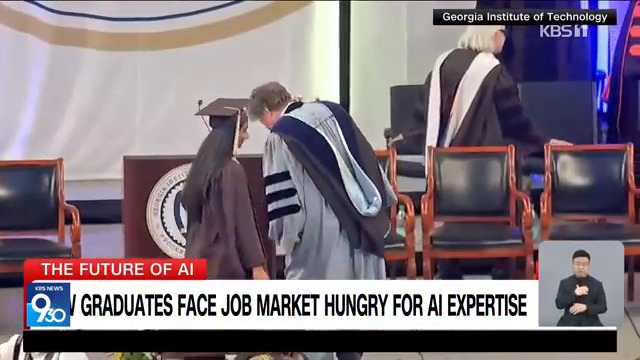
The article begins by citing a report from KBS News on May 29, 2026, which highlights the challenges faced by graduates from prestigious universities in the United States in securing jobs in the tech industry. This trend is not limited to the US, as it also affects students, job seekers, and educators in Korea, raising questions about the skills required to succeed in the job market.
The shift in the job market is attributed to the increasing use of AI, which has led to structural changes, reduced hiring, and cost-cutting measures in the tech industry. While having a degree in computer science was once a strong signal for securing a job in the tech industry, the landscape has changed, and the ability to work with AI has become a crucial factor.
entry level hiring in the AI era.
Change in Entry Barriers Rather Than Replacement
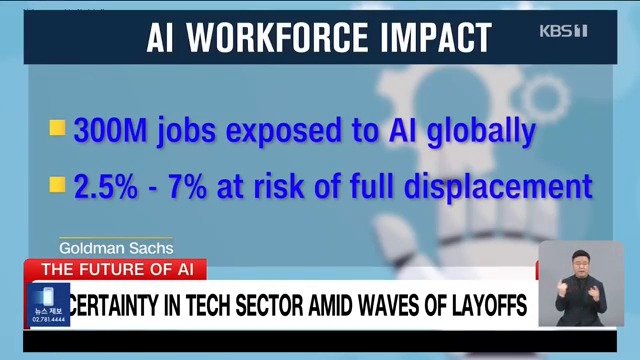
According to Goldman Sachs, generative AI could impact around 300 million jobs worldwide. However, this does not necessarily mean that all these jobs will disappear. Instead, many jobs will undergo changes, with some tasks being automated, and new ones emerging. The challenge lies in the fact that new graduates lack a proven track record, making it essential for them to demonstrate their ability to work with AI tools and produce results quickly.
The article emphasizes that the focus should be on the change in entry barriers rather than replacement. While experienced professionals can rely on their existing performance and domain knowledge, new graduates need to demonstrate their ability to work with AI tools and produce results quickly.
AI skills and career preparation.
Combination of Skills Rather Than a Single Major
A student featured in a video mentions that they are double-majoring in computer science and accounting to connect technology with real-world business problems. This approach highlights the importance of combining skills and knowledge from different fields to succeed in the AI-driven economy.
The article suggests that having a single major is no longer sufficient; instead, the ability to combine skills and knowledge from different fields, such as accounting, manufacturing, education, healthcare, and public administration, is becoming increasingly important. The focus should be on understanding real-world problems and being able to structure them using AI.
college education and AI literacy.
Social Issue 1: Youth Anxiety is Not Just a Personal Problem
The article argues that viewing AI job market anxiety as a personal problem due to a lack of effort is misguided. The promise of a university degree leading to a stable job is weakening, and young people are being asked to acquire more skills and qualifications while companies demand more productivity with fewer employees.
This creates a social issue, as university education is still focused on imparting knowledge in a specific major, while the job market requires skills such as project execution and AI utilization. Shifting the burden solely to individuals will only exacerbate anxiety.
new graduate portfolio strategy.
Social Issue 2: AI Gap Becomes an Employment Gap
The article highlights that the difference between those who can use AI tools effectively and those who cannot will result in a productivity gap. This gap can widen due to disparities in access to education, practice environments, and mentorship.
Therefore, AI education should go beyond just coding skills and include the ability to break down questions, verify data, critically revise results, and design automation that fits the work context.
Social Issue 3: Focusing Only on Disappearing Jobs Misses New Opportunities
The article notes that while AI may lead to job displacement in some areas, it also creates new opportunities in fields such as data centers, semiconductors, power, cooling, security, networks, education, consulting, and regulatory compliance.
Instead of focusing solely on whether to join an AI company, individuals should consider what new bottlenecks are emerging in their industry due to AI and position themselves to address these challenges.
5 Skills for Individuals to Prepare
The article outlines five essential skills for individuals to prepare for the AI-driven job market:
AI tool utilization: applying tools such as search, summary, coding, documentation, and data cleaning to real-world tasks
Domain understanding: connecting major knowledge to real-world problems
Verification ability: checking AI results for errors, biases, and sources
Work design ability: dividing repetitive tasks between AI and human roles
Communication ability: explaining AI-generated outputs in the organization’s language
What Universities and Organizations Need to Change
Universities should not view AI utilization solely as a means of preventing academic misconduct. Instead, they should teach students how to use AI in their major courses, how to verify results, and how to take responsibility for their outputs.
Companies and public organizations should also change their approach to hiring and education. Rather than simply asking if a candidate has experience with AI, they should provide real-world data and ask them to define problems, design prompts, verify results, and write reports.
Conclusion: Transition Strategy Over Fear
The article concludes that while AI job market anxiety is real, it is essential to focus on developing a transition strategy rather than simply being fearful. The key question should be “What problems can I solve better with AI?” rather than “Will AI take my job?”
What young people need is not just a collection of specs, but a practical portfolio that demonstrates their ability to connect their major with AI and real-world problems. Universities and organizations also have a clear role to play in redesigning their approach to education and work.
Related Reading
Continue with these related Thinknote English articles in the Digital Transformation cluster.
This article explains a digital transformation, platform, market-structure, or technology-adoption topic with Korea-specific context and global implications.
How should I use this guide?
Use it to understand market signals and strategic patterns. Combine it with current market data before making business or investment decisions.
This English version is a fuller translation and adaptation of the original Korean article, “넷플릭스 개발자의 토큰 다이어트: Headroom이 보여준 AI 비용 절감법,” for global readers. The article discusses the importance of reducing token costs when using AI agents, and how the open-source project Headroom can help achieve this goal. As AI agents become more prevalent in various industries, the need to optimize their performance and reduce costs becomes increasingly important. One of the key challenges in using AI agents is the high cost of tokens, which can quickly add up and become a significant expense. In this article, we will explore the main arguments and findings of the original Korean article and provide a comprehensive overview of the topic.
Headroom is a context compression layer that compresses the input sent to LLM (Large Language Models) by AI agents. According to the GitHub repository description, it is a tool that reduces tool output, logs, files, and RAG (Retrieval-Augmented Generation) chunks before they reach the LLM. Headroom is not just a simple prompt compression tip, but rather a developer tool that can be used in various forms, such as a library, proxy, MCP (Model-Parallel Computing) server, or agent wrapper. It can be used in front of coding agents like Claude Code, Codex, Cursor, and Aider to reduce token waste.
LLM agent cost optimization.
Why do AI agent costs increase?
When using chatbots, users input questions and receive answers. However, AI agents are different. They read files, search, check logs, call tools, and put the results back into the LLM. The problem is that this process creates a lot of duplication. The same error logs are entered multiple times, unnecessary file contents are included, and RAG search results are too broad. Even information that seems like noise to humans can incur token costs. According to The Register, Tejas Chopra, the creator of Headroom, became interested in token reduction after receiving a $287 bill while using Claude Sonnet. He then discovered that many inputs were not necessary for actual reasoning, but rather consisted of repetition, boilerplate, and duplicate data.
Headroom’s Core Structure
The Headroom README explains the structure as consisting of components like CacheAligner, ContentRouter, CCR (Context Compression and Retrieval), SmartCrusher, CodeCompressor, and Kompress-base. Although the names may seem complex, the flow can be understood in a practical sense. First, ContentRouter distinguishes the type of input. Reducing code, JSON, logs, and plain text in the same way can lead to errors, so it is essential to determine the nature of the content first. Second, CodeCompressor and SmartCrusher carefully reduce structured data like code and JSON. Reducing code can damage identifiers or grammar, leading to more loss than gain. Third, CCR stores the original content locally and retrieves it when necessary. It sends only the compressed version but allows the model to retrieve the original content if needed. Fourth, CacheAligner stabilizes the input prefix to prevent the provider’s cache from being broken. Simple compression can lower the cache hit rate, ultimately increasing costs. This is where Headroom differs from simple prompt summarization tools.
context compression for logs and files.
What do the numbers mean?
The Headroom README claims that it can reduce tokens by 60-95% in actual agent workloads. Examples include code search, SRE incident debugging, GitHub issue triage, and codebase exploration, which show significant reduction rates. However, it is essential to note that these numbers do not guarantee the same results for all organizations. Some tasks may have a lot of logs and search results, making them more prone to reduction. On the other hand, short questions or well-organized inputs may not have many tokens to reduce. Therefore, the practical judgment standard is not just about how much reduction is promised, but rather about measuring input tokens, output tokens, latency, cache hit rate, and failure rate in the actual agent workflow.
Signals that a team needs token diet
Teams that should consider introducing Headroom or similar tools are those that exhibit certain signals. These include: coding agents that repeatedly read large repositories, logs and test results that are attached to every request, RAG search results that are overly broad, system prompts and policy documents that are repeated continuously, and AI tool utilization that is halted due to usage limits or monthly costs. In such situations, it is essential to examine the context structure before changing the model. The problem may not be the expensive model itself, but rather the structure that continuously sends unnecessary inputs to the expensive model.
5 Lessons for Organizations
First, AI cost optimization is not just a financial issue, but an engineering problem. Costs are determined by token structure, tool calls, cache design, and RAG quality. Second, prompt compression is the last step. It is essential to reduce search results, remove duplicates, and read only necessary files before compressing sentences. It is challenging to solve waste that is not reduced at the source through sentence compression alone. Third, compression must be accompanied by quality verification. If the answer is incorrect, even if the tokens are reduced, it is a failure. This is why Headroom provides benchmarks and reproduction commands. Fourth, cache-preserving design is crucial. Provider prompt caches can be ineffective if the input changes slightly. If the reduction tool breaks the cache, the total cost may increase. Fifth, preserving the original content is essential. If AI only looks at compressed information, it may miss important context. Having a structure that can retrieve the original content when needed is safe.
Pre-Introduction Checklist
When reviewing Headroom or similar tools, check the following items first: Are you currently measuring input tokens and output tokens for each agent task? Do you have topK and duplicate removal criteria for RAG search results? Are you putting logs, files, and test results in their entirety? Can you compare the answer rate and task success rate before and after compression? Are you safely protecting code, JSON, security policies, URLs, and identifiers? Is the cache hit rate maintained after compression? Do you have a fallback to turn off compression and re-run in case of failure?
Conclusion: AI costs are a design problem, not a usage problem
The insight provided by Headroom is not just about reducing tokens, but about how AI agents fit into an organization’s workflow. When AI agents become part of the workflow, the key capability is how to collect, reduce, preserve, and reuse context. In the future, good AI systems will not just have good models, but will also be able to send only necessary information, reduce duplication, utilize caches, and return to the original content in case of failure. Token diet is not just a cost-reduction technique, but also the starting point for AI operation design.
Related Reading
Continue with these related Thinknote English articles in the Digital Transformation cluster.
This article explains a digital transformation, platform, market-structure, or technology-adoption topic with Korea-specific context and global implications.
How should I use this guide?
Use it to understand market signals and strategic patterns. Combine it with current market data before making business or investment decisions.